High Throughput Screening Versus AI Virtual Screening Cost Comparison
Hit rate, not price tag, determines which screening method costs less per useful result.
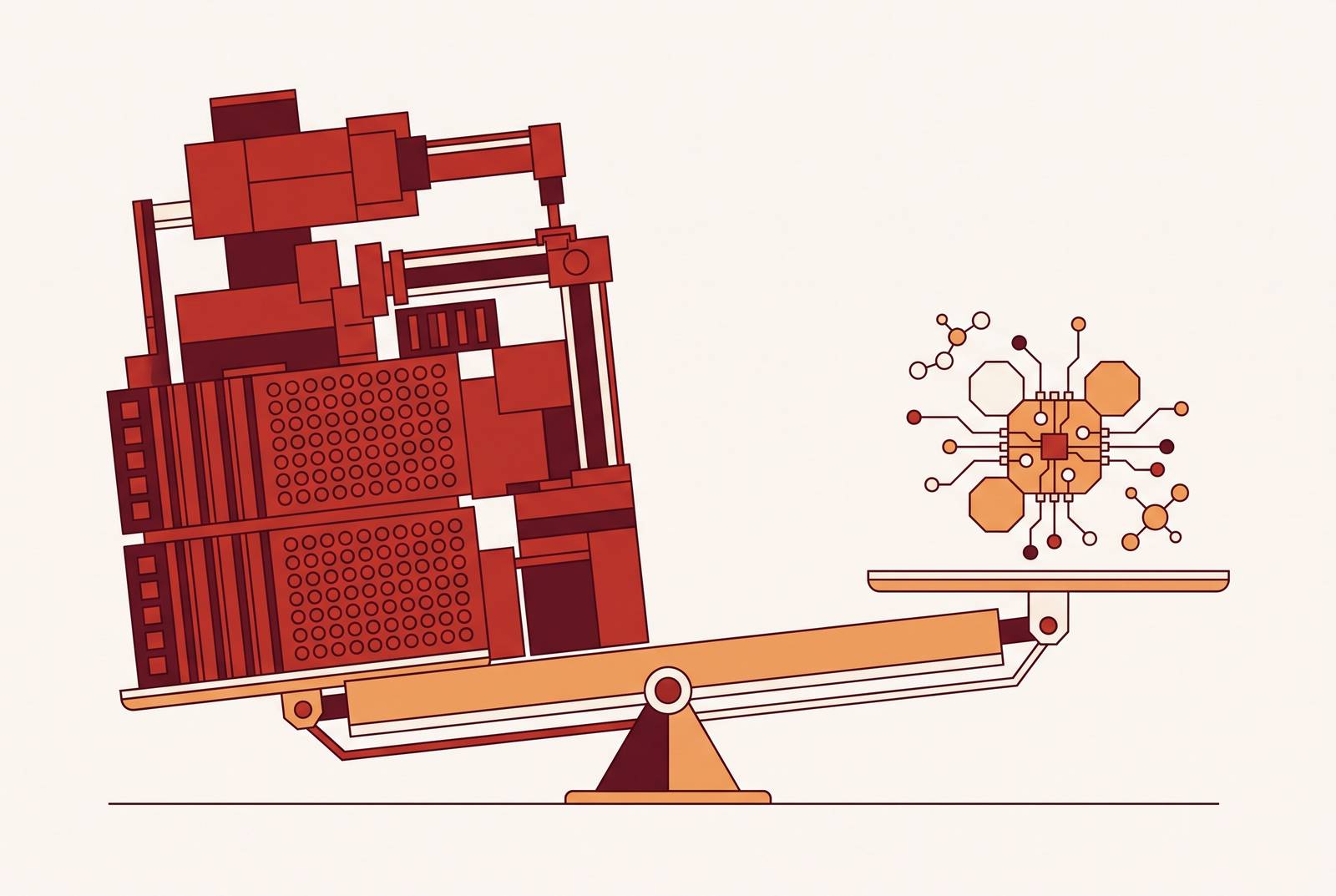
You can't buy drug discovery screening off the shelf. What a method really costs isn't the money to run it, but what you get back after spending it, and that gap is exactly why this comparison deserves care. HTS and AI virtual screening are both after the same goal: turning the large number of compounds examined per approved drug into leads people can actually use. They just get there with opposite resource profiles. HTS gets real-world certainty at scale, at the cost of robots, reagents, and floor space. AI virtual screening buys speed and reach through computation, paid for in model quality and whatever lab work is needed to prove the computer right.
On their own, both figures are pretty useless. Hit rate is what counts, the fraction of tested or predicted compounds that actually work, since a cheap screen with a poor hit rate can cost more per useful result than a pricey one that almost never misses. That idea runs through all the sections that follow: infrastructure, campaign spending, hit rates, downstream validation, and where the economics tip. Hold onto it. It’s what makes a per-compound price tag useful or misleading.
The capital and infrastructure cost of running HTS at any scale
HTS doesn't work like a pay-per-experiment service. You spend the cash well before a single compound gets screened. Just one flow cytometer can cost six figures. Liquid-handling workstations, the robots that pipette thousands of tiny wells, also require significant capital investment. Toss in detectors, imaging gear, and the space to hold them, and you've committed facility-level money before screening a single plate.
Then come the endless bills: maintenance contracts, software licenses, assay development, and staff who can run the equipment without breaking it. A 2026 MarketsandMarkets report flags the steep price of HTS instruments as a genuine market constraint, one that lands hardest on small biotech firms, academic labs, and emerging-market institutions because they lack a depreciation schedule to hide behind. Reagents, kits, and plasticware, the biggest recurring expense, made up the largest share of the HTS products market in 2025, per that same report. Screening isn't a one-time purchase. It's a machine you keep supplying.
To see what the low end looks like, the University of Colorado's HTS core facility billed $10,837.24 to test 14,400 compounds and pull up to 145 hits for follow-up (rates from July 1, 2015, so take this as a minimum, not today's price). A 1,000-compound pilot cost $1,354.66. Those figures are ten years old, but they help because they make the abstract concrete: this is what one modest campaign costs even at academic, non-profit pricing.
Put simply: HTS rewards organizations that can spread the fixed cost across many campaigns and years. Big pharma firms with robots on hand are basically running screens on gear they've already bought. A startup with a single campaign foots the whole bill for infrastructure it might never reuse.
What a full HTS campaign actually costs to run
At full pharma scale, lead discovery often involves screening millions of compounds in a short timeframe, a logistical challenge that lives up to its name. An often-quoted, though older, review puts the price of screening one million compounds at $500,000 to $1,000,000 (PubMed, PMID 16822701). Assays have only become more complex since that figure was published, especially phenotypic and cell-based readouts, so treat it as a conservative floor, not an upper bound.
A large pharma HTS run can screen about 2 million compounds, thousands of plates in high-density formats, and significant reagent volumes. It also generates substantial plastic waste, an odd but real way to judge a drug discovery program: by its trash.
What you pay per well depends heavily on the assay. Well-optimized biochemical assays can cost as little as 10 to 25 cents per well. Disease-relevant phenotypic assays regularly run above $1.50 per well, SLAS Discovery researchers report, a sixfold or greater gap over the cheap version. The screening libraries also raise costs: collections that held tens of thousands of compounds in the early 1990s now reach the millions, and keeping that inventory (storage, quality control, replenishment) isn't free.
Here's the thing: a per-compound figure is useless unless you know the assay type, plate format, and library size driving it. A campaign that seems cheap per well can end up costly per useful result, and that gap is where budgets quietly explode.
AI virtual screening's cost structure: compute, models, and what you still have to spend in the lab
By computing instead of physically handling most compounds, AI virtual screening moves its costs from reagents and robotics to cloud bills, model development, and data curation. Pharmaceutical Executive, citing Mordor Research (2025), lists typical AI infrastructure and operational costs at $25,000 to $100,000 yearly per use case, a figure covering AI applications broadly rather than virtual screening campaigns specifically, worth flagging since the two aren't quite the same.
Scale changes the math fast. One large-scale AI-driven screening of millions of compounds can incur significant cloud computing costs. A full AI drug discovery campaign can incur substantial computational costs. The clearest public number comes from Insilico Medicine's rentosertib program: preclinical costs that represent a fraction of conventional program expenses.
The costs missing from the headline figures matter most. Biological training data is messy, riddled with batch effects and conflicting labels, and fixing it requires actual human effort, not just an automated script. Research indicates the field still faces challenges testing models on unseen data. And those computational hits still require wet-lab confirmation. AI virtual screening saves money by testing far fewer physical compounds, not by skipping testing altogether.
So HTS spending against AI spending was never the real comparison. It's HTS costs versus AI costs plus whatever confirmatory biology the computational hits require. Skip that second half of the equation and the economics look better than they are.
How hit rates turn per-compound costs into cost-per-useful-hit
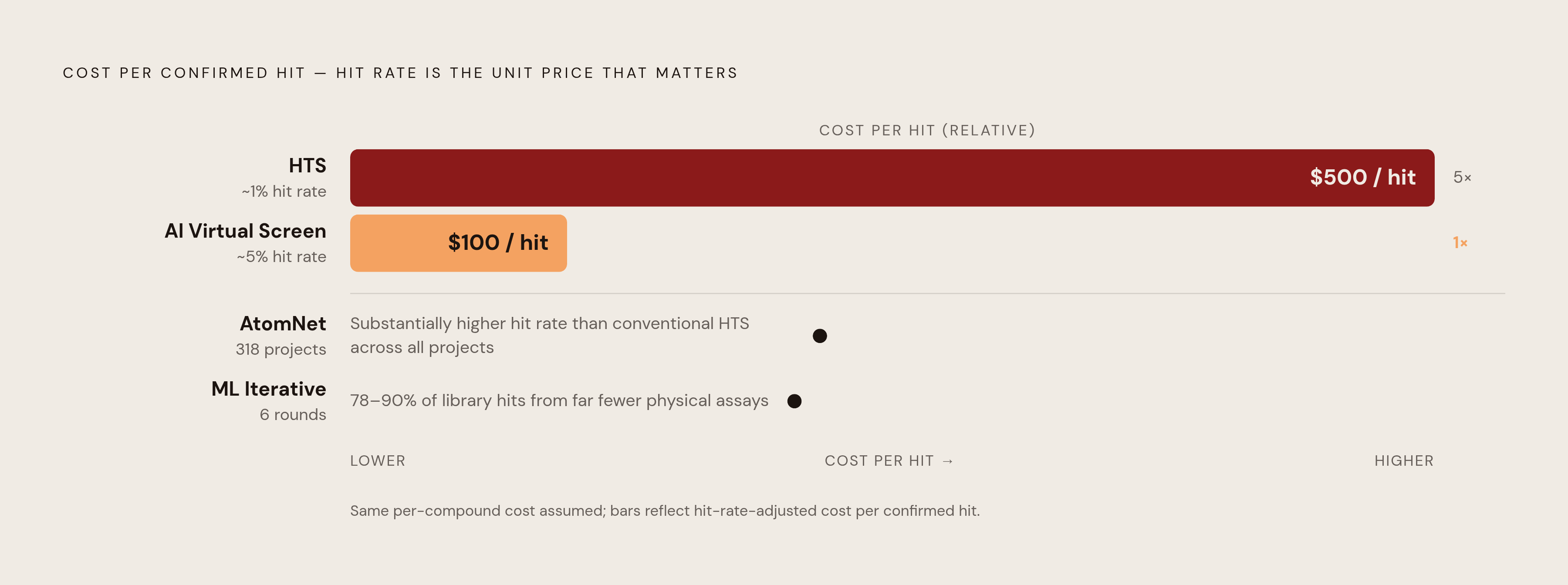
The cost math that actually picks a winner: a cheap screen with a 1% hit rate can cost more per confirmed hit than a pricier one returning 20% or more, once you count everything spent validating the misses. Hit rate is no minor point. It's what changes a per-compound price into a per-useful-result price, the number anyone managing a budget actually cares about.
HTS starts from a low baseline. The industry norm for HTS hit rates is very low, which is what most assays actually deliver. Atomwise's AtomNet platform, described in a September 2024 Nature Scientific Reports paper as the largest and most diverse virtual HTS campaign published to date across 318 projects, averaged a substantially higher hit rate in analog expansion validation per project. Per that paper, conventional HTS hit rates are typically low by comparison. Some virtual screening estimates, using compounds pre-filtered for drug-like properties, reach up to 5%, still about five times better than the 1% HTS baseline.
Running machine learning in cycles drives that number even higher. Research found that screening only 35% of a compound library over three ML-guided rounds yields about twice the hits of random screening; push it to six rounds and you recover 78% to 90% of all hits in the library, from the same collection with far fewer physical assays. A July 2025 biorxiv preprint on a system named HTS-Oracle used this approach to identify a significant portion of molecules with improved hit rates, significantly better than historical baselines.
The hit rate gap drives cost more than anything, and neither method's sticker price reveals it. Overlook it, and the whole comparison turns into noise.
Downstream validation: the cost that both methods defer but neither eliminates
A hit is only a starting point, not an actual drug. You still need lead optimization, selectivity testing, ADMET profiling, and IND-enabling studies regardless of how you found the hit, and a computer doing the first pass doesn't lower any of those costs.
AI virtual screening has a documented validation problem of its own. Research summarized in PMC (a 2025 piece titled "Virtual Screening: Hope, Hype, and the Fine Line In Between") points to a growing gap between the volume of computational predictions being published and the number of those predictions that ever get confirmed experimentally, alongside a rise in "claimed" hits that never get verified. There's also a distribution shift risk: models trained on well-studied targets can do much worse on new ones, as examples where unfamiliar data affected model performance and created confirmatory costs because the predicted hits simply didn't reproduce in the lab.
HTS has its own mess too. False positives and promiscuous compounds, the molecular equivalent of a partygoer who's friendly with everyone but means nothing by it, are a well-known issue, and secondary assays, counterscreens, and dose-response confirmation are standard added costs, not optional extras.
Insilico's rentosertib path offers a useful reality check here. Insilico spent $2.6 million on preclinical work from target discovery to IND, yet Phase IIa data in Nature Medicine (June 2025) showed a meaningful gain in forced vital capacity, a clinical result that demands major additional spending. The upstream AI costs were compressed. The downstream spend was not. Nobody was really asking which approach is cheaper. It's which method yields hits that endure validation at a cost the program can truly afford.
Where each method's economics actually favor the program
HTS works best for well-validated targets and assays that miniaturize cleanly, because an optimized biochemical format drives cost per well down quickly. It also works well for organizations that already own the infrastructure, or have a CRO relationship that lets them rent someone else's amortized equipment rather than buy their own. HTS is still basically the only option for phenotypic assays, cell-based models, organoid systems, or any biology too complex to model. And when speed counts more than chemical diversity, HTS platforms can screen 100,000 compounds a day.
AI virtual screening pays off under a different set of circumstances. It needs a target with enough structural or bioactivity data to train or apply a model, and it pays off most when the goal is exploring a chemical space too large to physically synthesize. Atomwise's library of over 3 trillion synthesizable compounds shows that at the far end: no HTS platform, however well-funded, could screen that space by hand. Programs on tight budgets, especially startups and academic labs that can't afford a $500,000 to $1,000,000 HTS campaign, find AI infrastructure's lower entry cost more realistic. Under tight deadline pressure, meanwhile, Boston Consulting Group reported in 2025 that AI-augmented programs produced candidate molecules 40% to 60% faster than traditional pipelines in 2024.
Cost doesn't favor one method in every case. What tips the balance is the target's biology, the data on hand, and the infrastructure the organization already has in place.
Hybrid and iterative approaches that change the cost calculation for both
The research literature keeps pointing the same way: AI virtual screening and HTS are increasingly used in sequence, not as competing options. A standard hybrid approach lets AI trim a multimillion-compound library to a few hundred or a few thousand candidates, and that shortlist then goes to focused HTS or direct synthesis. So the program covers chemical space with AI while keeping real lab data.
Those iterative ML screening figures from earlier deserve another mention here, since sequencing is what drives them: testing 35% of a collection across three ML-guided rounds doubles the hit return rate compared with random screening, and six rounds pulls in 78% to 90% of the library's hits from the same compound collection with far fewer physical assays. HTS-Oracle's July 2025 preprint makes the same point another way: picking a targeted subset of molecules for testing cut the experimental workload dramatically, yet still achieved a hit rate many times the historical baseline.
Industry deals show the same thinking. When Recursion and Exscientia merged in November 2024 for hundreds of millions of dollars, they joined phenomic screening (the physical, image-based HTS side) and automated precision chemistry on a single platform, treating computational and physical screening as steps that feed each other instead of rivals fighting for money.
What this means for cost: hybrid methods can greatly reduce physical screening volume while keeping the experimental confirmation HTS provides. The real choice for a team isn't "AI or HTS." It's how much AI pre-filtering to apply before physical testing begins, and that choice hinges entirely on how much you trust the model's accuracy for your specific target class. Misjudge it and you'll waste either compute or plates.
What the cost comparison looks like across organization types
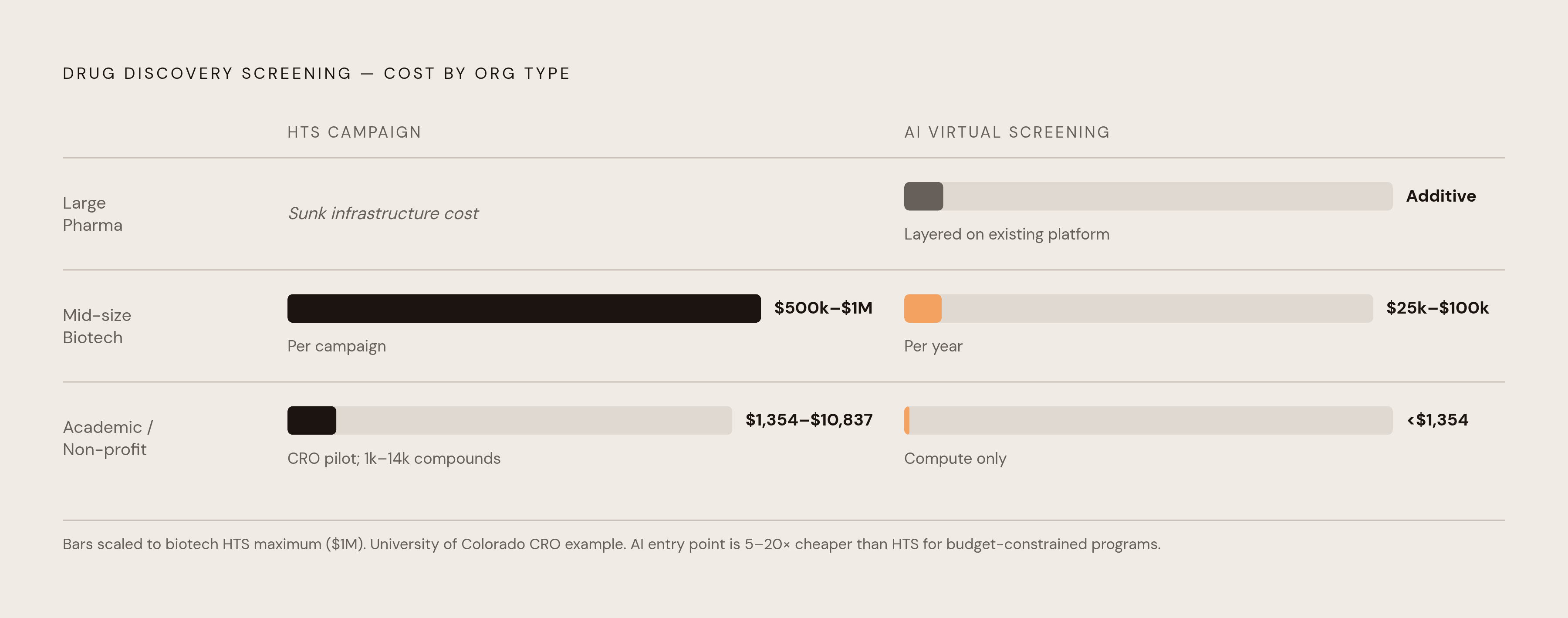
Most large pharma companies have already paid for their HTS infrastructure, so it is sunk cost, and the next decision is per-campaign variable spend. These companies mostly use AI virtual screening to explore compounds their current libraries miss, not to swap out HTS entirely.
For mid-size and emerging biotech firms, a $500,000 to $1,000,000 HTS campaign is a real budget event that can take a meaningful chunk of a funding round. The lower entry point for AI virtual screening, that $25,000 to $100,000 yearly infrastructure range from Mordor Research, sits closer to reach, but model quality and the validation costs that come after still have to be budgeted honestly, not assumed away.
Academic and non-profit labs mainly depend on core facilities or CRO access to run HTS. The University of Colorado pricing noted earlier, though dated, shows the structured, lower-cost access smaller programs can get, even if it is still a major cost against a typical academic lab budget.
The wider CRO market adds context as well: per that MarketsandMarkets 2026 report, the HTS market was worth USD 26.43 billion in 2025 and should hit USD 45.90 billion by 2031, a 10.7% compound annual growth rate. Part of that growth comes from outsourced discovery models, meaning teams without in-house infrastructure have a mature vendor market to draw from, which changes the calculation from "build or don't build" to "how much to rent." And per Mordor Research, over 95% of pharmaceutical companies are already investing in AI capabilities in some form, suggesting that for large organizations the live question isn't whether to adopt AI screening. It's how to integrate it into existing HTS infrastructure without duplicating spend.
How to read cost claims from vendors and published benchmarks
Be as skeptical of a 90%-plus cost reduction claim as you'd be of a stranger promising to double your money by Friday: intriguing, worth checking, unlikely to hold up once you read the fine print. AI virtual screening looks way cheaper than HTS on paper, but that's usually because the comparison lines up per-compound compute costs against per-compound wet-lab costs and ignores the follow-up biology that has to happen no matter which method found the hit.
The same warning works the other way. Low per-well HTS benchmarks usually come from huge, finely tuned biochemical assays, setups a five-person biotech running its first phenotypic screen can't match.
Here's a practical test for any cost claim, from a vendor deck or a published paper: does the number cover downstream validation, or stop at the initial screen? Does it name the assay type and plate format, or just toss out "cost per compound" as though that phrase means one thing everywhere? And is the hit rate reported with the cost, or does the number quietly treat every hit as good? A cost figure that passes all three questions is worth trusting. If it fails, it's just a sales pitch dressed up as science.