AI Diagnostic Accuracy Versus Clinician Accuracy in Pathology
AI dominates narrow, pattern-heavy tasks but loses ground fast when cases get messy or ambiguous.
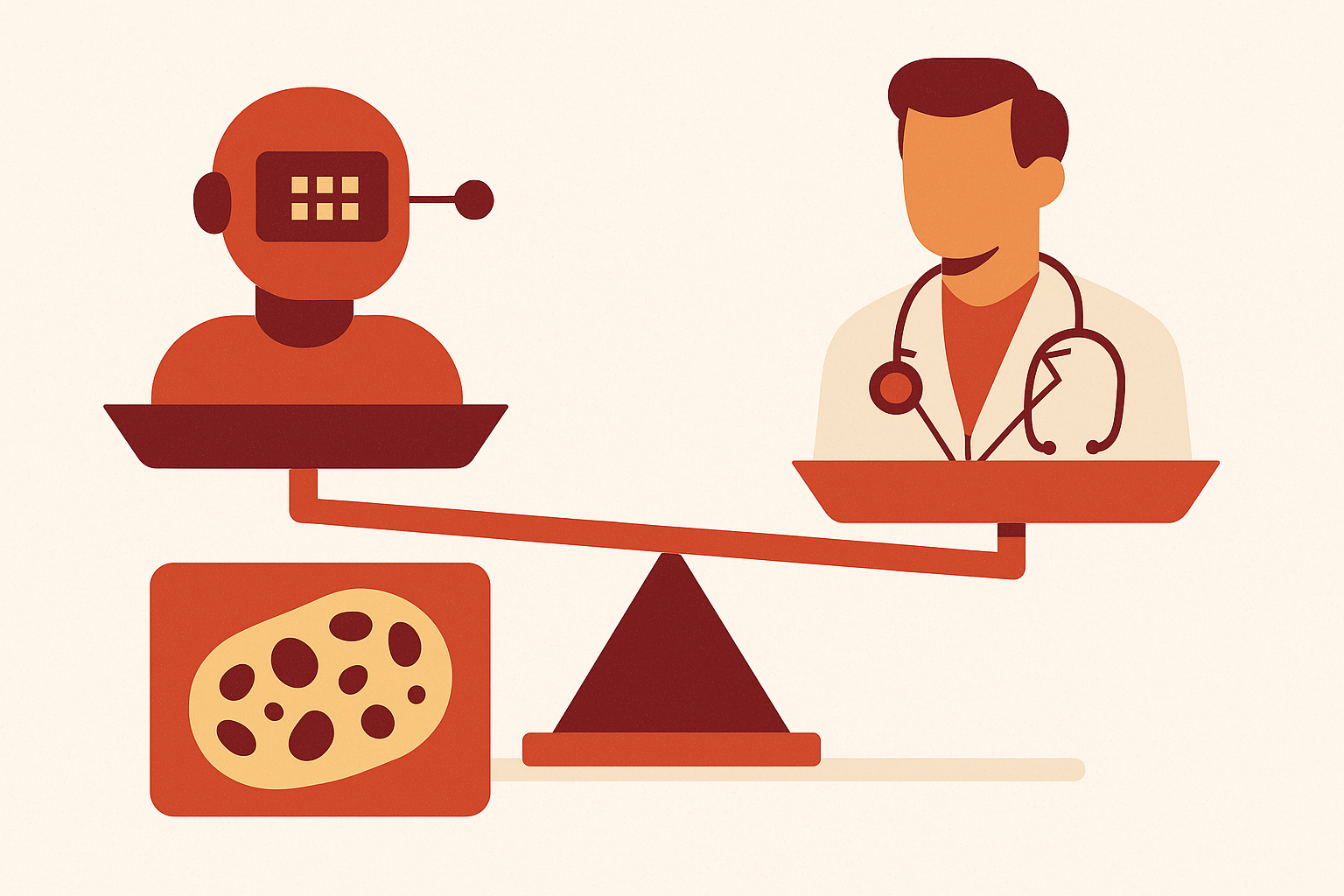
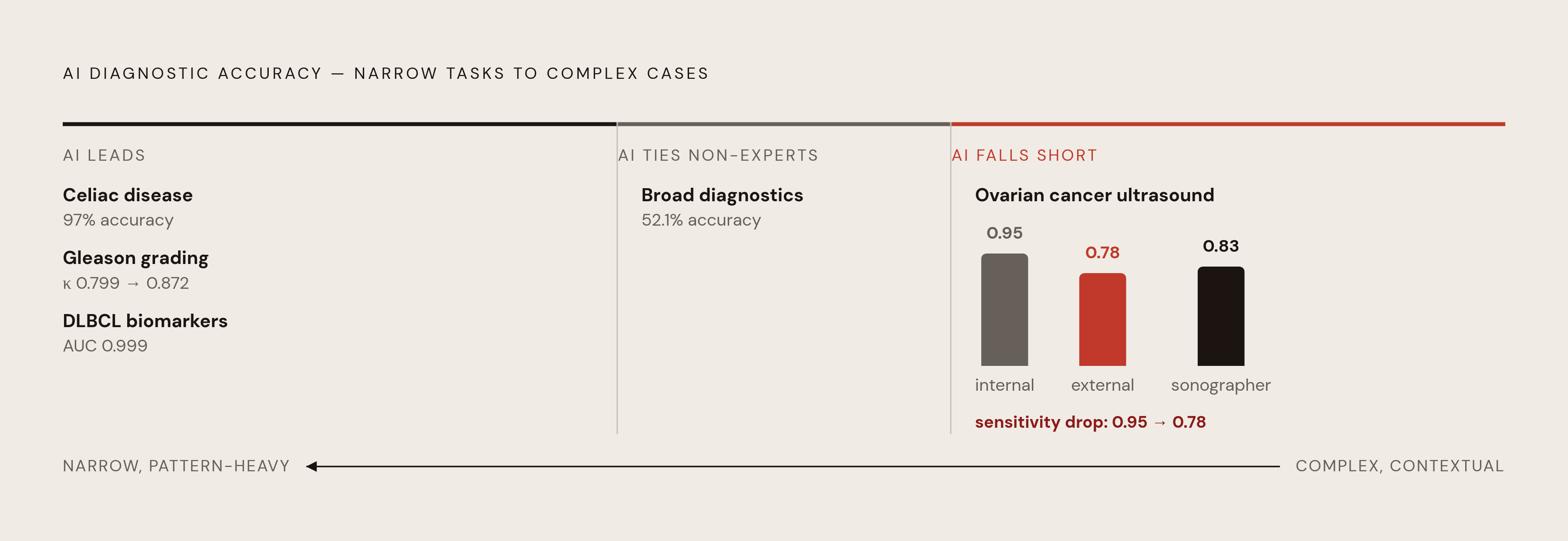
AI diagnostic accuracy in pathology isn't one number—it's a spread, and the spread is the whole story: AI beats or ties pathologists on narrow, repetitive, pattern-heavy tasks, then falls behind fast once cases get messy or ambiguous. I've read enough of these papers now to trust the spread over any single headline number a press release wants to hand you.
None of this makes sense until you admit something uncomfortable: pathologists don't agree with each other very often either. If two pathologists looked at the same slide and landed on the same answer every time, AI wouldn't have anywhere to claim an edge in the first place. Interobserver variability is pathology's oldest headache, and standardized reporting systems haven't cured it. Agreement on atypical or borderline samples stays shaky even among trained specialists working from identical guidelines, and diagnostic error runs an estimated 3 to 5% of all diagnoses worldwide. That's a small number, until you multiply it across global pathology volume and land on tens of millions of errors a year. Discrepancy reviews trace most of these back to microscopic interpretation, clustered around cases that are either genuinely hard or already well known for triggering disagreement.
Gleason grading for prostate cancer is the textbook case here. It's the single most important prognostic marker a prostate cancer patient gets, and pathologists have scored it inconsistently for decades; that instability is exactly why Gleason grading became one of AI's earliest proving grounds. Once you accept the human baseline wobbles on its own, the real question shifts: where does AI's consistency add something, and where does it just trade one kind of error for another?
What aggregate evidence across hundreds of studies actually shows
The most thorough synthesis so far comes from a 2024 systematic review out of the University of Leeds, published in npj Digital Medicine. It started with 2,976 identified studies, narrowed to 100 for full review, and pooled 48 into a meta-analysis. Scope like that changes how much weight one result deserves. Across whole-slide imaging diagnostic tasks, the pooled numbers came out to a mean AI sensitivity of 96.3% and specificity of 93.3%.
Read fast, that sounds like a verdict. Read slow, and it's an average smeared across studies that don't have much in common with each other; sensitivity and specificity swung hard depending on which disease was being studied, which dataset trained the model, and how validation was run. Averages have a bad habit of flattening exactly the parts you need to see.
A second 2024 meta-analysis, covering 83 studies of generative AI on physician-facing diagnostic tasks, found overall accuracy of just 52.1%. No real gap showed up between AI and non-expert physicians, but AI performed significantly worse than expert physicians (p = 0.007). That expert-versus-generalist split explains almost everything else in this piece. Line the two reviews up and a shape appears: AI reaches near-expert performance on constrained, image-based, pattern-heavy tasks, then loses ground fast once the comparison widens to real diagnostic reasoning against genuine subspecialists.
Breast cancer detection makes the point cleanly. Reported accuracies range from 77% to 98% across studies of the same disease, studied over and over, swinging by two full letter grades depending on dataset and method. Nobody agrees on a single number because there isn't one.
Where AI genuinely outperforms or matches clinicians: narrow, pattern-intensive tasks
Celiac disease diagnosis is where AI looks close to unbeatable. One tool hit 97% overall accuracy, with specificity and sensitivity both clearing 95%. In an inter-observer study, a given pathologist was just as likely to agree with the AI as with a fellow pathologist, which means the AI slots into the room as just another reader whose opinion carries the same weight as anyone else's. Celiac disease works this well for AI because the features are discrete and learnable, and the task is high-volume and repetitive, drawing on exactly the pattern-recognition strength these systems were built for.
Diffuse large B-cell lymphoma tells a similar story, though with sharper numbers. A systematic review covering 2020 through 2025, pulling together 11 studies, found diagnostic accuracies from 87% to 100%, sensitivities from 90% to 100%, and AUC values pushing up to 0.999. Several models beat pathologists specifically at biomarker quantification and MYC rearrangement prediction, tasks where human visual estimation runs into real limits. Manual counting of stained cells across a thousand fields of view was never going to out-precision a pixel counter, and it doesn't.
Genitourinary pathology, covering prostate, bladder, renal, and testicular tissue, shows the same pattern again. Contemporary algorithms match or beat expert accuracy for cancer detection, grading, and prognostication, and real-world deployments at high-volume centers have been associated with operational improvements. Three fields, one common denominator: well-defined visual targets, big training sets, and tasks where speed and repeatability matter as much as depth of interpretation.
Where the comparison gets complicated: external validation and real-world performance gaps
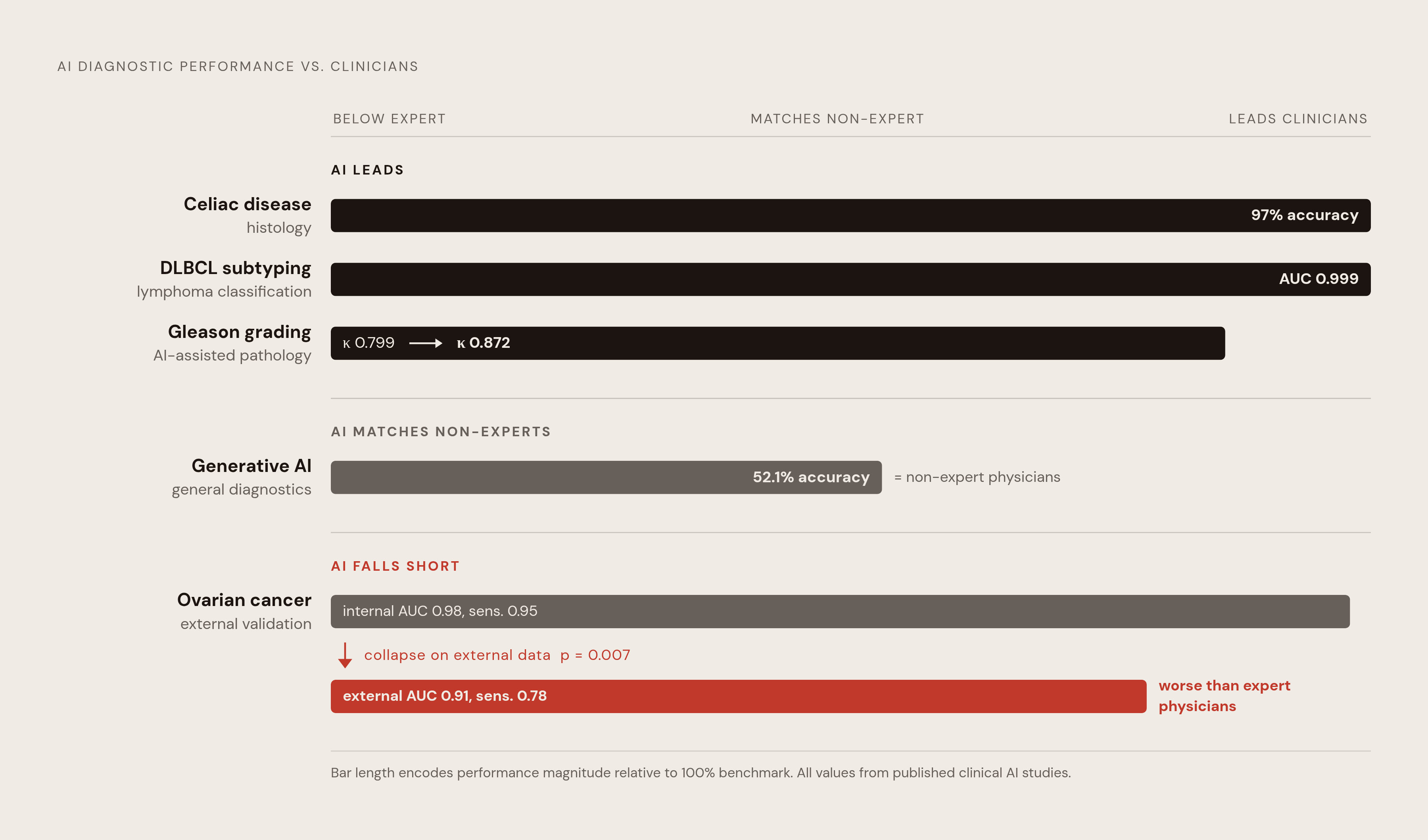
Ovarian cancer ultrasound is where the gap between promise and delivery gets hard to look away from. A meta-analysis covering 18 studies and 22,697 patients or images found internal validation numbers that looked terrific: AI sensitivity of 0.95 and AUC of 0.98. Then external validation happened. Sensitivity dropped to 0.78, specificity to 0.88, AUC to 0.91, while sonographers in the same body of research scored sensitivity of 0.83, specificity of 0.84, AUC of 0.87. Take the model out of the setting that trained it, and the gap between AI and human clinicians narrows fast, sometimes almost to nothing.
Lung cancer subtyping shows a related pattern: a 2025 scoping review of 22 studies found subtyping models performing well under controlled conditions, but clinical adoption stayed limited, partly because solid external validation hasn't caught up yet.
A few mechanisms stack on top of each other to explain why this keeps happening, and it's worth naming them individually instead of waving at "generalization problems." There's (i) shortcut learning, where models latch onto spurious signals instead of real biology; (ii) batch and stain drift, where a slide prepared in one lab doesn't quite look like a slide prepared in another, chemically speaking; (iii) data leakage between training and test sets; and (iv) interface design that projects more confidence than the underlying model earned, nudging clinicians toward trusting outputs they should be questioning harder. Selection bias compounds all of it: methodological concerns have been flagged in the DLBCL systematic review, and most of the evidence base draws from large European and US academic centers. What happens with under-represented populations is mostly a guess at this point, and not a confident one. The gap between internal and external validation is the main wall standing between an impressive benchmark and a tool a hospital can actually run on a Tuesday morning with real patients waiting.
What lung pathology's prospective trials reveal about AI in realistic conditions
Most of the numbers above come from retrospective work, useful but limited, since prospective trials test claims against reality instead of a curated dataset built to make the model look good. Lung pathology has produced some of the field's more careful examples of that harder kind of test.
The PulmoFoundation prospective study followed 1,357 patients across 11 diagnostic tasks, one of the more carefully built prospective efforts in pathology AI to date. Average AUC landed at 92.3% across tasks, but the more interesting numbers concern workflow, not accuracy: the system showed potential to cut second-review burden for 68.8% of biopsies and 83.0% of frozen sections, and could defer 44.5% of IHC stain orders. Those are operational numbers, the kind that show up in a lab's throughput report rather than just a paper's abstract.
A crossover randomized controlled trial, involving 8 pathologists across 4,928 case-reader pairs, found AI assistance raised diagnostic accuracy to 91.7%. Median diagnostic time fell meaningfully, and inter-rater agreement moved from moderate (kappa 0.56) to substantial (kappa 0.76). All 8 pathologists improved individually, not just on average, which matters more than it sounds: averages can easily hide a result where three people got much better and two quietly got worse.
Junior pathologists benefited nearly three times as much as their senior colleagues. That gap suggests AI might compress the distance between someone five years into practice and someone twenty-five years in, rather than replacing seasoned judgment outright. Structurally, this study carries more weight than most of what's discussed elsewhere here: prospective, preregistered thresholds, run as a crossover RCT. That's a different category of evidence than a retrospective benchmark comparison, and it should be treated that way.
How human-AI collaboration consistently outperforms either working alone
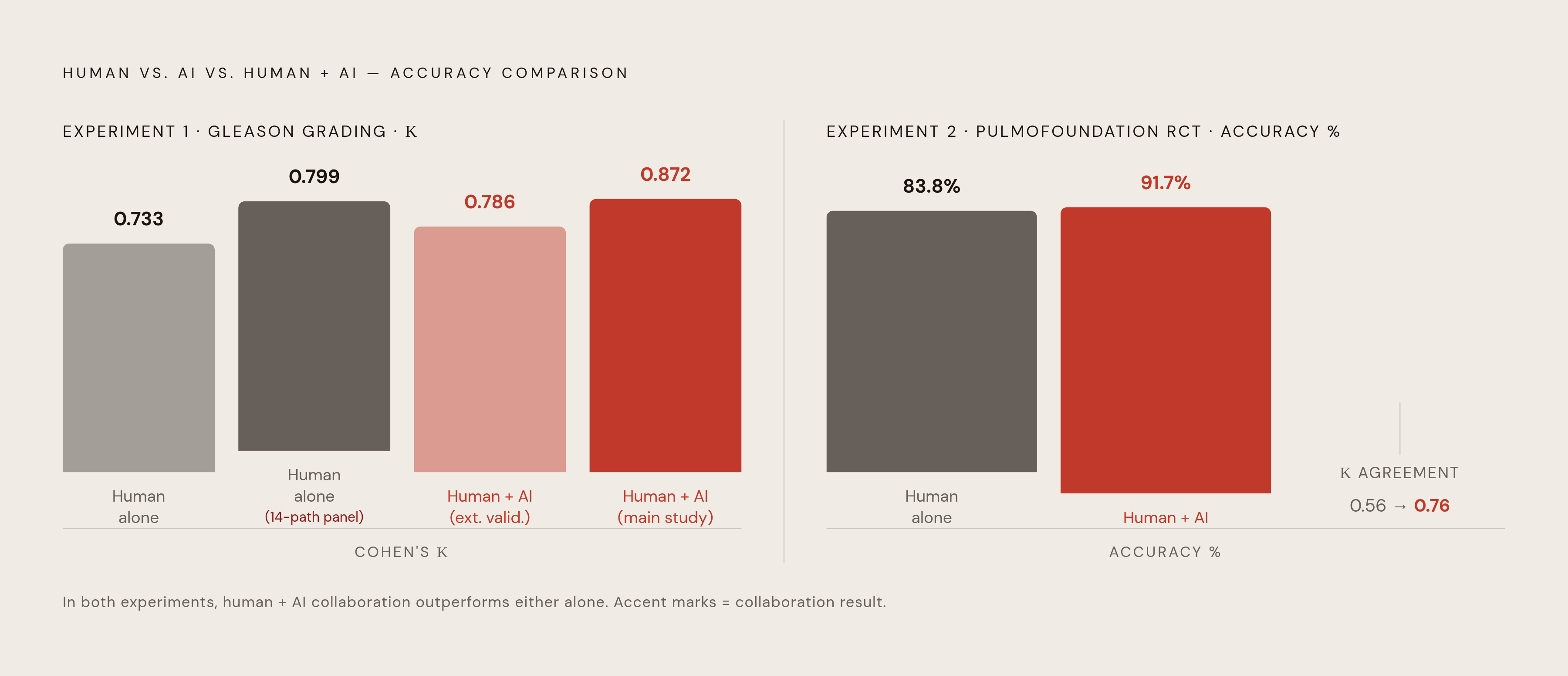
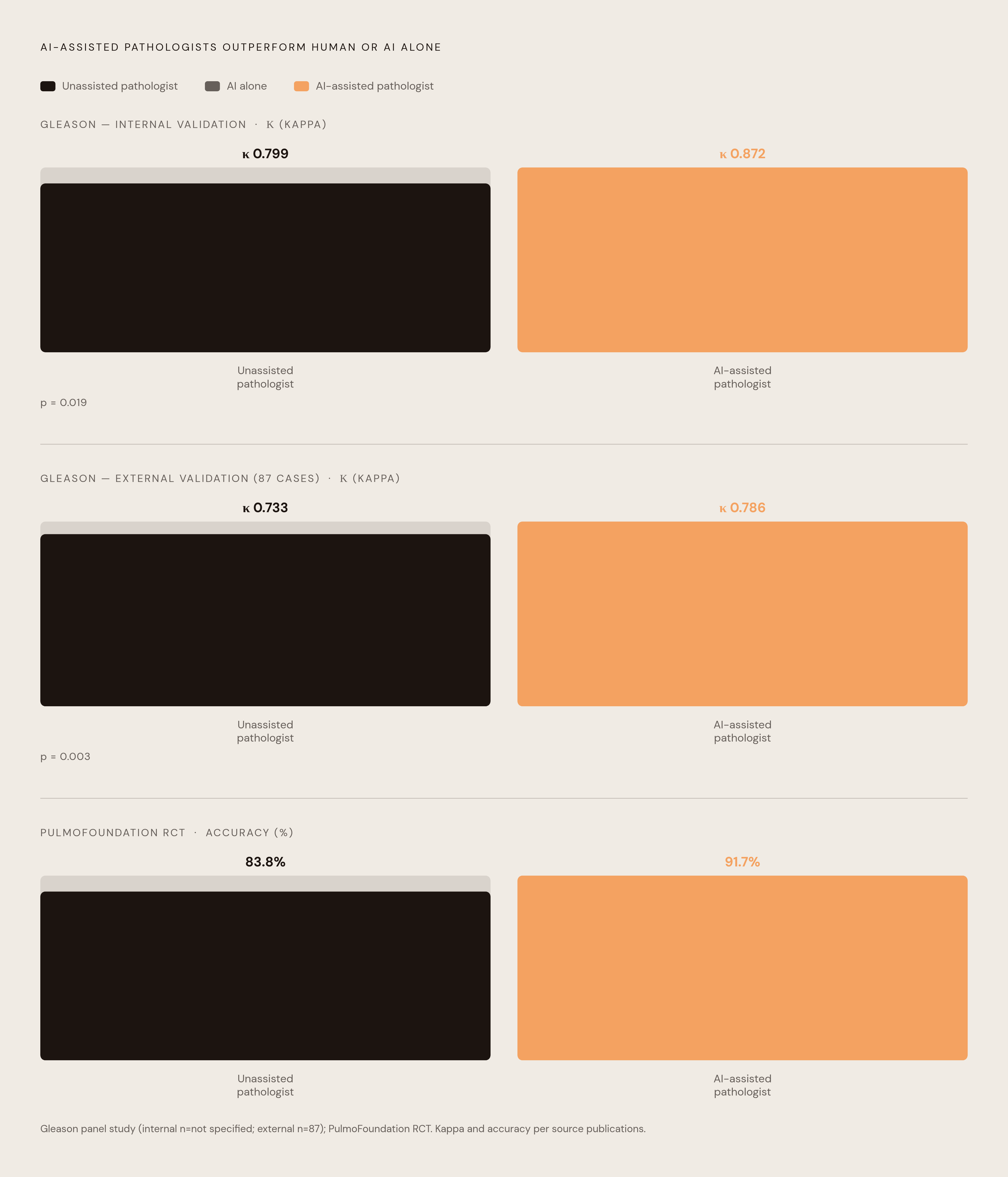
Gleason grading shows up again, and for good reason: it's the clearest demonstration of what happens when AI and pathologists work together toward the same result. A 14-pathologist panel, working with AI assistance, was compared against the same panel working unassisted. Agreement with the expert reference standard improved from a kappa of 0.799 to 0.872, a statistically significant jump (p = 0.019). On external validation across 87 cases, the improvement held: kappa moved from 0.733 to 0.786 (p = 0.003). In both experiments, the AI-assisted pathologists beat not just the unassisted pathologists but the standalone AI running on its own. Worth sitting with that for a second: the pairing outscored both the machine alone and the human alone.
The PulmoFoundation RCT backs this up at scale, with that same 91.7% versus 83.8% split across thousands of case-reader pairs. What's happening mechanically is fairly simple once you say it out loud: AI is good at surfacing pattern-level consistency across huge volumes of visual data, and pathologists are good at contextual reasoning, weighing clinical history, and handling edge cases that refuse to fit a learned pattern. Two different jobs, feeding one diagnosis.
The junior-pathologist effect points somewhere specific too: AI might matter more as a training and equity tool than as a pure efficiency play. If a tool helps a five-year pathologist perform closer to a twenty-five-year pathologist, that has consequences well past turnaround time.
Risks that benchmark numbers do not capture: bias, overreliance, and training effects
So AI helps junior pathologists close the gap. Encouraging, sure, but a real worry sits right next to that finding: what happens when junior pathologists start deferring to AI output instead of building their own independent judgment? The same mechanism that closes the experience gap in year one could, if training programs aren't watching closely, keep that gap from ever closing through actual skill development.
There's the shortcut-learning problem again, this time from the bias angle instead of the validation angle. Models pick up correlations tied to scanner type, staining protocol, or which lab processed the batch: features that have nothing to do with biology and don't travel between institutions.
Demographic representation is the least talked-about gap here, and maybe the most concerning one. Reviews of FDA-authorized ML-enabled devices have found that only a minority report both sensitivity and specificity, and even fewer provide any demographic data at all. Under-represented groups (ethnic minorities, children, patients from lower-resource settings) are largely missing from validation cohorts. There's a real tension sitting in that gap: these are often exactly the populations where AI-assisted pathology could help the most, in settings where specialist review is scarce or doesn't exist at all.
Then there's automation bias, which is less a data problem and more a design problem. Interfaces that project confidence without earning it can nudge a clinician toward accepting an output they'd otherwise question. Pathology AI has been validated almost entirely on large European and US academic-center cohorts, and adoption in under-resourced settings, precisely where pathologist shortages hit hardest, is waiting on validation studies that mostly don't exist yet.
Where regulatory frameworks stand and what they leave unresolved
The number of FDA-authorized pathology AI devices remains limited, and whole-slide imaging algorithms represent only a small fraction of those cleared. That's a narrow authorized footprint given how much research volume this piece has already walked through, and the gap between papers published and tools actually cleared for use is worth sitting with for a moment.
The vast majority of FDA AI-enabled devices have been cleared through the 510(k) pathway, a route built for low-to-moderate-risk devices that can show substantial equivalence to something already on the market. It wasn't built with novel, autonomous diagnostic systems in mind, and it shows. Regulators have started approving AI tools for specific, narrow applications, cancer detection being the clearest case, but a full framework for fully autonomous diagnostic AI remains unfinished.
Europe is taking a different road. The EU AI Act classifies medical AI as high-risk, bringing transparency, documentation, and conformity requirements that will shape how pathology AI gets built and deployed across the continent. The tension underneath all of this: approval pathways built for static devices are being stretched to cover software that updates, drifts, and interacts with clinical workflows in ways no earlier product ever did. What that means for the accuracy debate is simple, if underappreciated: a tool can post excellent published benchmarks and still sit a long way from wide deployment, because validation, documentation, and post-market surveillance haven't caught up. The gap here is institutional as much as technical, and it may end up being the slower-moving of the two bottlenecks.
What the evidence actually tells clinicians and health systems deciding how to use AI now
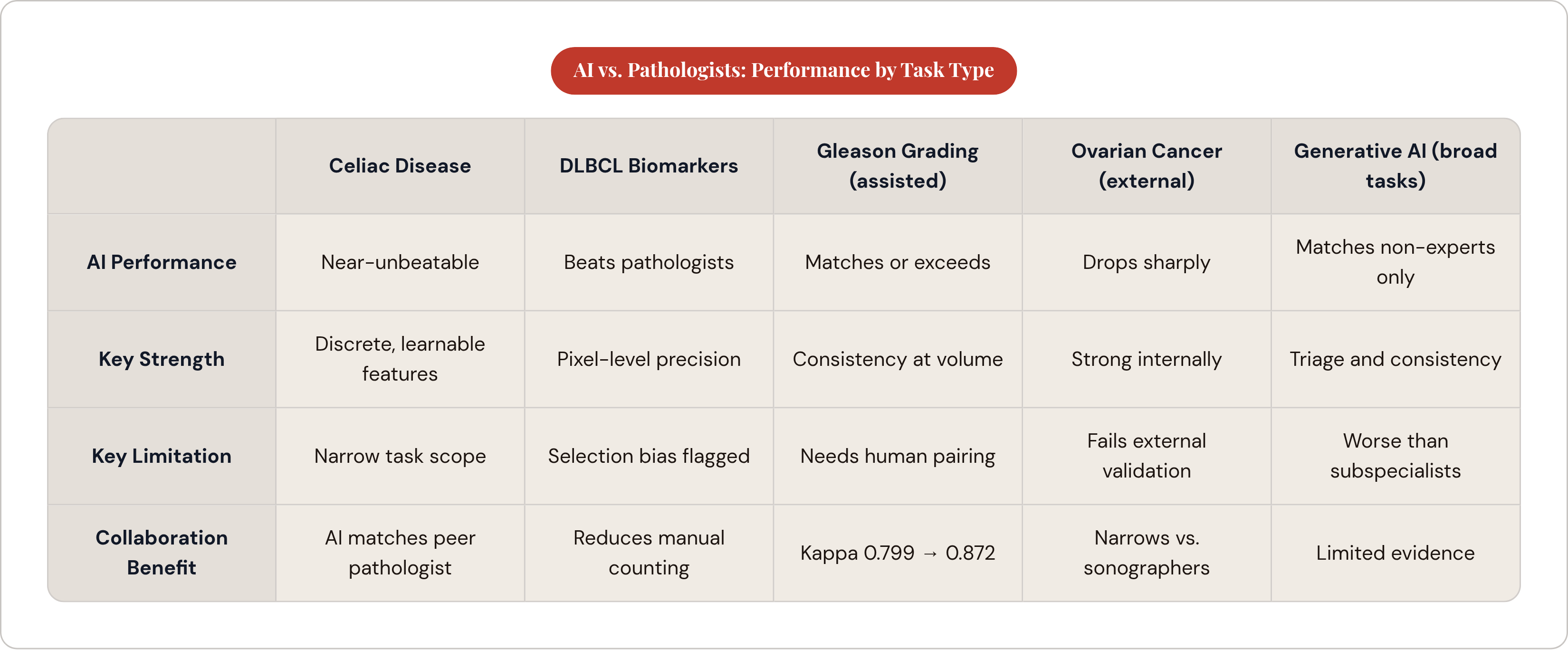
Put the spectrum in plain terms. AI leads on high-volume, visually discrete, pattern-heavy tasks: celiac disease diagnosis, Gleason grading assistance, biomarker quantification in DLBCL. AI matches non-expert clinicians on broader diagnostic tasks and generative AI use in mixed clinical settings, useful for triage and consistency but no substitute for subspecialty judgment. Then AI falls short on complex, ambiguous, multi-system cases, on external validation cohorts, and on populations barely represented in the training data to begin with.
The collaboration model wins across the strongest evidence in this piece, whether that's the Gleason grading panels or the PulmoFoundation RCT. Running AI standalone, or ignoring it altogether, both leave accuracy sitting on the table.
Health systems evaluating these tools should ask for external validation data, demographic reporting, and prospective trial results, instead of settling for internal benchmark scores dressed up as proof of readiness. The finding that junior pathologists benefit most from AI assistance also has real consequences for how training programs get built, and for health systems in lower-resource settings where senior expertise is often the scarcest thing on staff.
So, does AI match pathologists? That question treats a spread of outcomes as a single verdict, and that's the trouble with it. AI in pathology runs on a different axis from clinicians entirely: it wins where patterns are discrete and volume is high, and it struggles where ambiguity and context take over. Knowing which axis you're standing on, task by task, case by case, is the actual work left to do here, and no amount of averaging is going to do that work for you.