FDA Cleared AI Diagnostic Tools in Radiology
Radiology dominates FDA-cleared AI approvals, but clearance means safety review, not clinical proof.
Radiology is the biggest single category in FDA-cleared AI, and it's not particularly close. As of early 2026, 1,163 of the 1,524 total cleared AI algorithms sit in radiology, which works out to 76.31% of everything the agency has authorized, climbing toward 80% once you fold in the imaging-adjacent specialties riding along for the trip. The FDA now clears something like 30 of these devices a month. That number alone tells you radiology AI is a big deal. The harder question, and the one this piece keeps circling back to, is what "cleared" is actually telling you when you see that word stamped across a product page.
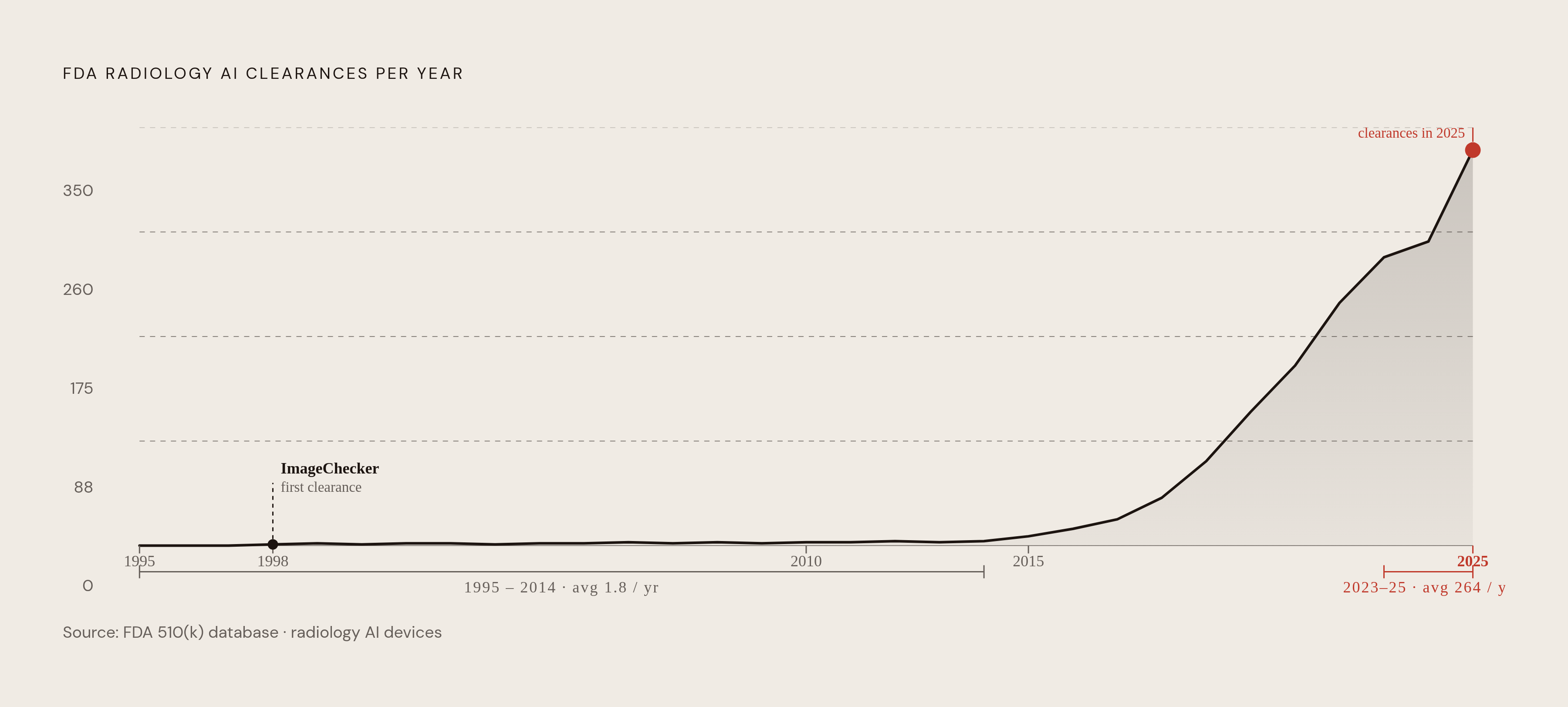
Start with the origin story. The first radiology AI device ever cleared was a mammography reading aid called ImageChecker, from a company called R2 Technology (later bought by Hologic), back in 1998. Then, for roughly two decades, almost nothing happened. Between 1995 and 2014, the FDA cleared an average of 1.8 radiology AI devices a year, slow enough that you could count most years on one hand. Between 2023 and 2025, that number hit 264 a year, with 331 clearances in 2025 alone. Something clearly came loose.
Why radiology, of all the specialties? Three reasons keep surfacing when you dig into the field. Medical images are already structured, machine-readable data (a CT scan is a grid of numbers before it's ever a picture a doctor squints at), which makes it a natural fit for pattern-recognition models built to find signal buried in pixels. Radiology also had a mature labeling system waiting around: decades of radiologist reads gave researchers ground-truth data to train on, no need to invent a new way of scoring right and wrong from scratch. And the stakes are immediate, sometimes brutally so. A stroke or a brain hemorrhage is a race against a clock that doesn't pause for paperwork, and any tool that shaves minutes off detection has a buyer waiting with a checkbook open. Put those three together and you get a specialty basically tailor-made for an AI land rush.
What FDA clearance actually means for a radiology AI device
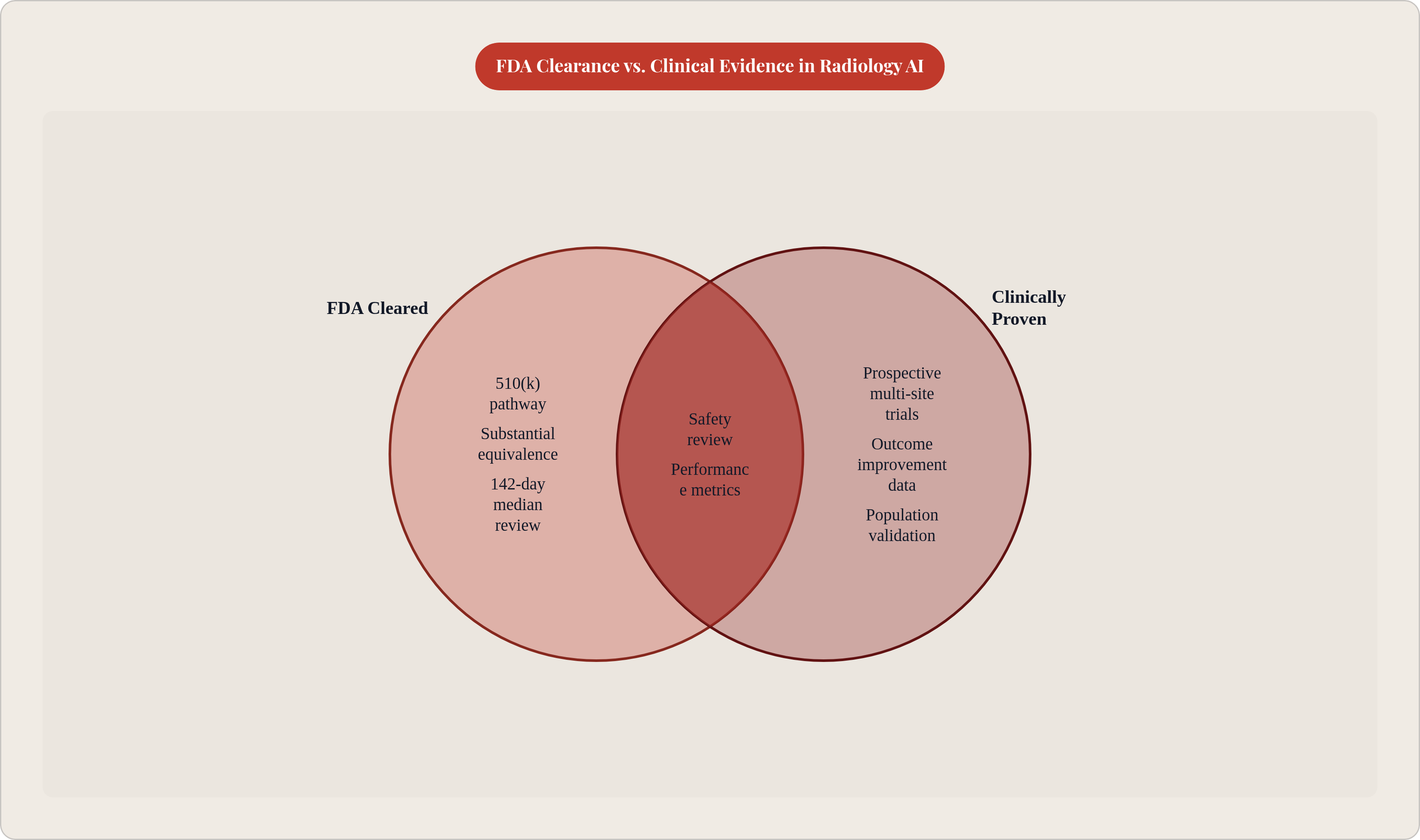
FDA clearance is a regulatory determination, nothing more mystical than that. It means the FDA reviewed a submission and didn't find a safety objection worth blocking the product over. It does not mean the device works well in clinical practice, and that gap between "cleared" and "proven" is the single most important thing to hold onto before reading any headline about a new AI tool.
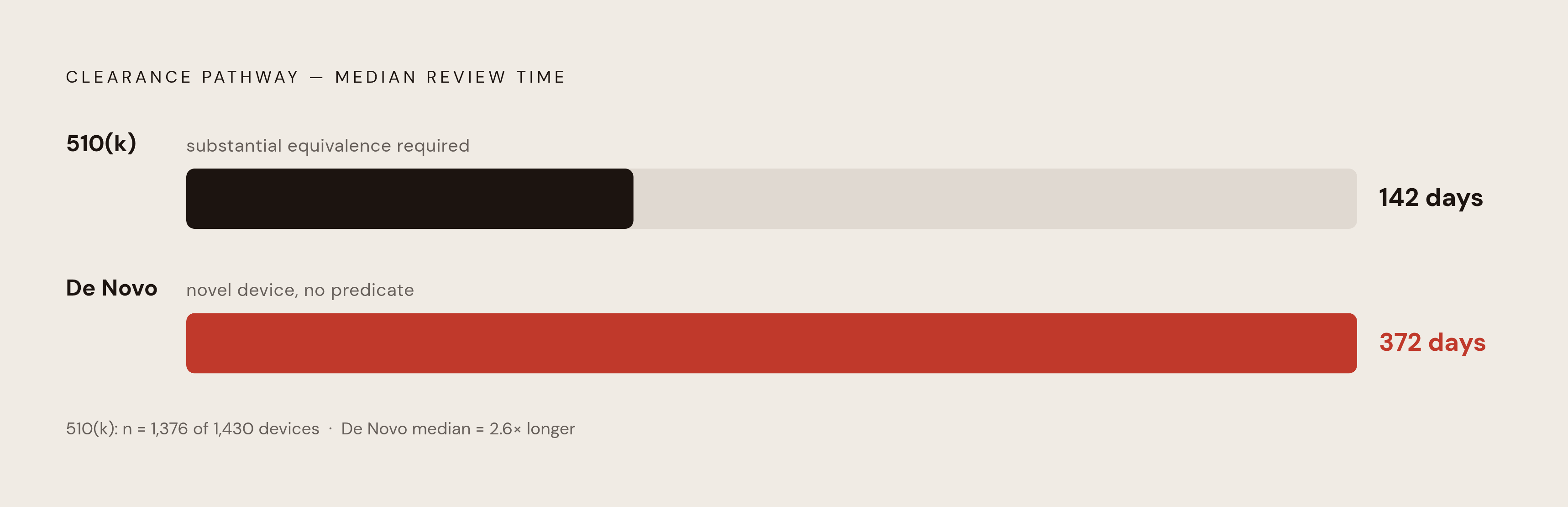
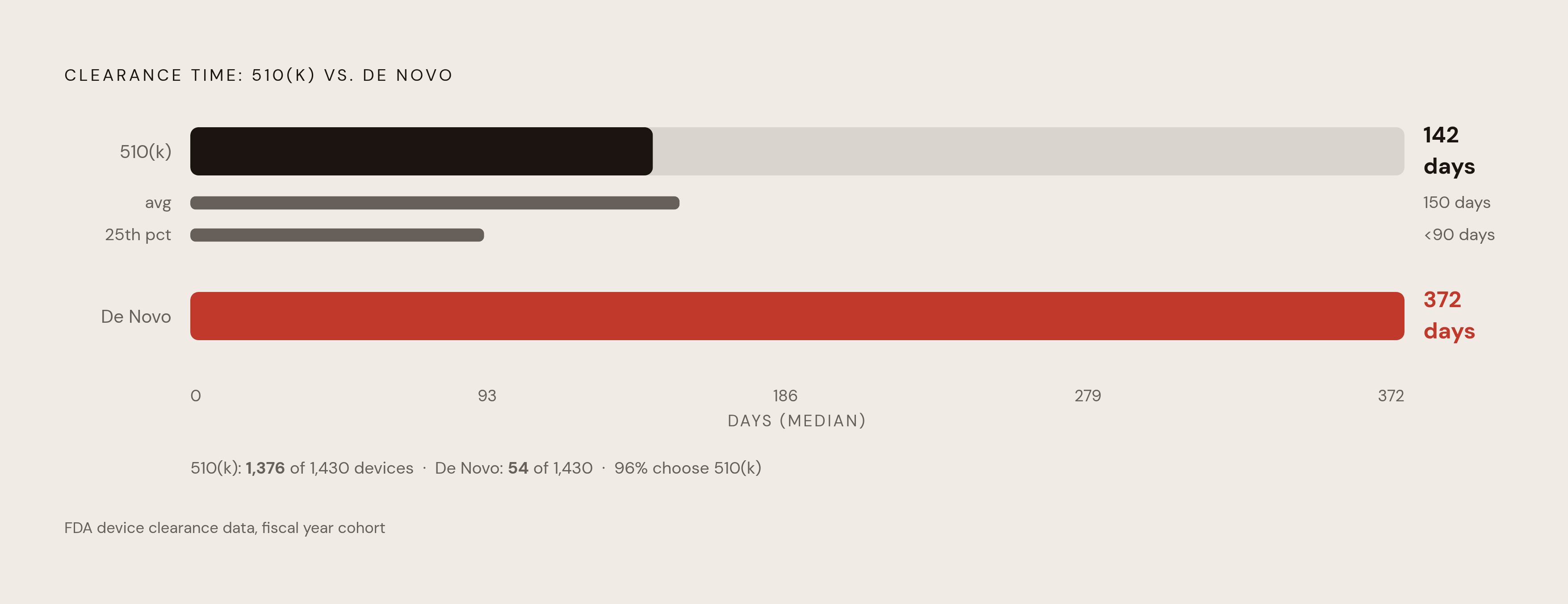
Most of these devices go through a process called 510(k); 1,376 of the 1,430 devices in the count took this route rather than De Novo authorization or full premarket approval. Under 510(k), a manufacturer doesn't have to prove its product beats what's already out there. It has to show "substantial equivalence" to a device already on the market. A new chest X-ray triage algorithm can clear by showing it performs comparably to an older, already-cleared chest algorithm; no head-to-head trial against a human radiologist, no proof it improves outcomes for a single patient. It just has to not be worse, or at least not different in a way that opens new safety questions.
That structure explains the speed, and the speed is genuinely fast. The median time from submission to clearance in 2025 was 142 days, average landing at 150, with a full quarter of devices clearing in under 90 days. Compare that to De Novo, the pathway for genuinely novel devices with no predicate to point back to: median time there runs 372 days, well over double. If you're a manufacturer picking which door to walk through, the math isn't subtle at all. Radiology devices specifically clear even faster than that overall median, landing at 146 days, ahead of most other device panels.
So what does clearance actually buy you? It confirms the paperwork passed a safety review, and that's a real bar, not nothing. But it leaves wide open (i) whether the tool beats current workflow, (ii) whether it holds up across different patient populations, and (iii) whether whatever evidence existed in a lab setting survives contact with a real hospital full of real, messy patients. Clearance is a floor. Every section that follows is really just an extended answer to the question of what sits, or doesn't sit, above that floor.
How FDA-cleared radiology AI tools actually function
Most cleared tools fall into four jobs, once you get past whatever the product brochure calls them: (i) detection and triage tools flag something abnormal in an image (stroke, hemorrhage, pulmonary embolism, a lung nodule) and bump it up the radiologist's worklist so the sickest patient doesn't sit behind a stack of normal scans; (ii) measurement tools automate the tedious stuff, organ segmentation, lesion sizing, bone density scoring, the kind of work a radiologist could do by hand but would rather not burn ten minutes on; (iii) risk-stratification tools skip the yes-or-no finding entirely and hand back a number, a probability that this particular patient develops breast cancer over the next several years, say; and (iv) workflow-routing tools sit quietly in the background, reordering worklists or paging on-call teams based on how confident the algorithm is that something needs eyes on it now instead of later.
Underneath all four, convolutional neural networks still do most of the heavy lifting; they've been the workhorse architecture for finding patterns in pixels since the field first took off, and nothing has knocked them off that perch yet. But a newer category is starting to show up in the clearance data: foundation models, the same broad architecture family behind large language models, adapted for imaging work. Aidoc's CARE1 Foundation Model got the first FDA clearance of a foundation-model-powered clinical AI device in 2025. That single clearance matters less for what the product does day to day than for what it signals about where the architecture is heading next.
Worth flagging, too: "cleared device" doesn't always mean standalone software sitting on a server somewhere. Some clearances cover hardware with AI baked directly in, like a mobile X-ray unit that ships with a triage algorithm built into the machine itself; that counts as one cleared device, hardware and software bundled together. And if you want the single most common thing being cleared, it's computer-aided detection: the product code covering radiological CAD accounts for a quarter of every AI and ML clearance on its own. The FDA has said, on the record, that it's actively trying to figure out how to tag and track devices built on foundation models and large language models. That's a classification system built for an older, narrower kind of algorithm, now visibly showing its age.
Where the cleared tools are concentrated: clinical applications that dominate
Ask which body part radiology AI cares about most and the answer is the brain, first and by a wide margin. Viz.ai's stroke-detection algorithm became the first FDA-cleared AI tool for neurovascular imaging back in 2018, and it now runs in hundreds of hospitals worldwide. Documented average time savings of around an hour have been associated with its use in stroke care, and in stroke care, an hour can be the difference between a good outcome and a permanent one. For intracranial hemorrhage detection on CT, commercial systems including Viz.ai's ICH product and Canon's AUTOStroke Solution report sensitivity in the high-80s to low-90s percent range and specificity in the low-to-high 90s percent range, under the controlled conditions of clinical validation studies. That's a real number. It also comes with the caveat that shadows this entire field: controlled conditions are not the emergency department at three in the morning.
Pulmonary embolism detection tells a similar story with slightly less dramatic numbers attached. Deep learning models reading CT pulmonary angiograms report pooled sensitivity of 0.88 and specificity of 0.86 across meta-analyses, solid without the ceiling-scraping figures you see in stroke imaging. One cleared platform in this space trained on a genuinely large annotated dataset of CTPA scans, and the size of that training set is doing real work here; PE has enough visual variety that a model trained on a thin dataset is going to miss the weird ones, the atypical clots that don't look like the textbook picture.
Bone and joint imaging turned into its own crowded lane. Multiple cleared platforms are doing fracture detection across a range of clinical settings. Meta-analyses put pooled sensitivity and specificity both above the high-80s percent mark, strongest in extremity fractures like the wrist, ankle, and shoulder; ribs and spine stay messier, with more variable performance. The overall performance picture across meta-analyses is one of genuine clinical utility, with sensitivity and specificity both holding up at a level that makes the tools worth taking seriously.
Breast imaging deserves a mention for what's new and what's old at once. Clairity's Allix5 got De Novo authorization in 2025 as a software-only device that analyzes imaging data and returns a numeric probability, or a risk category, for future breast cancer; it's a clean example of the risk-stratification use case rather than a simple detect-or-don't tool. Breast imaging is also where this whole story started, since mammography CAD was the very first cleared radiology AI category back in 1998. The newest risk-scoring tools and the oldest cleared category both live in the same organ.
Vascular imaging is the newest frontier worth watching, and it's still small. A recent clearance in the vascular space has pushed AI coverage past the brain and chest into aortic disease. It's a modest clearance in the grand count, but it's a sign the map keeps expanding into territory nobody was covering even two or three years back.
Who makes these tools and how the market is structured
A small number of very large names dominate the clearance count, and the gap between them and everyone else is not subtle. GE HealthCare leads with 120 radiology AI authorizations, and that number is largely a shopping list: Bay Labs, BK Medical, Caption Health, MIM Software, icometrix, Spectronic Medical, all folded in through acquisition rather than built in-house from the ground up. Siemens Healthineers sits at 89 (counting Varian), Philips at 50 (counting DiA Analysis and TomTec), Canon at 45 (counting Vital Images and Olea), United Imaging at 38. Among companies that build AI as their core business rather than as one line in a broader imaging catalog, Aidoc leads with 31 clearances and DeepHealth follows at 28, counting its Quantib and iCAD acquisitions.
Below that top tier, the market fragments fast. Of 740 unique manufacturers with cleared devices, 67.8% have exactly one. Just 13 companies account for 17.3% of every authorization in the dataset. The typical company in this space cleared a single product and, as far as the data shows, hasn't necessarily followed it up with a second, let alone the kind of large post-market study that would tell a hospital whether the tool actually holds up once deployed at scale.
That has consequences for the buyers, not just the sellers. Hospital IT departments and procurement teams aren't choosing between a handful of well-resourced vendors alone; they're picking through a long tail of single-product companies with uncertain staying power, sitting next to a small set of giants whose growth strategy is mostly acquisition rather than internal development. Neither situation guarantees quality on its own. It just means your due diligence will look different depending on which end of that spectrum you're shopping in.
Adoption numbers, when you actually go looking for them, are all over the map. A 2024 survey of European radiologists found roughly half were actively using AI tools in practice. A separate U.S. report put actual use at a much smaller share of practices. The American College of Radiology landed in between, reporting that 30% of radiologists use AI clinically. Three surveys, three different numbers; the honest takeaway is that "adoption" depends enormously on who you ask, where they practice, and what counts as "using" a tool in the first place.
What the evidence record behind cleared tools actually shows
This is where the gap between clearance and evidence starts to feel less like a technicality and more like a real problem. Research into the evidence records behind cleared devices has found clinical performance studies reported for only a portion of them at the time of approval, with a meaningful share of devices reaching the market without any such study on record. A quarter of these devices reached the market with an explicit acknowledgment that nobody had run a clinical performance study on them, ever.
Transparency in the paperwork itself isn't much better. Analyses of FDA summary documents have found large shares of documents omitting clinical studies or performance metrics entirely. What that adds up to is a public record too thin, most of the time, to tell you whether a given device is good, bad, or somewhere unremarkable in between.
Demographic representation is its own specific hole, and a stubborn one. Across cleared devices, reporting of sex-specific, age-specific, and race or ethnicity data in validation sets has been consistently sparse and uneven. This matters beyond simple fairness bookkeeping, because an algorithm trained mostly on one population, at one hospital, using one imaging protocol, can behave differently the moment it meets a population it's never seen before. There are documented cases where AI tools deployed for chest X-ray and brain CT reading showed real drops in diagnostic accuracy moving from retrospective testing into prospective, real-world use. The model that looked great on paper got noticeably less reliable once it met actual new patients walking through the door.
That prospective-versus-retrospective gap runs through nearly everything in this piece. Retrospective validation means training and testing on historical data, often from a single hospital, which is faster, cheaper, and tells you less than you'd like. Prospective, multi-site, randomized evidence is the gold standard everyone agrees on in theory. It's also rare in the actual literature behind cleared devices, because it's slow, expensive, and the 510(k) pathway simply doesn't require it.
One finding deserves more attention than it usually gets: a prospective multicenter study across 67 organizations found radiologists working with AI assistance hit markedly higher sensitivity for intracranial hemorrhage detection than the AI running standalone. The gap looks small in raw numbers, but it's statistically significant, and the pattern behind it is bigger than this one study. AI paired with a radiologist beats AI running alone. The evidence so far leans hard toward AI as a partner in the room rather than a replacement for the person already standing in it.
How the FDA is adapting its framework for tools that keep learning
Traditional device regulation was built on a simple assumption: once a device clears, it stays exactly the way it was cleared. AI models don't work that way. They get retrained, refined, updated, sometimes on a schedule the manufacturer controls and the FDA never sees in real time. That mismatch, a static regulatory model chasing a moving target, is the structural problem the FDA has spent the last few years trying to solve.
The current answer is something called a Predetermined Change Control Plan, or PCCP. The mechanism was authorized by the 2022 Food and Drug Omnibus Reform Act and formally written into law under Section 515C of the FD&C Act (with final guidance published by the FDA in August 2025). The idea is straightforward even if the execution is new: instead of returning to the FDA for a fresh clearance every time an algorithm changes, a manufacturer can lay out in advance exactly what kinds of updates it plans to make, what performance boundaries the updated model has to stay inside, and how it will monitor the device to make sure those boundaries hold up.
It's a sensible fix, and it drags an obvious new question in behind it. If a device can legitimately change after it's already installed and running in a hospital, at what point does that change matter enough to warrant a fresh look from the clinical team using it every day? The PCCP framework answers the regulatory half of that question. It doesn't fully answer the clinical half, and that's a gap hospitals will have to work out on their own as more PCCP-covered devices land on the floor.
Layer on top of that the foundation model problem from earlier: the FDA has said plainly it's still figuring out how to identify and tag devices built on these newer architectures, because the classification system in place wasn't designed with them in mind at all. It's a technology moving fast enough that the rulebook is being written in the same years the tools are already shipping and reading someone's chest X-ray. The clearance count keeps climbing, roughly 30 new devices a month and rising. Whether the evidence behind each one keeps pace with that number is still an open question, and it's one worth asking yourself the next time "FDA cleared" shows up stamped across the top of a brochure.