AI Sepsis Prediction Algorithms in Hospital EHR Systems
Early alerts cut sepsis deaths when AI models are carefully validated.

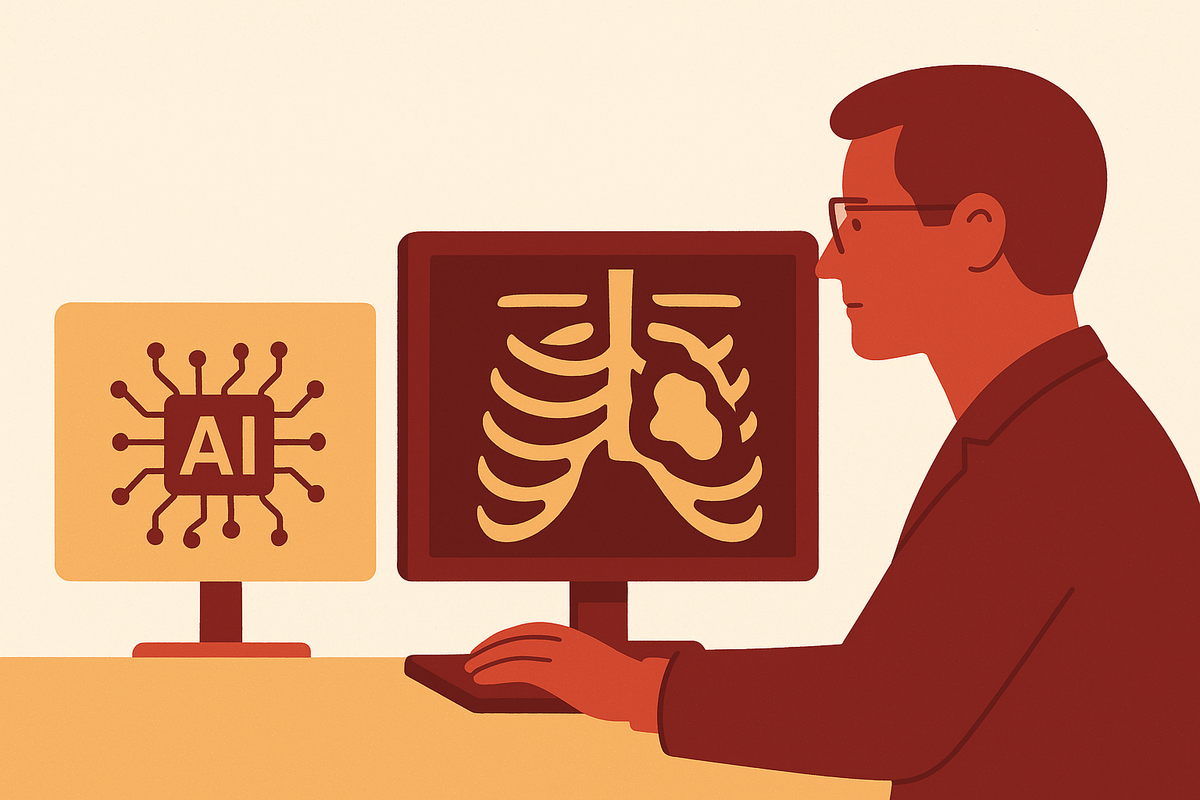
Sepsis kills through speed, not just severity. It's the body's own immune response spiraling out of control, attacking organs instead of the infection that triggered it, and it can move from "manageable" to "multi-organ failure" within hours. This piece looks at how AI prediction models are getting wired directly into hospital EHR systems to catch that spiral earlier than clinicians can on their own, where that promise holds up against the actual evidence, and where it doesn't.
Globally, sepsis is one of the leading causes of death in hospitals, and it costs health systems billions each year. What makes it cruel from a treatment standpoint is the clock, since delaying antibiotics and fluids by even a few hours after onset sends mortality risk climbing fast. That narrow window is exactly why clinicians have leaned on screening tools like SIRS (Systemic Inflammatory Response Syndrome) and qSOFA (quick Sequential Organ Failure Assessment) for years. Both are rule-based checklists, checked at one point in time, and both miss a real chunk of patients who go on to develop sepsis anyway. A clinician staring at a messy set of vitals still has to make a judgment call, and judgment calls, however well-trained, aren't the same as watching a patient around the clock.
AI sepsis prediction tools are built to close that gap. Whether they actually close it, and how cleanly, is what the rest of this piece digs into.
What AI sepsis prediction algorithms actually do inside an EHR
The idea behind AI sepsis tools is continuous monitoring: the model watches a patient's chart the way a nurse would if that nurse never slept, never blinked, and could hold a few dozen variables in working memory at once.
The data feeding the model is a wide mix. Vital signs update in real time, while lab values like lactate, white blood cell count, and creatinine feed in as results arrive. Demographics and existing health conditions sit in the background as context. Administrative data, things like length of stay and prior hospital visits, adds a longer thread across time. Some newer platforms are starting to pull in biomarker or imaging data too, stacking that on top of the standard fields.
The engine behind the score is usually a machine learning model: sometimes a random forest classifier, sometimes a deep learning neural network. What these models actually do is find patterns across dozens of variables at once, patterns too subtle or too tangled for a person to catch by eye. The output is a probability, a risk score, and it refreshes on a schedule, hourly in some systems, with every new data point in others. Cross a set threshold, and an alert fires inside the clinician's normal EHR workflow.
Here's the real difference from SIRS or qSOFA: those older tools encode a fixed rule ("two or more of these four criteria means flag it"), while machine learning models learn statistical relationships from thousands of past patient records. That's what lets them pick up on faint early signals a checklist just isn't built to notice. Published accuracy numbers for these models span a wide range, and the best performers clear the older scoring tools by a good margin. But that range itself is telling, since a lot of variation shows up once these models leave the lab and land at an actual bedside.
How leading hospital systems have embedded these tools into clinical care
Several major hospital systems have embedded AI sepsis tools into routine clinical care, with results ranging from genuine mortality reductions to cautionary lessons about real-world performance gaps. The Epic Sepsis Model, released in 2017, is probably the most widely deployed version of this technology, simply because it runs on Epic's EHR platform, which sits inside a huge share of U.S. hospitals. It's also become something of a cautionary tale. External validations at major academic health systems found real-world performance a lot weaker than Epic's internal numbers suggested. At the alert thresholds hospitals were actually using, sensitivity in some of these outside studies was low enough that the model missed most of the septic patients it was supposed to catch.
A follow-up analysis from the University of Michigan found something stranger still: accuracy improved when the model pulled in data spanning a patient's entire hospital stay. Which raises an uncomfortable question: was the model detecting sepsis, or was it partly detecting that a clinician had already grown suspicious and started ordering more tests? Epic has since updated the model and now tells hospitals to retrain it on their own local data, a sensible fix, but also a quiet admission that the original pitch (plug it in anywhere, it just works) didn't hold up.
Duke Health's Sepsis Watch tells a better story. Billed as the first deep learning sepsis model running in routine U.S. clinical care, it has operated continuously across all three Duke Health hospitals since late 2018, generating hourly predictions for adult inpatients. Duke has reported a real drop in sepsis deaths tied to its use, along with alerts firing hours before a patient's clinical presentation would have tipped off a bedside team. What sets it apart is a multisite external validation covering more than two hundred thousand patient encounters, which found the model's performance held up across different hospitals and patient populations. That kind of portability barely shows up in this literature, and that rarity is the whole point.
UC San Diego Health's COMPOSER runs inside two emergency departments, chewing through a large set of clinical variables in real time. A study published in npj Digital Medicine tied its deployment to a meaningful drop in mortality among septic ED patients, along with better compliance with standardized sepsis treatment bundles. TREWS, studied in a prospective multisite trial, showed similar wins: fewer deaths, less organ failure, shorter hospital stays, faster antibiotics.
Lausanne University Hospital's HERACLES takes a different shape entirely. Instead of firing discrete alerts, it sorts patients into confirmed, possible, or invalidated sepsis categories and feeds that into a live clinical dashboard. Wards using it saw in-hospital and ninety-day mortality drop, while control wards without the system showed no comparable change.
And in April 2024, the FDA granted its first-ever marketing authorization for an AI sepsis diagnostic: Prenosis's Sepsis ImmunoScore, cleared through the de novo pathway. It risk-stratifies patients for sepsis, both current presence and development within twenty-four hours, and for downstream outcomes like mortality and ICU admission. It was validated across multiple U.S. institutions over a multi-year enrollment window, giving it a regulatory pedigree most of these tools don't have.
Mayo Clinic's Luminare deserves a mention too, though its real innovation is less about the algorithm and more about the interface. Nurses get contextual patient information and a phenotype classification alongside ordering options, all inside the EHR, and the nurse keeps final say. That last part is not an accident; it's a deliberate answer to alert fatigue, which gets its own section below because it earns one.
Where the outcomes evidence is strong and where it is still thin
The outcomes evidence for AI sepsis tools is genuinely promising in some settings and notably thin in others, and knowing which is which depends on study design and validation scope. The strongest signal comes from prospective studies at institutions that integrated these tools well. Where that happened, researchers found real drops in in-hospital mortality, length of stay, and thirty-day readmission. Sepsis Watch's multisite validation is the standout example, showing a model trained at one institution can hold its accuracy in a different geography and a different patient mix, a result the field doesn't often manage. COMPOSER's numbers carry extra weight too, since they came from a controlled before-and-after study design rather than a retrospective chart review after the fact.
But the evidence base has real holes. Most published AI sepsis models have never been tested outside the hospital that built them, and where outside testing did happen, performance dropped, sometimes by a lot, compared to the vendor's original numbers. A lot of published research also measures the wrong thing entirely: AUROC, sensitivity, specificity, statistical metrics describing how well a model separates sick from healthy patients on paper. None of that guarantees fewer deaths if the alert gets ignored or the workflow around it is clumsy. Layer onto that the fact that hospitals still work from two competing sepsis definitions, Sepsis-2 and Sepsis-3, and comparing results across studies gets genuinely hard.
The Epic Sepsis Model is the cautionary tale to remember here. A model can get adopted at massive scale, post strong internal numbers, and still fall short once independent researchers get a look at it. That gap between what a vendor reports and what gets independently confirmed is a structural problem this field hasn't solved. If you're a health IT leader sizing up a new tool, the lesson is plain: a vendor's internal validation is a starting point, not a verdict. Local pilot data and independent, published validation are what can actually tell you whether the tool will work in your hospital, with your patients, on your nursing floors.
Alert fatigue and the workflow integration problem that limits even accurate models
A model can be statistically excellent, catch early sepsis better than any human screening tool ever has, and still fail completely at the bedside because nobody looks at the alert anymore. That's the single biggest practical failure mode in this whole field.
Alert fatigue isn't a minor annoyance clinicians grumble about at lunch. Documented cases show large drops in sepsis mortality at a given institution happening alongside a real rise in nursing staff alarm fatigue, which is its own kind of warning sign: the tool worked in the short term while quietly wearing down the people using it. That's not sustainable, and it raises an obvious question: what happens five years into deployment, once the novelty wears off and the alerts just become wallpaper?
A few things drive this. Set the threshold too low, and clinicians get buried under notifications; eventually they tune them out. Route an alert into a generic inbox with no named owner, and it sits there unacknowledged, because checking it isn't specifically anyone's job. Timing matters more than people expect too: an alert firing on a patient who's obviously stable, or firing after a clinician has already acted, teaches people fast that the system can't be trusted.
One survey found that most trainees who saw a sepsis alert never actually opened the decision-support tool attached to it. The alert registered, but the workflow it was supposed to trigger did not.
The fixes that seem to work share a common thread: narrow the target, and give the clinician something to act on right away. Sepsis Watch is designed to route alerts through a targeted clinical workflow rather than broadcasting indiscriminately across everyone touching the patient's chart. Luminare embeds the clinical reasoning and the ordering options directly into the alert, so a nurse can act without leaving the EHR screen, and crucially, the nurse still makes the call rather than getting told what to do. Institutions that calibrate alert thresholds to their own patient volume and case mix, instead of running the vendor's default settings, report better engagement from clinical staff. Underneath all of this sits a less glamorous problem: EHR systems vary wildly in their technical setup, and a model that plugs in smoothly at one hospital might need a ton of custom engineering at another. That slows adoption everywhere, and it's rarely the part vendors put in the sales pitch.
How biased training data and missing social context can skew predictions by patient population
Biased training data can cause AI sepsis models to deliver systematically worse predictions for already-underserved patient groups, amplifying existing disparities rather than correcting them. A model only knows what its training data taught it, and if that data reflects existing gaps in care, the model doesn't fix them. It repeats them, often at scale.
Take testing rates. Research has found that white patients get tested more often than Black patients presenting with comparable age, sex, symptoms, and triage scores. That means some sick Black patients look healthier in the historical record than they actually were, simply because fewer tests got ordered for them. Train a model on that record, and it learns, wrongly, that lower testing intensity means lower risk for Black patients. The model isn't being malicious; it's just repeating a pattern that was already baked into the data before anyone wrote a line of code.
The SOFA score, which underpins many sepsis models and sits inside Surviving Sepsis Campaign guidelines, has its own documented problems. Research has found it performs worse for Black patients, female patients, and patients with disabilities. Any AI model using SOFA as an input feature or as its outcome label inherits that same distortion, whether its developers meant for it to or not.
Insurance status compounds the issue in a quieter way. Patients without insurance interact with the health system less, so their EHR records end up thinner, sparser, less complete. A model trained mostly on richer records from insured patients can generalize poorly to uninsured patients, a group that includes a disproportionate share of Black Americans. And social determinants of health, the housing, income, and access factors that shape a patient's actual risk, barely show up in these datasets at all. A 2025 analysis found only a small fraction of the text in EHR training data even mentioned social determinants of health, and structured EHR fields captured them even less.
None of this shows up in a headline AUROC number. A model can post strong overall accuracy and still deliver meaningfully worse predictions for specific patient groups, and that gap stays invisible unless developers go looking for it: testing performance separately by race, sex, insurance status, and disability rather than trusting one overall score to tell the whole story.
The transparency problem — proprietary models, black-box outputs, and the limits of explainability
Proprietary models and black-box outputs create a transparency deficit that limits clinical trust and independent accountability, and the field has only partial answers so far. Several widely deployed sepsis models, the Epic Sepsis Model most prominent among them, have been treated as trade secrets, which keeps their inner workings shielded from independent peer review. Hospitals adopted the ESM at scale before outside researchers ever got the chance to test how it performed in the real world. The gap between what Epic reported and what independent researchers later found only came to light because outside teams ran their own studies, without the vendor's cooperation.
That's a genuine problem if you're signing a procurement contract. If you can't independently check a model's real performance, or commission someone who can, you're often stuck choosing based on a vendor's internal testing, testing the vendor has every incentive to present in the best light.
Deep learning adds a second layer of fog on top of the first. These models can outperform simpler approaches, but their outputs often can't be traced back to specific inputs in a way a clinician can follow. A doctor looking at a high-risk score wants at least a plausible clinical story: what pushed this number up? Without that, adoption gets harder, because physicians asked to override their own judgment based on a score need some reason to trust it. Explainable AI methods, ones that surface plain-language feature contributions like "lactate rising, heart rate elevated, recent antibiotic started," are increasingly built into newer platforms specifically to answer this complaint.
The FDA's 2024 de novo authorization of the Sepsis ImmunoScore matters here too, since it shows a regulatory path now exists for these tools, one that asks for prospective, multi-site validation rather than internal claims alone. That's a meaningful check, even if it's still early days. And models built inside academic health systems, Sepsis Watch, COMPOSER, and TREWS among them, have generally gone through peer review and published their methods in the open. That openness sets a bar the proprietary commercial market hasn't consistently matched.
What clinicians and health IT leaders should weigh when evaluating an AI sepsis tool
Evaluating an AI sepsis tool well means pressing beyond vendor claims on two fronts: the rigor of the validation evidence and the practical fit of the workflow design. Start by asking where the validation actually came from. Was it internal, run by the vendor on their own data, or external, run by an independent team on a different patient population? Single-site or multisite? And does that validation population actually look like the patients you treat? A strong internal AUROC that's never been tested outside its home institution isn't a selling point; it's a flag.
Workflow matters just as much as the algorithm underneath, maybe more. How does the alert actually reach a clinician, and who's on the hook for responding to it once it lands? Does the tool hand over next steps right inside the EHR, or does it just interrupt someone's day with a number and no context? And what does the vendor offer for calibrating alert thresholds to your hospital's own patient volume and case mix, instead of shipping a one-size-fits-all default tuned somewhere else entirely?
None of these questions have a universally right answer, and that's precisely why you need to ask them.