Communicating AI Diagnostic Results to Patients
Doctors must explain how AI contributed to a diagnosis, not just the result itself.
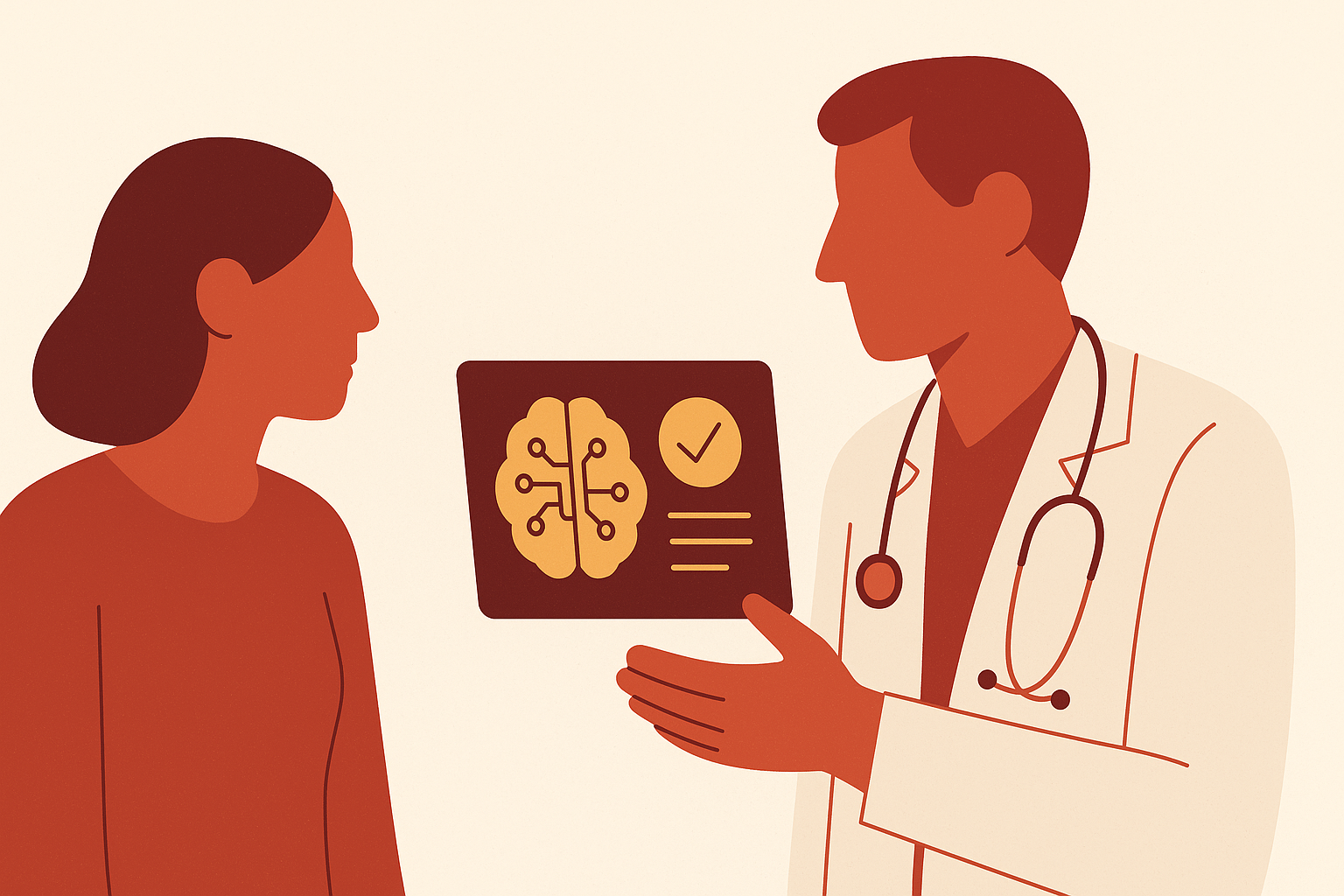
AI diagnostic tools have moved out of the pilot phase and into the exam room. As of late 2025, the FDA's list of AI-enabled medical devices runs to 1,430 approvals, and radiology alone accounts for 1,094 of them, which works out to 76.5% of everything on that list. That concentration matters because it means most patients who encounter AI in their care will meet it first as a shadow in a scan rather than as a chatbot or an app.
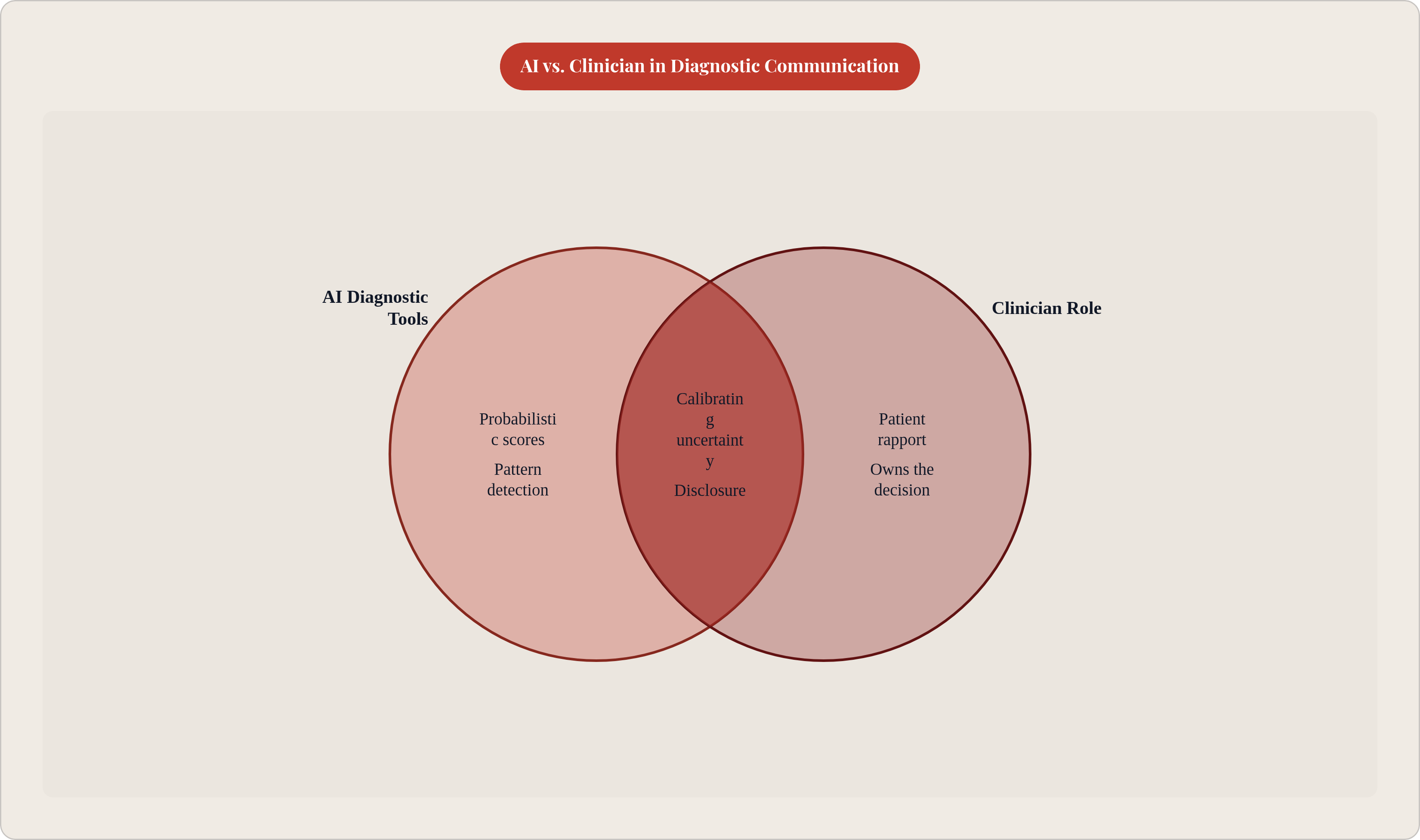
Here's the thing nobody warns you about in med school: an AI output is a probabilistic score, a flagged region on an image, a ranked list of differentials sorted by likelihood. Traditional diagnostic communication was built around a single expert who examines evidence and owns the verdict; AI adds a second voice to that room, except it's a voice the patient can't ask follow-up questions to, can't read body language from, and can't push back on directly. When a patient asks the oldest question in medicine, "what does this mean?", the honest answer now sometimes requires explaining two things instead of one. That gap between what the algorithm produced and what the patient expects to hear in plain English is what this piece is about.
What patients actually think about AI involvement in their diagnosis
Patient attitudes toward AI in healthcare are more measured than most coverage suggests, and the dominant mood is pragmatic acceptance rather than fear. A 2026 Salesforce global survey of more than 3,200 patients across eight countries found 61% are comfortable with agentic AI being part of their healthcare, and 64% said they'd hand over their full medical history to AI if it meant a faster diagnosis. That reads less like fear and more like pragmatism.
Yet the same survey found something that should reframe how clinicians think about their own role: patients are three times more likely to trust an AI agent deployed by their own doctor than a generic public chatbot. That trust turns out to be borrowed, on loan from the clinician who's vouching for it, and take away the doctor's endorsement and the AI's credibility mostly evaporates with it.
Context sharpens this further. In a multicenter prostate cancer MRI study out of Western Europe with 212 patients, 91% agreed with AI serving as the primary reader of their scan, and 79% were fine with it as a secondary reader, once the clinical setup was actually explained to them. Acceptance climbs when patients understand the AI's specific job, and it falls when the job is vague.
Skepticism hasn't gone anywhere, nor should it. A 2025 survey found 52% of patients worry AI could produce an incorrect result, and 63% think it needs more oversight than it currently gets. Those findings sit alongside the acceptance numbers above as the same patients holding two reasonable thoughts simultaneously, and ninety percent said a clear path to a human, an actual escalation option, is essential before they'll trust AI in a medical context at all. Trust here is conditional, and the condition is legibility: can the clinician make the AI's role clear enough that its limitations stop feeling like landmines?
The disclosure question: when and how to tell patients AI was involved
Is AI's involvement in a diagnosis a fact a patient is entitled to know, the same way they're entitled to know a drug's side effects before they sign a consent form? Scholars and regulators are converging on yes, and fairly quickly.
Hurley and colleagues, writing in 2025, argue that informed consent isn't actually informed unless the patient understands the specific role the algorithm played: was it a second reader double-checking the radiologist, a triage tool sorting urgency, or something closer to an autonomous decision-maker? Those are three very different arrangements wearing the same "AI was used" label, and lumping them together does the patient a disservice.
A 2024 web-based study found something that should give pause to anyone who assumes AI disclosure is a nice-to-have: when AI was part of a diagnosis, patients rated information about that involvement as at least as important as, if not more important than, the standard disclosures clinicians already give about short-term procedural risks. Patients are already telling us where this ranks on their priority list, and we just haven't fully caught up.
Regulators are catching up faster than clinical practice is. By 2025, more than 20 state bills required some form of disclosure when AI touched a diagnosis or treatment plan, and Texas House Bill 149, effective January 1, 2026, makes this explicit: patients must be told when AI is involved in their healthcare services. Current case law in the US doesn't yet demand disclosure across the board, but the scholarly consensus points to specific triggers that should prompt it regardless: the patient asks directly, the model is a black box even to the clinician, the AI carries outsized weight in the decision, or it's being used mainly to cut costs rather than improve care.
The practical read is simple even if the legal landscape isn't: disclose anyway. It's the lower-risk path and the one that preserves trust, regardless of what a given state statute currently requires. Good disclosure names the AI's specific role (screening, flagging, scoring), confirms a clinician reviewed and interpreted the output, and gives the patient something concrete to ask about.
How to explain what an AI finding actually means — and what it doesn't
This is where a lot of well-meaning clinicians trip. An AI "flag" gets treated like a rule-out, and a priority score gets read out loud like a severity rating, as if a number between 1 and 10 speaks for itself, and it doesn't. It's worth being blunt about the most common failure mode: saying "the AI didn't find anything serious," which quietly reframes a detection algorithm, built to catch specific patterns, as an all-clear that it was never designed to give.
The other failure mode is subtler and, frankly, more common with age. Incidental findings, the mild disc bulge, the minor degeneration you'd expect in anyone over 50, get flagged by an AI system doing exactly what it's supposed to do, and then that flag gets relayed to the patient without the context that would make it unremarkable. The AI did its job correctly; the framing around it is what needs fixing.
So what's the fix? Name the AI's role precisely, quantify uncertainty when you can, and anchor everything in your own interpretive judgment. Something like: "The screening tool flagged this area for closer review; here's what I found when I actually looked at it myself." Or: "This score indicates elevated likelihood of X, which I'm interpreting, given your history, as Y." The structure does real work: it tells the patient the AI raised a hand, and then it tells them a person walked over and checked.
Vanderbilt University Medical Center piloted a patient-friendly results format, built by health literacy experts working alongside internal medicine, laboratory medicine, and clinical informatics teams, that's worth studying as a template for portal-delivered results involving AI. It's a useful reminder that the format the patient reads matters as much as the words a clinician says out loud.
Here's a stat that actually helps make the case for AI's presence: reader studies have found AI assistance improved radiologists' sensitivity by 6 to 8 percentage points without a corresponding drop in specificity. That's a real, quantifiable benefit, and a far better thing to tell a patient than vague reassurance about "cutting-edge technology," because numbers land while buzzwords don't.
Communicating uncertainty honestly without undermining patient confidence
AI models are trained on particular populations, particular scanners, particular imaging protocols, and their performance can slip when any of those variables shift. A model validated on one hospital's equipment doesn't automatically perform the same way on another's, and clinicians should be ready to say this plainly if a patient asks, rather than treating it as an inconvenient footnote.
A 2025 systematic meta-analysis covering 62 peer-reviewed studies from 2018 through 2025 found real gaps in how explainability tools perform in actual clinical use and in how well they've been evaluated for clinician trust. Translation: the dashboards and visualizations meant to surface AI's uncertainty to both doctors and patients are still works in progress, and that calls for more care in how you talk through uncertainty.
Two kinds of uncertainty get tangled together constantly, and separating them is the whole trick. Model uncertainty is the AI's own confidence in its output, often a number or a probability, while clinical uncertainty is the judgment call a clinician makes given that output, the patient's history, and the current limits of medical evidence. They're not the same thing, and conflating them is how patients end up either falsely reassured or needlessly alarmed.
Research into explanation formats backs this up: giving patients case-specific rationales, visualized probabilities, and real-world comparisons increased trust and satisfaction more than a plain-text or no-explanation approach. Interestingly, general explanations about how AI works in the abstract didn't move the needle on immediate trust, though they did improve long-term understanding. So specificity wins in the moment, while general literacy pays off over time, and both matter, just on different clocks.
What to avoid on both ends: false precision, rattling off "the AI says there's a high probability" without context, and false certainty, saying "the AI confirmed" when what actually happened is the AI flagged. Neither serves the patient. Acknowledging uncertainty, done with specificity rather than a shrug, tends to build trust rather than erode it, because it tells the patient you understand the tool well enough to know where it stops.
How automation bias can distort what clinicians communicate before they say a word
Here's an uncomfortable truth: the conversation with the patient is only as good as the clinician's own homework before that conversation starts. If the clinician hasn't critically engaged with the AI output, no amount of careful phrasing in the exam room fixes that.
Automation bias, the well-documented tendency to over-trust an automated system simply because it's automated, is a real risk in clinical decision support. A study spanning more than 300 medical professionals across six diagnostic settings found AI advice improved average diagnostic accuracy by about 2 percentage points and clinician confidence by roughly 3 points on a normalized scale. Modest gains, sure, but the more telling number is this: appropriate reliance, meaning clinicians correctly following the AI when it was right and correctly overriding it when it wasn't, stayed well below 50%. The bigger problem traced back to disuse, ignoring genuinely useful flags more often than over-trusting bad ones.
Both directions distort what gets said to the patient. Over-reliance means the clinician presents the AI's output with more authority than it's earned, and the patient absorbs a certainty that was never really there. Under-reliance means a clinician dismisses a real flag without explaining the reasoning, and the patient loses the very benefit the AI was there to provide in the first place. Each starts as a judgment failure that becomes a communication failure the moment the clinician opens their mouth.
There's a longer shadow here too. Documented cases in tasks like polyp detection show that sustained reliance on AI assistance can lead to measurable declines in unassisted clinician performance, a deskilling effect that isn't hypothetical anymore. If the interpretive muscle atrophies, the quality of everything a clinician tells a patient atrophies right along with it.
The gut check worth running before any conversation: can you actually articulate, out loud, why you agree or disagree with what the AI produced? If the honest answer is no, go back and look again rather than winging it in front of the patient.
What the clinician's role as interpreter means in practice during the patient conversation
The clinician's most important role in any AI-assisted encounter is that of interpreter, translating a probabilistic signal into something meaningful for one specific patient. Naming that role out loud during the conversation does two jobs at once: it gives the patient an accurate picture of how the diagnosis actually came together, and it makes unmistakably clear that a human is accountable for what happens next.
Three things happen in that conversation that no algorithm can do on its own. Contextualizing: placing a finding against the patient's full history, prior scans, and individual risk profile. Calibrating: adjusting how much weight the AI's output deserves, given what's known about that model's blind spots for this particular population or imaging setup. Deciding: actually making the recommendation and standing behind it.
Language that keeps this visible without trashing the tool sounds something like: "The AI flagged this, and based on what I know about your history, here's what I think it means." Or simply: "I reviewed the AI's analysis, and here's my assessment." Or, when there's daylight between the two: "The tool flagged this as a priority; I see it a bit differently, and here's why." None of that requires throwing the AI under the bus, and it keeps the chain of accountability visible.
Patients ask predictable questions once they know AI was involved, and it's worth having answers ready rather than improvising. How accurate is this AI? Did an actual doctor look at this? What happens if the AI missed something? Can I opt out of AI being part of this? A 2024 study interviewing 18 Dutch general practitioners found three recurring challenges in communicating test results generally: managing what patients expect going in, using communication strategies suited to the specific purpose of the conversation, and balancing time pressure against genuinely engaging the patient rather than rushing through it. Every one of those gets harder, not easier, once AI enters the mix. Better-prepared language, more than additional time, is what closes the gap.
Using digital tools to support the conversation without replacing it
Digital tools, patient portals and AI-drafted messages, have extended the AI results conversation well beyond the exam room, and the quality of that communication depends on how much human judgment clinicians apply before anything goes out. Patient portals now push AI-influenced results directly to patients in real time, and clinicians increasingly draft their portal messages with help from large language models rather than typing every line from scratch.
A retrospective study at a large New York City health system, conducted from October 2023 through August 2024 across 75 healthcare professionals, found AI-drafted messages cut turnaround time meaningfully. Worth noting, though, is that overall use of those drafts sat at just under a fifth — a fifth of clinicians using the tool, and likely editing the drafts substantially before sending them.
That gap between "AI drafted it" and "clinician sent it" is exactly where the quality control needs to live. Before a drafted message goes out, it's worth checking three things: does it accurately describe what the AI model actually flagged, rather than overstating or softening it; does it use honest uncertainty language instead of drifting toward false confidence, which generated text tends to do; and does it include a clear next step along with an actual human to contact if the patient has questions.
Radiology is starting to push this further, with some systems delivering AI-generated preliminary reports to patients immediately after imaging, before a specialist has even reviewed the scan. If that becomes standard, those reports need to be written in plain language with explicit framing that a clinician follow-up is coming; otherwise, a patient is left alone with a probability score and no one to explain it. Recall that 90% of patients said an escalation path to a human is essential? This is precisely where that requirement gets tested. A portal message with no clear route to a person leaves the patient without the context they need.
GenAI's best use case in this space is drafting and summarizing. Clinicians who treat an AI-generated message as a rough first pass rather than a finished product keep the human judgment intact, which is the whole point of having a clinician in the loop to begin with.
Building a repeatable approach clinicians can use across AI-assisted encounters
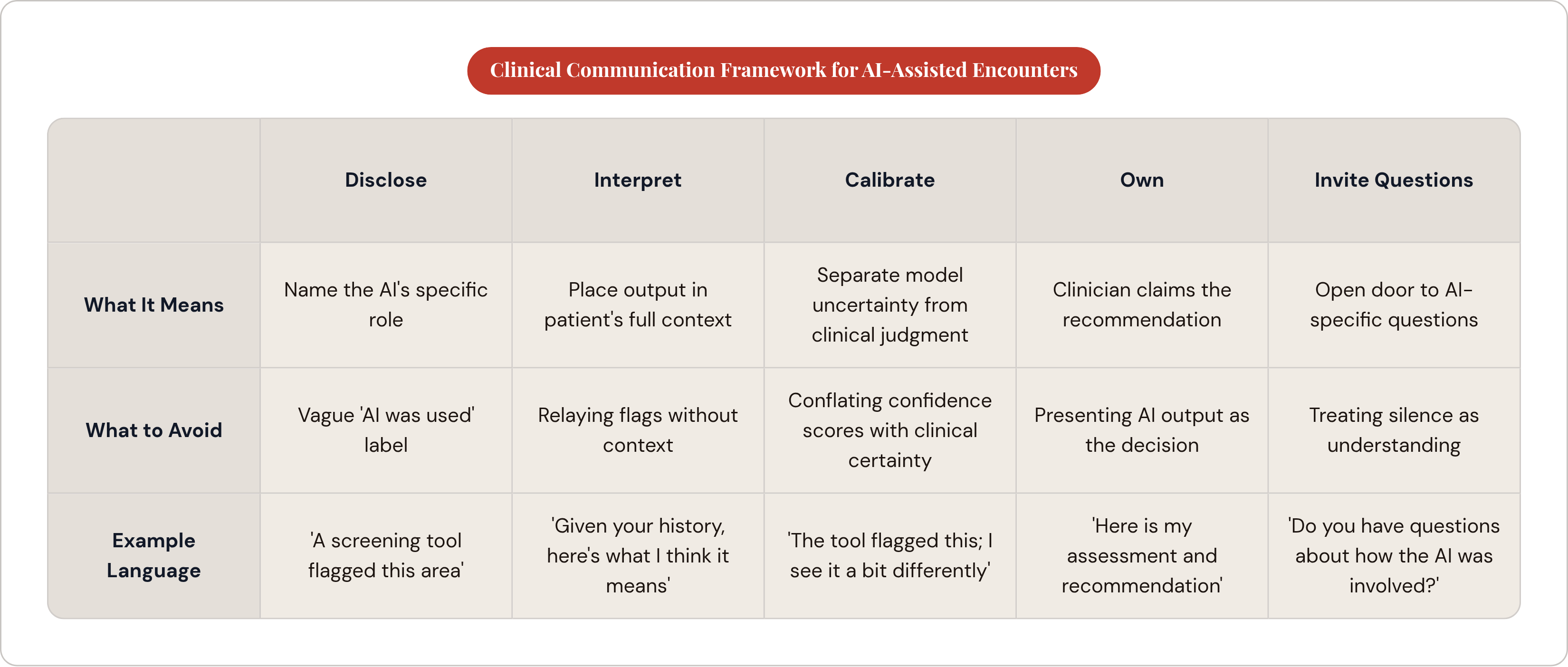
A repeatable communication framework, one that travels across specialties and AI vendors, is what turns individual good intentions into consistent, trustworthy practice. The same logic holds wherever an algorithm feeds into a finding a patient is eventually going to hear about, whether that's a cardiology risk score or a pathology slide flag.
A repeatable structure looks something like this. Disclose the AI's involvement and name its specific role: screening, flagging, scoring, not diagnosing. Interpret what that output actually means once it's placed in the context of this patient's full picture. Calibrate the uncertainty by separating what the AI itself was unsure about from what remains a clinical judgment call on your end. Own the recommendation outright, making clear the decision is yours and not the algorithm's. And open the door for questions specifically about the AI's role, rather than assuming silence means understanding.
Regulatory momentum is only going to reinforce this. As disclosure laws spread state by state, following the model Texas set with HB 149, institutions won't just need to have used AI responsibly; they'll need documentation proving the involvement was actually communicated to the patient, not just logged in a system somewhere.
The research keeps landing on the same basic point, stated different ways across different studies: patients don't require AI to be flawless. They require the clinician to be straight with them about what the tool did, what it didn't do, and who's actually steering. Get that right and the algorithm becomes one more instrument in the room, alongside the stethoscope and the history-taking and the follow-up call. Present the AI as more certain than it is, or hide it entirely, and a useful tool turns into a trust problem that has nothing to do with the technology itself.
The clinician who does this well brings something the algorithm was never built to provide: sitting with another person, in a room, and telling them honestly what all of this means for their life.