FDA Digital Therapeutics Approval Pathway Explained

FDA regulates digital therapeutics under the existing medical device framework. When software meets the statutory definition of a device, it enters that framework and gets reviewed through the same programs governing surgical instruments and diagnostic imaging equipment. No carve-out exists for digital therapeutics as a category, no specialized office processes them separately, and no amount of "digital health" branding changes that calculus.
The detail that actually matters is that the framework is risk-based. Regulatory controls scale to the potential harm a device poses to patients, so a low-risk behavioral health app and a high-risk clinical decision tool face categorically different scrutiny. Which premarket review program a developer uses is a downstream consequence of where their product lands in the risk hierarchy.
Three premarket programs apply to DTx depending on risk class and novelty: Premarket Approval, De Novo classification, and 510(k) clearance. Which one is relevant depends entirely on the product's risk classification and whether valid predicate devices already exist.
The legislative context shapes the outer boundary of all this. The 21st Century Cures Act, enacted in December 2016, codified which software functions are explicitly excluded from the device definition: administrative support, healthy lifestyle maintenance, electronic patient records, data transfer and display, and certain clinical decision support software. For software that technically meets the device definition but poses minimal risk, FDA also exercises enforcement discretion and does not require a premarket review application. A meaningful guidance update in early 2026 extended that discretion further, explicitly covering software that provides a single, clinically appropriate recommendation. That shift reflects FDA adjusting its posture in real time as AI-enabled clinical software outpaces the static regulatory frameworks built to govern it.
The practical starting point for any DTx developer is not "which pathway do we use" but "are we a device at all." Answer that question first. Everything downstream depends on it.
How the Three-Class Risk Structure Determines Which Pathway a DTx Product Enters
Class I devices carry low risk and are subject only to general controls. Very few DTx products land here. Class II devices carry moderate risk, subject to both general and special controls, and this is where the DTx field primarily operates. Approximately 90% of devices subject to FDA premarket review are classified as moderate-risk. Class III devices carry high risk, require Premarket Approval, and are reserved for products that sustain life or carry significant potential for serious injury. Class III is theoretically applicable to DTx in high-stakes clinical decision scenarios, but it remains rare in practice.
Classification is not automatic and it is not self-selected. FDA assigns it based on intended use claims and risk profile. The "DTx" or "PDT" label a company puts on its marketing materials carries zero weight in that determination.
The real-world consequence of how sponsors frame their labeling is well illustrated by the early cleared products. reSET-O was labeled solely to increase outpatient treatment retention. EndeavorRx was indicated to improve attention function rather than treat ADHD outright. These were not arbitrary marketing decisions. They were deliberate regulatory strategy, calibrated to the evidence available and the classification each sponsor was positioned to defend. That distinction, between what a product does clinically and what a sponsor claims it does in labeling, is where a lot of regulatory strategy actually lives.
De Novo Classification: The Primary Pathway for First-of-Kind DTx Products
De Novo was established by the Food and Drug Administration Modernization Act of 1997 and expanded in 2012 to allow direct application without requiring a prior 510(k) denial. It is designed for novel, low- or moderate-risk devices that have no valid predicate. If a DTx is genuinely first-of-kind in its indication, this is where it belongs.
When FDA grants a De Novo, it issues an order that includes Special Controls: binding requirements specific to that product type. Those Special Controls simultaneously become the predicate standard for future 510(k) submissions in the same category. That secondary effect is the part developers often underestimate. A successful De Novo doesn't just clear one product; it creates the regulatory infrastructure for an entire therapeutic category. The first company through pays a price in time and rigor that competitors behind them will never have to pay.
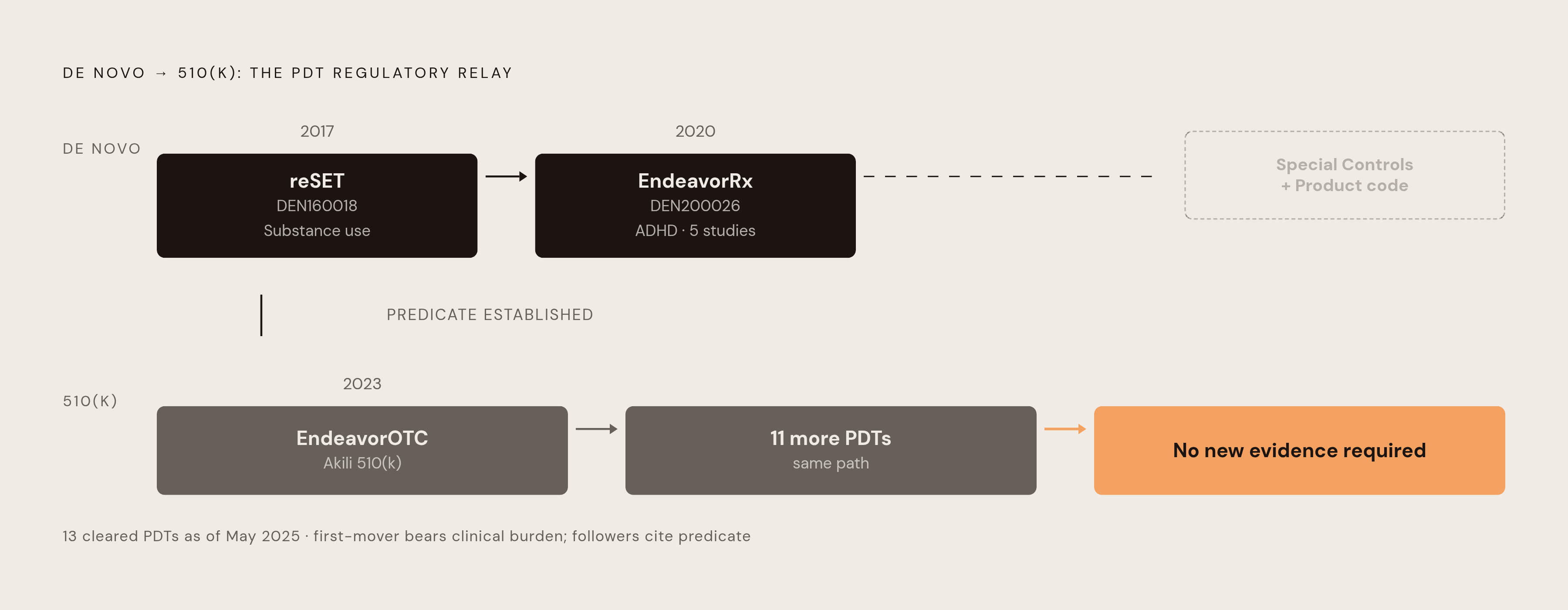
EndeavorRx illustrates this precisely. De Novo DEN200026, granted in 2020, established a specific product code and regulation for a "Digital therapy device for ADHD," supported by five clinical studies in more than 600 children. Any subsequent developer working on an ADHD-targeted DTx can now file a 510(k) against that predicate. Akili later expanded the EndeavorRx label via 510(k) in December 2023, demonstrating exactly how the De Novo-to-510(k) sequence plays out over a product's lifecycle.
reSET, cleared in 2017 via De Novo DEN160018 for substance use disorder, was the first prescription digital therapeutic ever cleared. Every cleared PDT that followed is working, at least partially, within the regulatory architecture that decision established.
510(k) Clearance: How Most PDTs Actually Reach the Market Once Predicates Exist
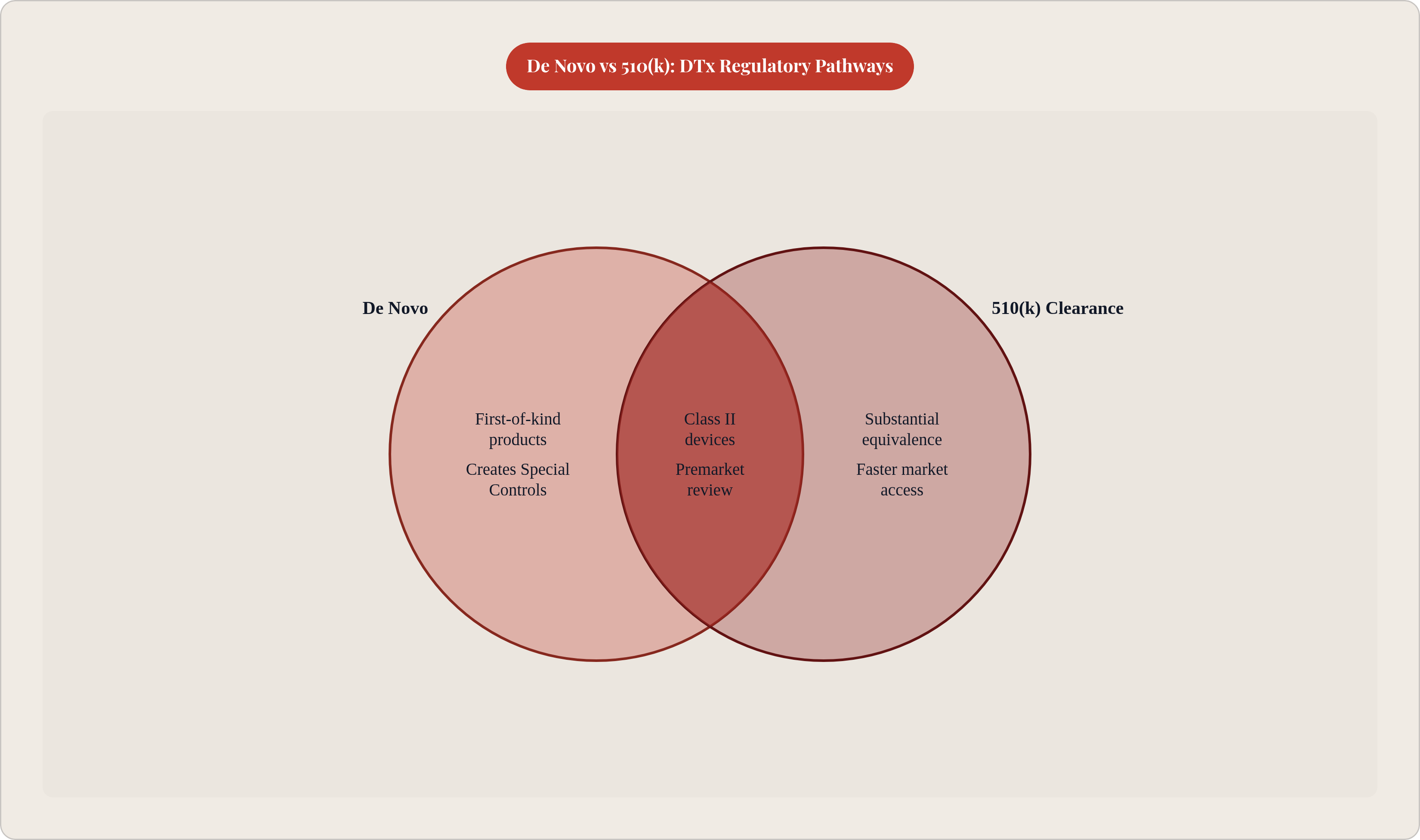
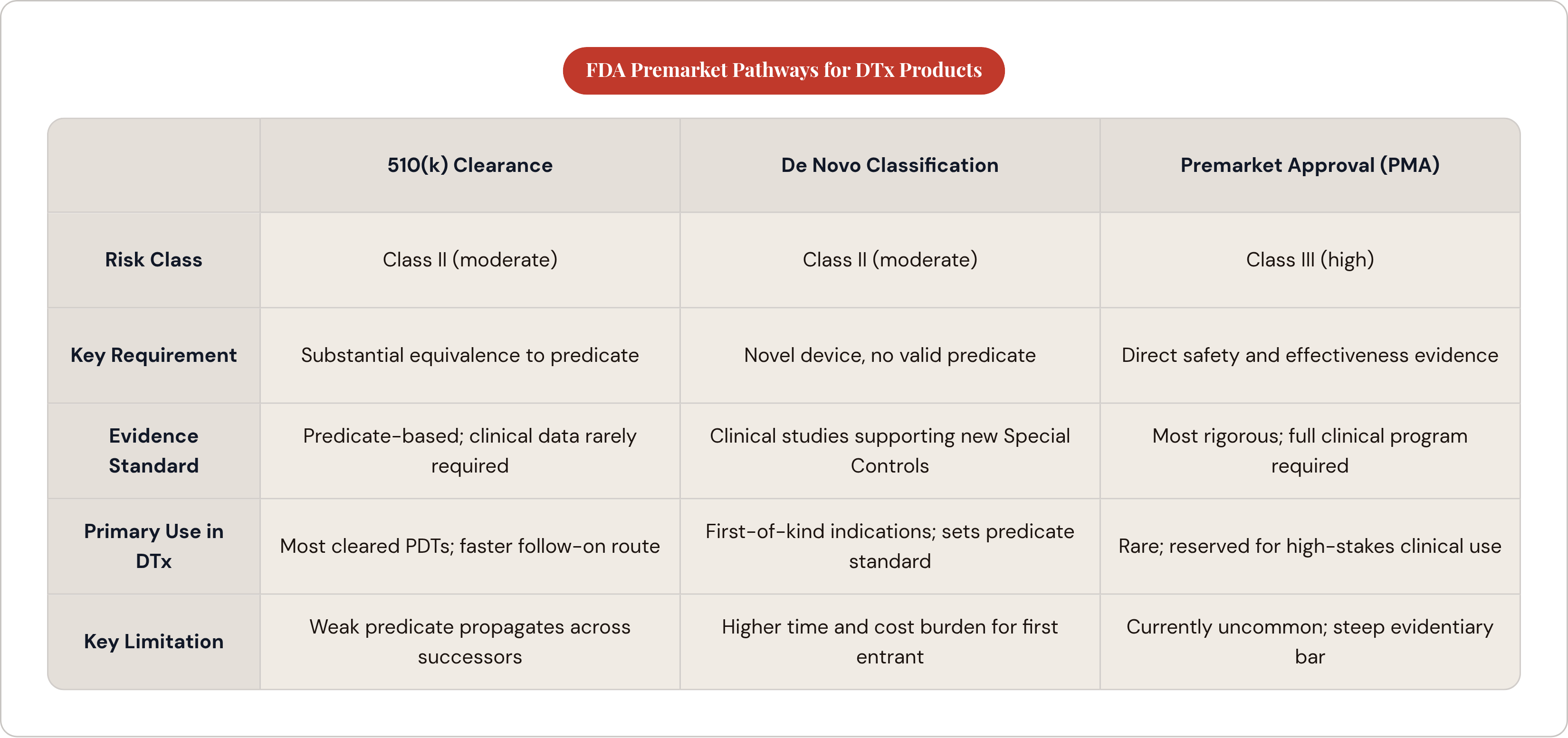
510(k) requires a showing of "substantial equivalence" to at least one previously cleared predicate device: same intended use, comparable technological characteristics. Among the 13 cleared PDTs identified as of May 2025, most reached the market through 510(k) rather than De Novo. The logic is straightforward: early De Novo decisions in a therapeutic area lower the barrier for every follow-on developer. The regulatory debt gets paid once, collectively, by whoever goes first.
That said, the model has a real vulnerability. Fewer than 10% of 510(k) devices are cleared based on direct clinical evidence submitted as part of the review. Safety and effectiveness are generally presumed from the predicate evaluation, which is faster but draws legitimate scientific critique. A weak predicate propagates across every 510(k) that inherits it, and the quality of that predicate chain is not a minor technical detail. It is the structural foundation the entire follow-on edifice rests on.
Where 510(k) breaks down: genuinely novel mechanisms of action, new therapeutic indications without predicate coverage, and risk profiles that don't map cleanly to existing cleared devices all point back to De Novo, or in rare cases to Premarket Approval. PMA is the most rigorous review, requiring direct evidence of both safety and effectiveness. It is currently uncommon for DTx, but it remains the required pathway for Class III classification and cannot be avoided if a product lands there.
What Clinical Evidence FDA Actually Requires DTx Developers to Generate
FDA evaluates evidence against the IMDRF SaMD clinical evaluation framework and the specific intended use claims of the product in question. Higher risk classification demands more rigorous evidence, and FDA's Digital Health Center of Excellence has raised expectations over time. Trials must demonstrate not only statistical significance but clinical meaningfulness: improvements in how patients feel and function, not just favorable movement on surrogate endpoints. This reflects broader FDA modernization of clinical evidence standards, but for DTx it lands with particular weight because the therapeutic mechanisms are behavioral rather than biochemical.
There is a complication DTx developers face that drug developers simply don't. Therapeutic effect depends on patient engagement with the software, and low engagement undermines efficacy outcomes in ways that pharmacotherapy trials never encounter. FDA may scrutinize engagement data as part of the clinical record. Developers who treat engagement as a product design consideration rather than a clinical variable tend to discover that problem during review, when the options for addressing it are limited.
NightWare, authorized in November 2020, illustrates how trial scale is calibrated to indication and risk. Its authorization was supported by a 30-day, sham-controlled study of 70 patients, small by conventional standards but appropriately sized for the indication and risk profile presented. Evidence thresholds are contextual, not universal.
Post-market obligations are built into approvals. Special Controls for Class II devices routinely include real-world evidence collection requirements covering therapeutic outcomes and software performance. Adverse event surveillance through FDA's MAUDE database is active and developing. The clinical program should be designed with the intended pathway and risk class in mind from the start, because retrofitting evidence to a pathway after the product is built is one of the field's most consistent and avoidable failures.
The Predetermined Change Control Plan and What It Means for DTx Products That Use Adaptive Algorithms
Traditional device regulation assumes a static product. You validate it, you clear it, it stays substantially the same. Software, particularly AI- and ML-enabled DTx, does not work that way. These products can update their algorithms post-clearance in ways that materially affect safety and efficacy, and under the traditional framework, every meaningful modification could require a new submission. That creates a structural problem for products whose entire clinical value proposition depends on adapting over time.
FDA's solution is the Predetermined Change Control Plan, the PCCP. It allows manufacturers to describe anticipated modifications and their validation approach upfront, within the original submission. Approved changes that fall within the scope of the PCCP don't require new submissions; the modification is pre-authorized, provided the developer validates it according to the agreed protocol.
For DTx that personalize treatment delivery, adapt difficulty in response to user performance, or refine recommendations based on accumulated data, the PCCP is not an optional enhancement. Without one, every meaningful algorithm update becomes a potential return trip to FDA, which defeats much of the clinical value of building an adaptive therapeutic in the first place.
The practical consequence is one that teams consistently underestimate: PCCP planning belongs in the original submission. Adding it retroactively is substantially harder, and the window for shaping the original framework closes at clearance. The 2026 clinical decision support guidance update reflects the same underlying tension. AI-enabled clinical software is evolving faster than static regulatory submissions can accommodate, and FDA is adjusting accordingly, but developers who fail to plan for adaptation upfront will find themselves perpetually out of step with their own product.
The Cleared PDT Landscape as of 2025 and What the Approval Record Reveals About How This Pathway Works in Practice
As of May 2025, 13 FDA-cleared prescription digital therapeutics have been identified in the literature. Most were cleared through 510(k). The most targeted conditions were neurological or psychiatric. All sponsors were US-based, concentrated in established digital health markets.
The labeling patterns across those 13 products are instructive. Most used qualified treatment language: "symptom improvement," "aid in management," "improve attention function." Unqualified treatment claims were the exception, and that conservatism reflects two things simultaneously: the evidence each sponsor generated and the risk classification they sought to maintain. The two are not independent variables.
The exceptions are worth naming precisely because of how rare they are. CT-132, authorized in 2025, received a straightforward preventive treatment label for episodic migraine, making it the first prescription DTx authorized with that kind of clean indication language. Rejoyn, cleared in April 2024, became the first DTx authorized to treat major depressive disorder, specifically as an adjunct to clinician-managed outpatient care for adults 22 and older. DaylightRx, cleared in September 2024, is a 90-day CBT-based application for generalized anxiety disorder. Somryst, cleared in 2020, established a nine-week CBT-for-insomnia delivery model that subsequent products have referenced as predicate.
The pattern is legible: behavioral health indications, CBT-grounded mechanisms, qualified labeling. Globally, the count expands when China, Germany, and Belgium are included, but the pace has remained modest, approximately 20 DTx approved worldwide in 2024. The regulatory path is navigable. The commercial path, once clearance is in hand, is a harder problem entirely.
Where Reimbursement Fits Into the Regulatory Picture and Why Clearance Alone Does Not Guarantee Market Access
FDA clearance is a prerequisite for market access, not a guarantee of it. Payers, health systems, and prescribers each represent a separate adoption gate, and many cleared PDTs have struggled to move meaningfully through all three.
Reimbursement for DTx remains inconsistent. Private insurers, Medicaid, and Medicare apply different coverage logic, and the administrative infrastructure for billing, specifically CPT coding and the HCPCS system, requires a billing pathway as distinct from the regulatory one. Developers need both, and the two are built on different timelines that rarely align naturally.
Medicare coverage is an active and evolving situation. A 2025 pilot testing Medicare coverage for digital therapeutics signals meaningful movement at the federal payer level, but a national coverage determination has not been established as a standard pathway for PDTs.
The regulatory evidence package and the reimbursement evidence package are not the same document, and they are not built from the same studies. Payers typically want real-world outcomes data, cost-effectiveness analysis, and adherence evidence that FDA's premarket review does not require. Developers who treat clearance as the finish line routinely arrive at payer submissions needing an entirely different evidentiary structure, built from studies that were never designed with health economics in mind.
Health economics and outcomes research planning should begin during clinical development. The timeline for building a credible payer submission runs parallel to clinical development, not after it. Starting it after clearance costs the team anywhere from one to several years of commercial runway, and some organizations have never fully recovered from it.
What the Pathway Means for Teams Building or Marketing a DTx Product Right Now
Sequencing matters more than most teams appreciate until they get it wrong. Here is the order of operations as it actually works, not as developers sometimes wish it did.
Start by determining whether your product is a device under the statutory definition. The 21st Century Cures Act carve-outs and FDA's enforcement discretion policies may remove your product from the premarket review requirement entirely. This analysis should happen before any meaningful clinical or regulatory investment is committed.
Once device status is established, identify the risk class based on intended use claims. The claims drive classification; the technology stack does not. If your intended use language implies high clinical consequence, your risk class will reflect that regardless of how the underlying software is constructed.
Check for predicate devices carefully, not casually. If a cleared De Novo in your target indication already exists, 510(k) is likely the faster route. If nothing maps cleanly to your indication and mechanism, De Novo is the primary option. This requires a thorough predicate search conducted by people who know what they're looking for, not a surface-level scan of the FDA device database.
Design the clinical program to match the pathway and risk class you've identified, before enrollment begins. Evidence requirements are calibrated to indication and intended use, not applied universally. A trial designed for the wrong risk class creates expensive gaps that surface during review, at precisely the moment when the cost of fixing them is highest.
If the product uses adaptive algorithms, build the PCCP into the original submission. Post-clearance modification planning does not get easier after clearance is granted; it gets substantially harder.
Start reimbursement strategy during clinical development. The payer evidence base takes time, requires studies that may be structurally incompatible with the FDA premarket evidence package, and cannot be assembled retroactively from data that wasn't collected with health economics in mind. Thirteen products have navigated this pathway successfully as of 2025, and the field's expansion into major depression, anxiety, and migraine in just the past two years confirms the regulatory infrastructure is mature enough to accommodate genuinely novel therapeutic claims. What those 13 clearances also confirm is that there is no shortcut through device classification, no special lane for software, and no substitute for building the right evidence package for the right pathway before the first patient is enrolled.