Strategic Healthcare Marketing Planning Frameworks
Compliance risk and tight budgets demand upfront strategic clarity, not post-campaign adjustments.

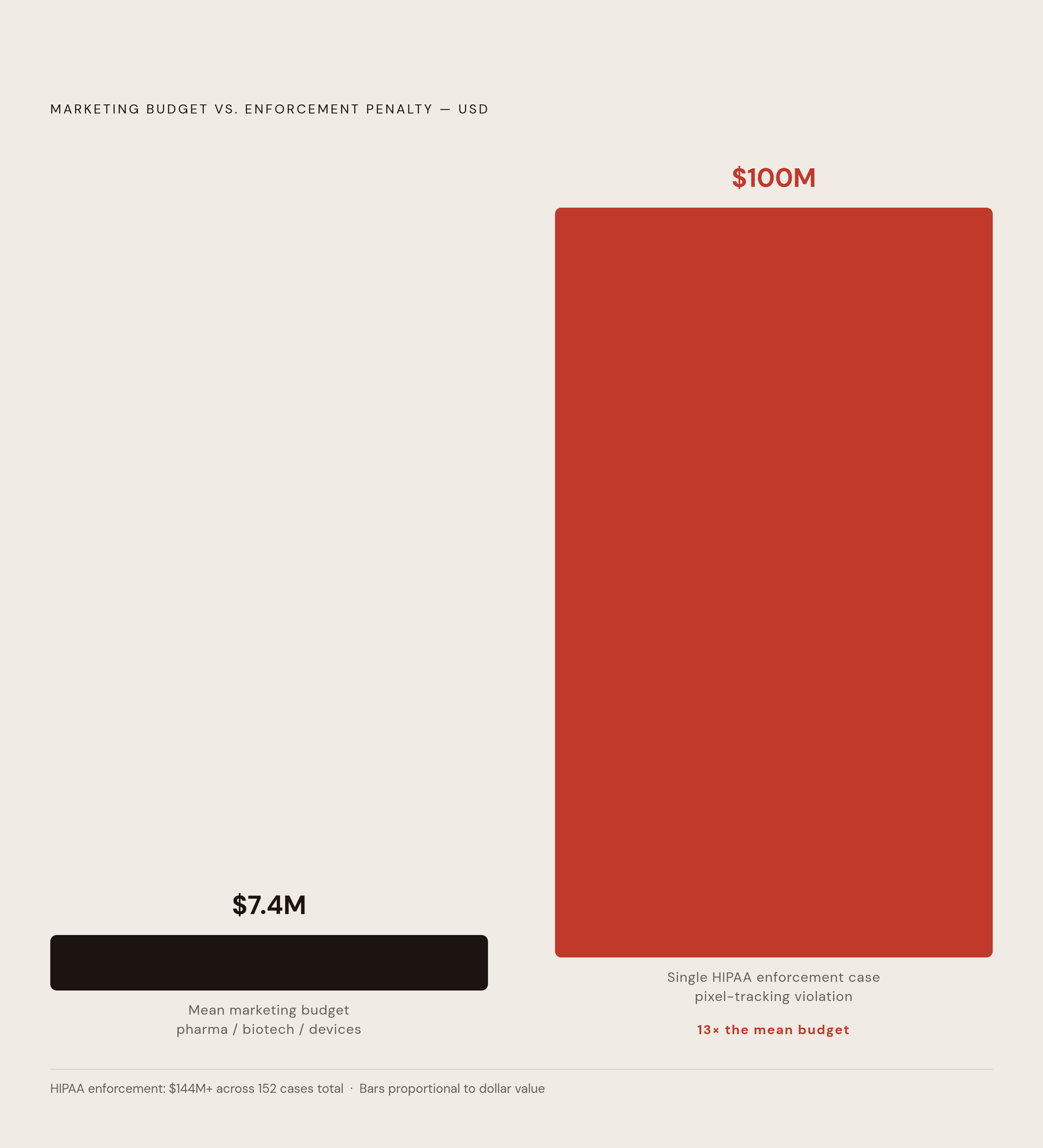
Budget constraint is not background context in healthcare marketing. It is the dominant operational reality, and it shapes every decision that follows. In the MM+M/Swoop 2025 Healthcare Marketers Trend Survey, 60.7% of pharma, biotech, and device and diagnostics respondents ranked smaller launch budgets as their top challenge. Estimated mean budgets across those three groups held roughly level at $7.4 million, with no meaningful growth projected. On the provider side, cuts to Medicare and Medicaid reimbursement are compressing margins and forcing care organizations into resource allocation decisions that carry genuinely strategic consequences, even when they feel purely financial.
What most planning processes underestimate is how compliance compounds this pressure. Over $144 million in HIPAA enforcement penalties have been issued across 152 cases, including a single case traced to pixel tracking violations that reached $100 million on its own. That is not a legal footnote. That is a planning variable with direct financial consequences that dwarfs most healthcare marketing budgets entirely.
The regulatory surface is also expanding. As of early 2025, 20 U.S. states have enacted comprehensive data privacy laws. Washington's My Health, My Data Act extends protections beyond what HIPAA requires. California is advancing reproductive health privacy rules. None of this is theoretical. The practical implication for anyone building a channel mix: decisions around paid digital advertising and behavioral retargeting carry regulatory risk that must be assessed at the strategy stage, before campaigns are built and before a dollar is committed.
Here is what actually happens in organizations that treat compliance as a post-production checklist: they discover their most efficient-looking channels are also their highest-liability ones. Third-party pixel-based tracking produces attractive cost-per-click numbers right up until it produces a breach notification — like a ticking clock that only shows you the bill when time runs out. The sequencing error is entirely avoidable. The cost of it is not.
Starting with SWOT: mapping organizational reality before choosing direction
A SWOT analysis in healthcare is not a formality you complete to satisfy a planning template. Strengths and weaknesses must account for clinical reputation, referral network depth, and service-line capacity, not just brand awareness metrics. Threats must include regulatory exposure and reimbursement risk alongside competitor activity. A SWOT that asks only marketing questions produces only marketing answers.
The output of a well-constructed SWOT feeds directly into every subsequent planning layer: market and competitive analysis, meaningful KPIs, budget allocation, channel strategy, audience segmentation. Only when sequenced correctly does each step constrain and inform the next. Skip the SWOT, and you lose the mechanism that keeps downstream decisions grounded in organizational reality.
The most common failure mode is not incompetence with the framework. It is organizations that skip it entirely and go straight to channel selection — like building a house by starting with the roof. They then discover, mid-execution, that their competitive position does not support the claims their campaigns are making. Positioning on clinical excellence without outcomes data to substantiate it is not just ineffective; it actively erodes the trust that clinical credibility is supposed to build. When budgets are tight and errors are expensive, that category of mistake does not get recovered cheaply or quickly.
Choosing a strategic archetype before allocating any budget
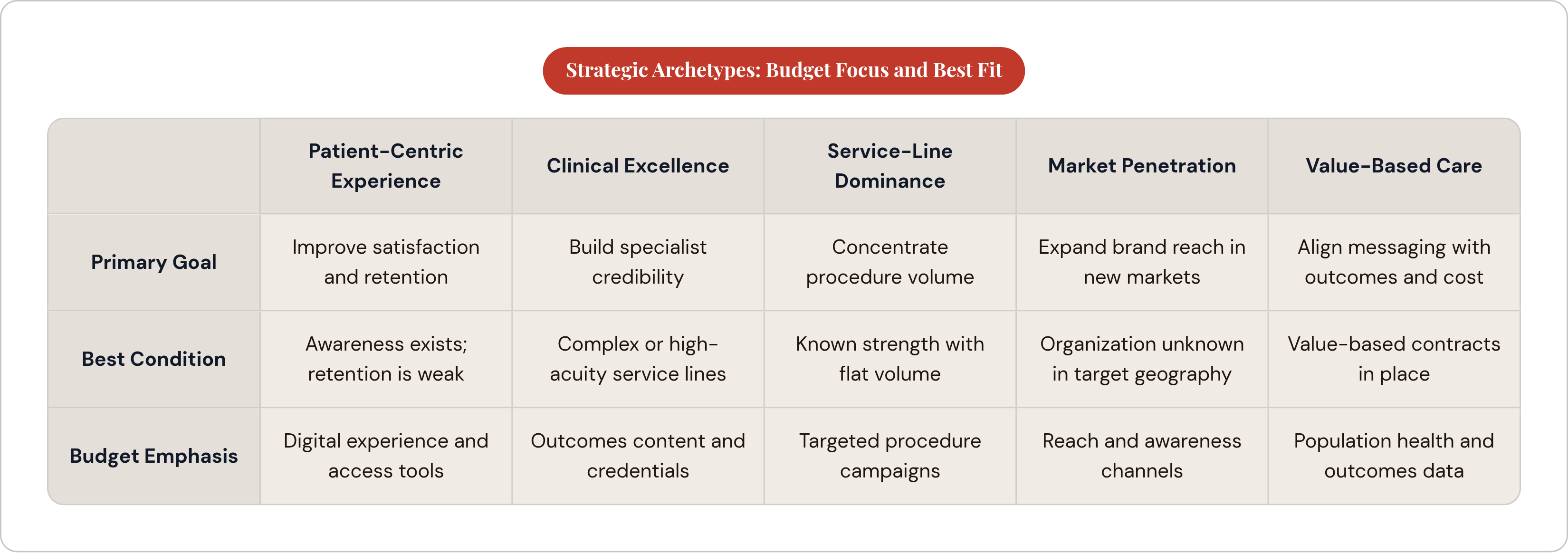
Five strategic archetypes describe the meaningful range of healthcare marketing approaches, and each one requires different budget allocations, different channel emphasis, and different measurement priorities. Getting clear on which archetype you are actually pursuing, before the budget conversation starts, is what separates an allocation logic from a wish list.
The Patient-Centric Experience archetype leads with convenience, access, and digital experience; it is most relevant where awareness already exists but satisfaction or retention is weak. Clinical Excellence Differentiation leads with outcomes, credentials, and specialist reputation, and works best for complex or high-acuity service lines where decision stakes justify detailed evaluation. Service-Line Dominance concentrates volume into specific high-revenue or strategically important procedures, a tactical intensification of a known strength rather than a broad brand play. Market Penetration front-loads spend on reach and brand awareness in geographies or segments where the organization is unknown, accepting that conversion will follow rather than lead. Value-Based Care aligns messaging with outcomes, total cost, and population health; organizations operating under value-based contracts do not get to treat this one as optional.
Most organizations operate across two or three of these archetypes simultaneously, and that is fine. The discipline is explicit prioritization. Which archetype receives 60% of budget, which receives 30%, and which receives 10% are the decisions that transform a list of goals into an allocation logic.
A decision-tree approach makes this systematic. Unknown in a target geography: Market Penetration. Awareness exists but preference is low: Clinical Excellence or Patient-Centric Experience, depending on what the SWOT identified as the gap. Known and preferred but volume is flat: Service-Line Dominance. Value-based contracts in place: Value-Based Care, layered underneath whichever of the above applies. Without the archetype choice, spending defaults to inertia: whatever worked last year, or whatever the vendor recommends based on their own capabilities.
Mapping the patient journey to assign content to the right stage
Healthcare-seeking unfolds across a multi-stage process. Symptom appraisal comes first, followed by information seeking, then care navigation and decision-making, the clinical encounter itself, post-consultation planning, treatment implementation, and long-term follow-up. Each stage carries distinct information needs. Content that answers the wrong question at the wrong moment does not just underperform; it creates friction at exactly the point the patient is closest to converting.
In the awareness stage, the patient is asking whether a symptom warrants a visit at all. Educational content, SEO-focused articles, and social media serve that question. In consideration, the question shifts to insurance coverage, access, and how this provider compares to alternatives. In the decision stage, the patient wants to know if they can get an appointment this week; frictionless scheduling and clear logistics close that gap. Retention content, follow-up programs, and community engagement serve a patient who has already converted and whose long-term value depends on an ongoing relationship.
Two segmentation variables complicate this picture and deserve serious attention. First, 84% of prospective patients use both online and offline sources to research providers. The journey map must account for offline touchpoints, physician referrals, word of mouth, and community relationships that digital content influences but that attribution tools cannot see. Second, generational behavior differences produce meaningfully different content requirements. Gen X leads with healthcare rating sites and detailed online reviews. Baby Boomers blend digital research with traditional trusted sources. Younger demographics have shifted away from linear television toward social media and search. These are not cosmetic differences. Personas built on demographic data, not just condition or specialty, produce different content briefs.
Building an omnichannel system rather than a multichannel presence
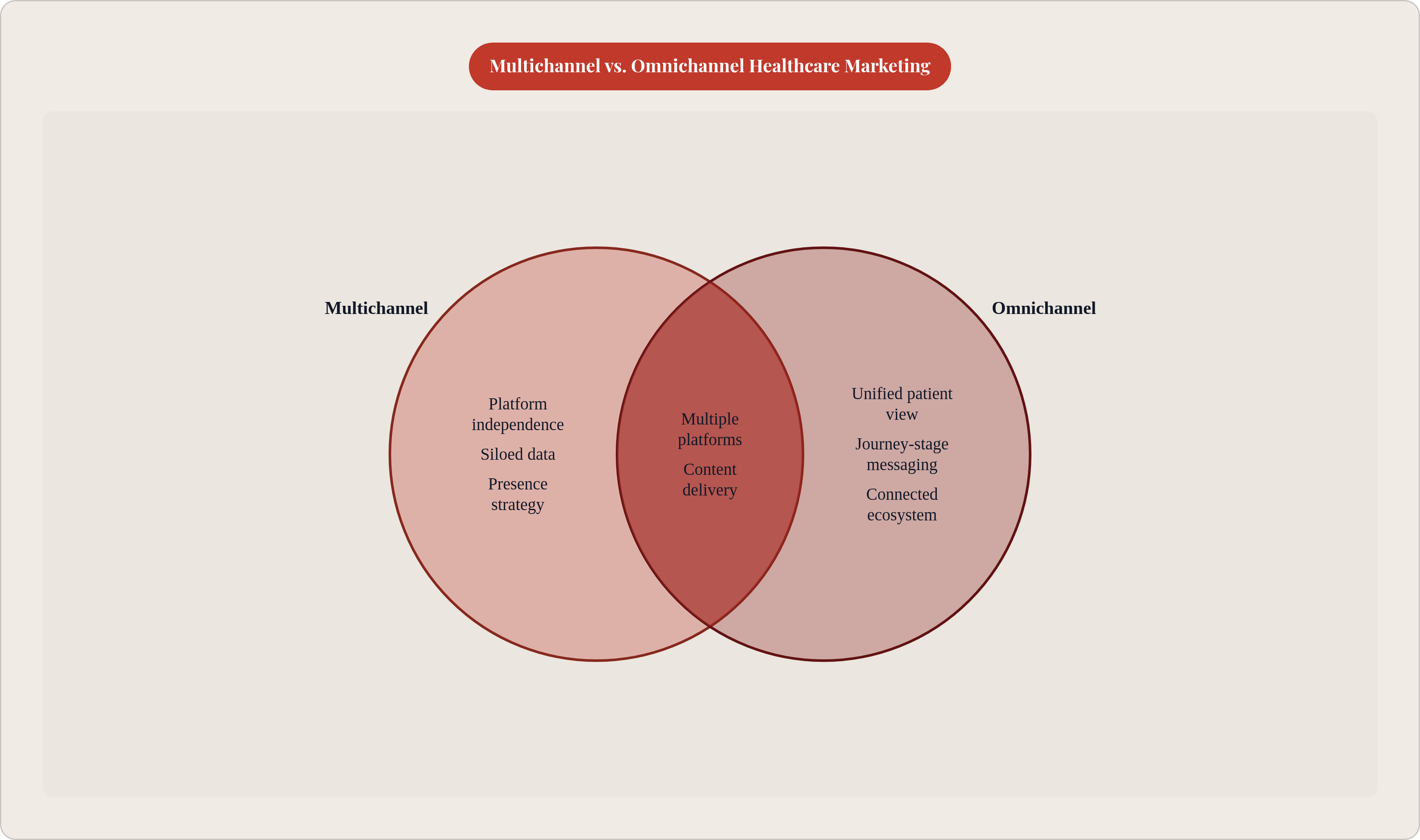
Multichannel means presence on multiple platforms operating independently of each other. Omnichannel means those platforms share data, recognize the same patient across touchpoints, and deliver messaging that advances the relationship through the journey rather than repeating the same awareness-stage message to someone who is already deciding. One is a presence strategy. The other is a system. The distinction has real budget consequences, and conflating them is a persistent and expensive mistake.
The foundational challenge is data fragmentation. CRM systems hold relationship history. Web analytics track digital behavior. Field rep notes and call center records carry qualitative context. Siloed, these sources prevent any unified view of where a patient or HCP actually is in their journey. Connected data ecosystems address this materially: organizations using them can achieve around 95% accuracy in matching HCP profiles, compared to roughly 70% accuracy using traditional methods. That gap compounds across every dollar of campaign spend.
Four pillars are generally required for omnichannel execution: (i) strategy that includes genuine customer understanding and persona architecture; (ii) content that is stage-aligned and channel-adapted; (iii) technology that includes a compliant CRM, marketing automation, and analytics; and (iv) the execution capability to operate all three coherently. Technology deployed without the first two pillars does not produce alignment. It produces sophisticated misalignment at higher cost. I have watched organizations invest in enterprise martech stacks and come out the other side with faster, more expensive versions of the same disconnected messaging they started with — like buying a faster car to sit in the same traffic.
On the HCP engagement side, the channel mix is shifting and must be treated as a live planning variable. In the MM+M/Swoop 2025 survey, more than three quarters of respondents planned to increase social media use for HCP engagement, and nearly two thirds saw AI-facilitated personalized clinician interactions as an emerging opportunity. The HCP audience is not a static segment, and treating it like one is how organizations find themselves optimizing for a behavior pattern that no longer exists.
The compliance layer cannot be retrofitted onto omnichannel infrastructure after the fact. HIPAA-compliant CRM platforms, business associate agreements covering every vendor in the stack, consent flows embedded at data collection points, and analytics tools configured to avoid passing protected health information to third parties: these are architectural decisions made early, not corrective measures applied later.
Treating compliance as a channel filter, not a legal review at the end
The channel decisions that most healthcare marketers treat as purely tactical are also the ones carrying the highest regulatory exposure in 2025. Pixel-based retargeting, behavioral ad targeting, and third-party data matching are not simply performance channels. They are surfaces where HIPAA, FTC guidance, and state privacy law intersect in ways that are actively being enforced.
Per IBM's X-Force 2025 Threat Intelligence Index, more than 70% of healthcare breaches are linked to internal activity, either intentional misuse or unintentional error. That means martech stack configuration and vendor oversight are responsibilities that marketing co-owns alongside IT. You cannot delegate this category of risk and expect the accountability to go with it. That is not a legal nuance; it is an organizational reality that enforcement actions have demonstrated repeatedly.
With traditional third-party tracking tools under sustained regulatory scrutiny, first-party data collected with explicit consent and housed in HIPAA-compliant infrastructure is the only foundation that holds up over time. It is harder to build. It is slower to scale. But it does not expose you to a nine-figure enforcement action, which strikes most reasonable people as a worthwhile trade.
There is also a trust argument that practitioners sometimes miss. Clear consent flows, visible data safeguards, and transparent targeting practices signal credibility to patients before the first clinical interaction occurs. Transparency at the data layer reinforces the same trust positioning that clinical excellence messaging builds at the content layer. They are not separate initiatives. They are the same message delivered at different touchpoints, and they either reinforce each other or contradict each other.
The practical implication: every channel in the media mix should pass a compliance filter before budget is assigned. Not during campaign review. Not after launch.
Allocating the digital channel mix once strategy and compliance constraints are known
In 2025, nearly three quarters of total media ad spending in the healthcare and pharma industry flows to digital channels. That aggregate figure is not an allocation guide. The distribution across digital channels reflects different strategic purposes, and blending them without reference to archetype and journey stage produces a mix that mirrors competitors or vendor defaults rather than organizational strategy.
Among U.S. healthcare companies, paid digital advertising receives the largest budget share, followed by social media, then paid traditional advertising. These ratios are a useful starting point. The archetype and journey stage frameworks exist precisely to modulate them based on your actual situation.
Search deserves particular emphasis because of where patients actually begin. Nearly two thirds of patients search online before contacting a provider, and roughly four in five U.S. adults go online when they have a health symptom or question. SEO and paid search serve the awareness and consideration stages simultaneously, which means they align directly with the journey architecture without requiring translation. They are not one channel among equals; they are usually the foundation.
Phone conversion is a persistent reality that digital reporting systematically undervalues. Nearly 40% of conversions in the healthcare industry happen over the phone. Without call tracking, digital channel performance gets overstated in ways that corrupt every budget allocation decision that follows. This is not a minor rounding error. It is a systematic bias in the data that most organizations have not corrected.
Online scheduling deserves equal seriousness. Patients who schedule online consume more services in subsequent months, and the scheduling experience itself influences whether a first visit becomes a long-term relationship. Investment in frictionless digital scheduling is conversion infrastructure, not a user experience amenity.
Email remains one of the highest-performing retention channels in healthcare, with an average open rate of 41% and a conversion rate of 2.6% in 2025. It aligns naturally with the retention stage of the journey map and compounds in value as the relationship extends. Channel mix decisions made before archetype and journey stage are established default to imitation; the planning sequence exists so that when the allocation conversation happens, every choice is defensible on strategic grounds.
Measuring outcomes rather than activity, and building the infrastructure that makes it possible
Healthcare marketing's attribution problem is structural, and it will not be solved by switching analytics platforms. Somewhere between 40% and 60% of healthcare conversions happen by phone rather than web form. Physician referrals absorb attribution credit for conversions that marketing content influenced earlier in the journey. Organizations that measure only digital form submissions are operating with a systematically incomplete view, and their optimization decisions will consistently be wrong in the same direction: underinvesting in channels that influence offline conversion and overinvesting in channels that capture credit for it.
The KPI framework that corresponds to a strategy-first approach separates three layers. Revenue and growth metrics, tracked monthly or quarterly, include patient-attributed revenue, patient lifetime value by acquisition channel, cost per acquisition, return on ad spend, market share by service line, and net promoter score. These prove ROI but lag by 30 to 90 days. Governance metrics, also tracked monthly or quarterly, include HIPAA audit findings, PHI exposure incidents, consent opt-out rates by channel, and marketing attribution data accuracy scores; these catch operational and regulatory failures before they become crises. Benchmark ratios for the relationship between lifetime value and customer acquisition cost should exceed 3:1 for primary care, 5:1 for specialty care, and 10:1 or higher for complex high-value procedures. These ratios translate the archetype choice into a financial test.
AI is entering the measurement layer and will continue to do so. A substantial majority of surveyed providers plan to use AI for lead generation and qualification. A similar proportion of respondents in the MM+M/Swoop 2025 survey see advanced analytics as an opportunity for personalized HCP interactions. Predictive analytics and AI-assisted content optimization are becoming standard capabilities for organizations that have built the data infrastructure to support them. Which is itself an argument for investing in that infrastructure now rather than trying to retrofit it when the competitive pressure becomes undeniable.
The organizations treating marketing as a revenue function, measuring patient-attributed revenue, lifetime value by channel, and actual incrementality, are building durable competitive advantages over those still reporting impressions and social followers. The measurement framework is the accountability mechanism for the entire planning sequence. Without it, every framework described above is an intention. With it, you have a closed loop.