Marketing Cleared Digital Therapeutics to Health Systems

Selling a cleared digital therapeutic to a health system is not a software sale. It is closer to a medical device acquisition, and the marketers who treat it otherwise spend months in the wrong conversations with the wrong people, presenting the wrong evidence, wondering why deals stall. The companies that are moving product right now understand one foundational thing: every message, every channel, every proof point has to be calibrated to a procurement process that runs on clinical evidence, reimbursement clarity, and workflow fit. Get those three things right, and your sale becomes a process. Get them wrong, and FDA clearance alone will not save you.
What FDA Clearance Actually Signals to a Health System Buyer
FDA clearance is table stakes. The moment you lead with it as a differentiator, you have already lost the room with any buyer who knows the space.
As of now, the FDA has cleared 192 digital therapeutic products, primarily through the De Novo and 510(k) pathways. The lineage starts with Pear Therapeutics' reSET in 2017, which established the device code framework that all subsequent cleared DTx inherit. Health system buyers with device procurement experience recognize this framework immediately. They know what it requires, and they know what it does not require.
That distinction matters enormously for your marketing. Recent clearances show the evidence bar rising: the FDA has increasingly demanded superiority over a sham comparator, not just an active control. More than half of DTx clinical trials have focused on disease management, with a substantial portion on treatment outcomes. The clearance pathway itself communicates something about the rigor of the underlying evidence, and buyers who live in device procurement read it that way.
The cleared products worth knowing right now tell the story of where the market is concentrating. Rejoyn received clearance in April 2024 as the first cleared DTx for major depressive disorder, positioned as an adjunct to outpatient clinician care. MamaLift Plus followed the same month, the first cleared DTx for postpartum depression, using a multimodal CBT and DBT approach. DaylightRx cleared in September 2024 for generalized anxiety disorder as a 90-day CBT intervention. SleepioRx followed in fall 2024 for insomnia. CT-132, from Click Therapeutics, cleared in April 2025 as the first cleared DTx for preventive migraine treatment. Mental health and neurology are where the cleared product pipeline is densest, and the institutional conversation is most active.
What clearance does not resolve is equally important to understand. It leaves open three questions that dominate every procurement conversation after clinical validity has been established: (i) reimbursement, (ii) workflow fit, and (iii) patient engagement. These are the questions your marketing must be built to answer.
The practical implication: do not lead with the clearance badge. Lead with what the clearance pathway required. Name the comparator. Name the patient population. Name the adjunct-to-care positioning. Buyers who evaluate devices will cross-reference your claims against the authorization, and if your marketing asserts something the clearance does not actually establish, you will lose the clinical champion before the deal ever reaches a committee.
The Reimbursement Picture as of 2025 and What It Means for Your Pitch
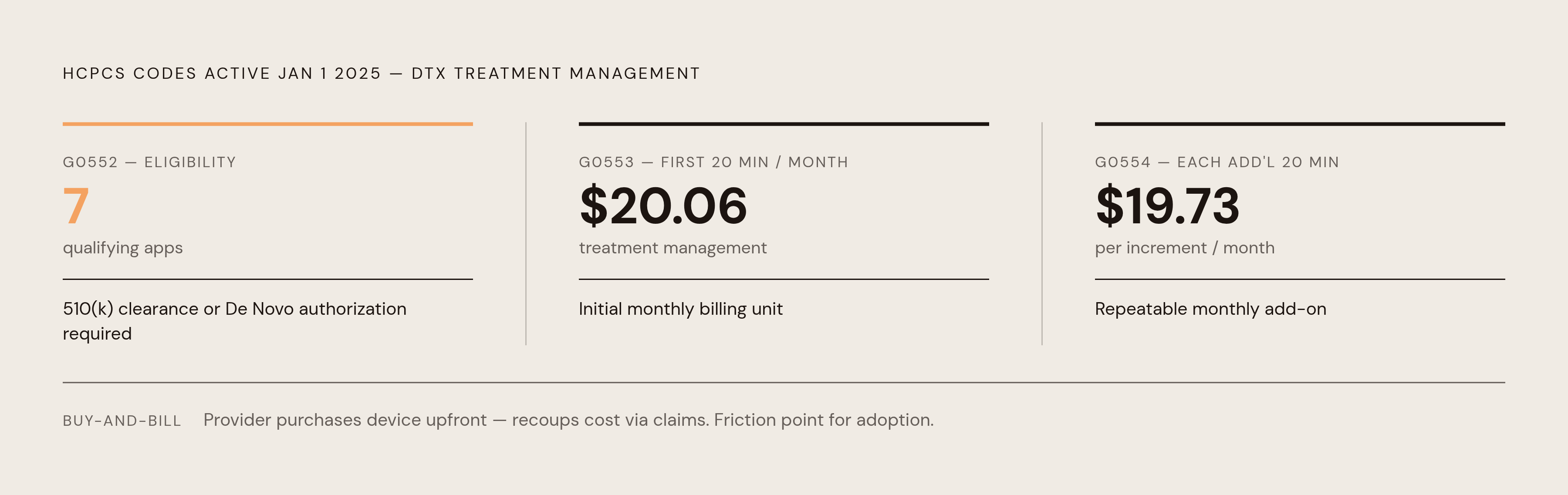
January 1, 2025 is a real inflection point. Medicare began reimbursing digital mental health treatments under new HCPCS codes G0552 through G0554, and the mechanics of those codes need to be part of every sales conversation you are having with health systems right now.
G0552 is only payable for devices cleared through a 510(k) or granted De Novo authorization. FDA clearance is a billing prerequisite, not just a quality signal. If your product qualifies, that is a concrete competitive argument, not an abstract credential. As of early 2025, only seven apps qualify for these HCPCS codes. Seven. That is a short enough list to name explicitly in a conversation.
The rate structure matters for your ROI model. G0553 reimburses at approximately $20.06 for the first 20 minutes of treatment management per month. G0554 reimburses at approximately $19.73 for each additional 20-minute increment. These are not large numbers in isolation, but they represent a durable recurring revenue stream at the practice and system level, and they build the actuarial foundation for a credible cost-per-outcome model.
The buy-and-bill friction is real, and CMS has acknowledged it. Providers must purchase the device upfront and seek reimbursement through claims afterward. This is atypical for mental health practitioners accustomed to pharmacy-fronted costs, and claims volume has remained low even though the codes are live. This is an administrative workflow problem, not a demand problem. That distinction is critical for how you position your go-to-market.
Commercial coverage is accelerating alongside Medicare. Cigna announced DTx coverage in September 2025. Over 300 billing codes now support digital health tools broadly, including more than 100 for software-based technologies specifically, according to IQVIA's 2025 analysis. The coverage landscape has structurally improved, and marketers can legitimately present multiple reimbursement tracks rather than betting everything on one payer channel.
Looking forward, CMS's proposed rule would extend G0552 through G0554 eligibility to ADHD devices, signaling directional intent that you can use in strategic planning conversations with health system administrators. The pending Access to Prescription Digital Therapeutics Act would create a dedicated Medicare benefit category. That bill has not passed. Position it as a tailwind, not a guarantee, because health system buyers will know the difference.
Your marketing must do billing education, not just clinical education. If a health system's finance and billing teams do not understand the administrative workflow, they will not commit to adoption regardless of how compelling the clinical evidence is.
Mapping the Stakeholder Buying Committee and What Each Role Needs to Hear
A 2025 peer-reviewed article in Telemedicine Reports, co-authored by executives from Jefferson Health and Mass General Brigham, identified five criteria health systems often apply when evaluating DTx: (i) whether the proposal is solicited or unsolicited, (ii) payment model compatibility, (iii) EHR integration and workflow fit, (iv) patient and provider engagement rates, and (v) demonstrated ROI. Each criterion maps to a different buyer. That mapping is where your messaging architecture has to start.
The clinical champion, typically a psychiatrist, neurologist, or primary care lead, is the person who initiates the internal conversation. They need peer-reviewed evidence, a clear mechanism of action, and patient population specificity. They rarely approve the contract. What they do is create or kill the internal political will to engage. Your strongest scientific communication belongs in their hands first.
The CMO or VP of Medical Affairs needs clinical outcome data, a clear liability and safety profile, and confirmation that the product fits within existing care protocols. They are evaluating institutional risk as much as clinical efficacy. They are not impressed by market size projections. They want to know what happens when something goes wrong with a patient using your product.
The CFO or VP of Finance needs a credible ROI model built on actual reimbursement codes with realistic claims volume assumptions. If you have reduced readmissions data, that belongs here. The model needs to reflect the buy-and-bill mechanics honestly, not optimistically. Finance buyers have seen enough vendor projections to smell an inflated assumption from across a conference table.
The CIO or Health IT lead needs EHR integration specifications, FHIR compatibility documentation, data security posture, and a realistic implementation timeline. They have been burned by integration failures before, and their skepticism is earned. The integration conversation is not a technical checkbox; it is a trust-building exercise.
Where relevant, the pharmacy or formulary committee needs clarity on the prescribing workflow, patient dispensing logistics, and buy-and-bill mechanics at the transactional level. These buyers are operationally minded. They want to understand the process, not the vision.
The unsolicited versus solicited distinction from the Jefferson/Mass General Brigham article deserves more emphasis than it typically gets. An unsolicited pitch faces a fundamentally higher skepticism threshold. You need a clinical champion who is already internally credible before any formal process begins, because without one, you are asking a procurement committee to spend political capital on something nobody asked for. The entry strategy matters as much as the message.
Building the Proof-Point Hierarchy: What Evidence to Lead With and When
A Fierce Healthcare survey found that 97% of digital health leaders say ROI models are important in the sales process. Among the substantial majority of companies that have a model, more than half say their own models need improvement. The gap between having a model and having a credible model is precisely where deals stall.
The evidence hierarchy the same survey data supports is somewhat counterintuitive for companies that have invested heavily in clinical trials. Outcomes from prominent customer deployments ranked as the most important evidence type, cited by the majority of respondents. Customer testimonials ranked second. Peer-reviewed publications were required by roughly a third of respondents overall, though that figure rose considerably for publicly traded health systems compared to smaller buyers.
The practical implication: real-world outcomes from named, recognizable health systems carry more sales weight than clinical trial abstracts for most buyers. But the trial data is what earns the clinical champion's initial credibility and gets you the internal sponsor you need to reach the committee at all. Neither can substitute for the other.
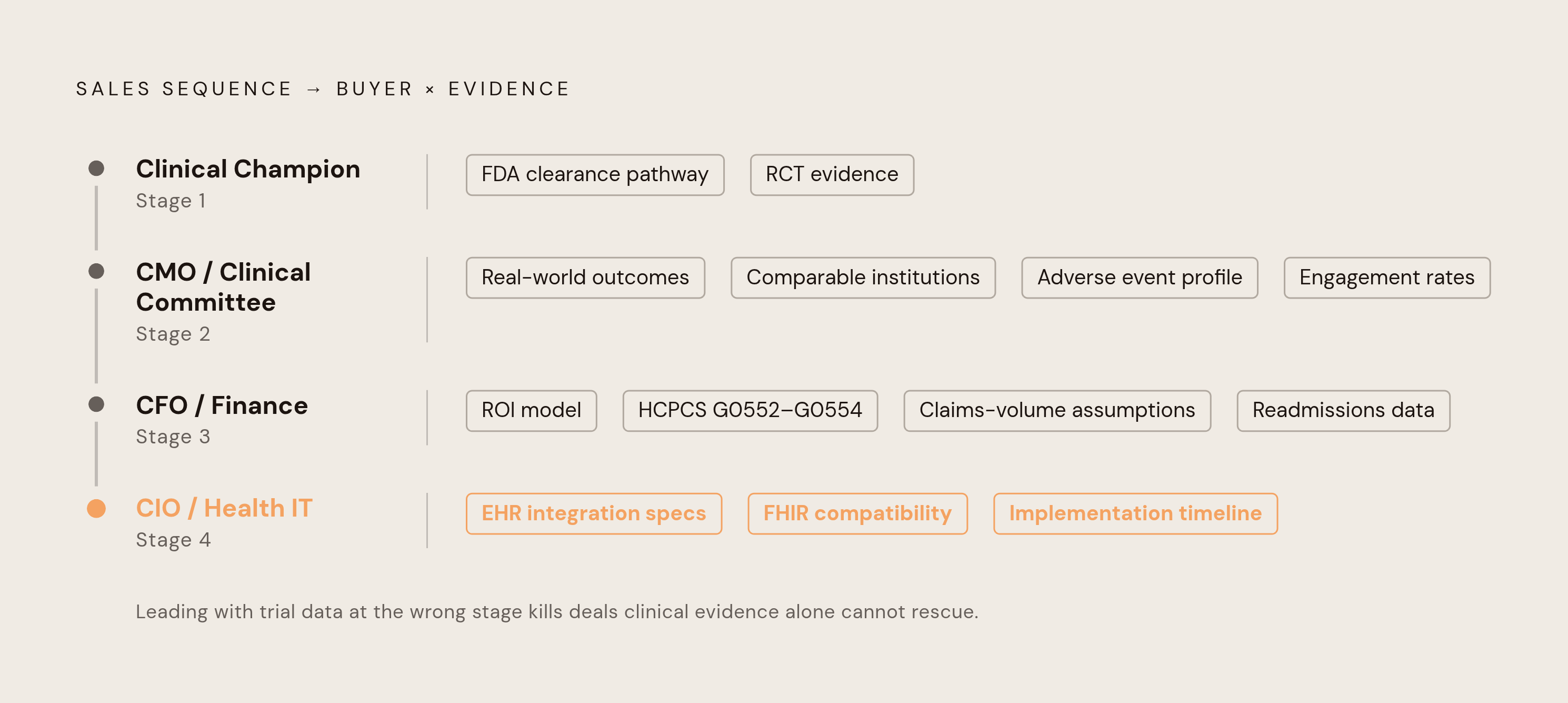
The sequencing model that follows from this evidence is straightforward once you map it to the stakeholder journey. With the clinical champion, lead with the FDA clearance pathway and RCT evidence. Establish that your product meets the same evidentiary standard as a cleared device, because that is the reference frame they will use. When you move to the CMO and clinical committee, transition to real-world outcomes data from comparable institutions, engagement rates, and the adverse event profile. When you reach the CFO, present the ROI model built on actual reimbursement codes with honest claims volume assumptions. When you reach the CIO, the conversation becomes integration architecture and timeline.
One condition-specific note: the diabetes therapeutic segment held the largest application revenue share as of 2024, and the clinical outcomes data for diabetes DTx is the most developed and most credible in the field. If you are marketing in another condition category, the evidentiary burden is higher by comparison, not lower. You will need to work harder to build comparable proof points, and that effort needs to start before the first sales conversation, not during it.
What to avoid completely: leading with market size projections or growth rates in buyer conversations. These are investor metrics. They signal that you are selling a trend rather than solving a clinical or operational problem. Health system procurement committees are not allocating budget to participate in a market. They are solving for patient outcomes, operational efficiency, and institutional risk.
EHR Integration as a Marketing Argument, Not Just a Technical Requirement
IQVIA's 2025 analysis is unambiguous: EHR integration is now critical for digital health adoption. Providers expect interoperability, seamless workflow fit, and compatibility with existing care pathways. This is not a preference. It is a procurement filter.
FHIR-compatible, cloud-native architecture has meaningfully reduced integration timelines. Systems like Mayo Clinic and NHS England have been able to move pilots to enterprise rollouts within a single budget cycle. That is a concrete operational promise, and it belongs in the headline of your value proposition for health system audiences.
Ask yourself the prescribing workflow question plainly: can a physician prescribe your DTx through the EHR portal the way they prescribe anything else? Does patient data auto-populate into the chart? If the answer to both is yes, that is a marketing headline, not a technical specification buried three pages into a product brief. Health system buyers who have managed failed integrations will ask this question before they ask about outcomes. Meet them there first.
The buy-and-bill workflow for the HCPCS codes is itself an integration problem that your marketing materials need to solve explicitly. Show exactly where in the clinical workflow the billing practitioner initiates the claim. Diagram-level specificity is appropriate here and will be appreciated by the operational buyers who have to implement what the clinical and financial teams approve.
Of the commercially available software-based digital therapies tracked by IQVIA, a meaningful portion are designed for use within clinical settings or digital care rather than purely for at-home patient use. The channel split matters for integration architecture and should be explicit in any health system pitch. A product designed for clinical deployment has a different workflow integration requirement than one designed for patient self-management, and conflating the two creates confusion at the operational level that can kill a deal that was otherwise progressing.
Channel Strategy for Reaching Health System Decision-Makers
Health system buyers do not discover new clinical tools through the channels that work for SaaS. Content marketing, SEO, and social advertising have limited reach inside procurement committees.
Clinical champions search PubMed before they answer a sales email. Peer-reviewed publications and conference presentations at major specialty meetings, whether in psychiatry, cardiology, endocrinology, or another relevant discipline, are how these buyers encounter new clinical tools in the first place. A KOL partnership with a named physician at a recognizable institution who has deployed your product and can speak to outcomes is a more credible channel than any content you produce yourself. CME-accredited content is another legitimate channel because it positions your company as an educational resource rather than a vendor, and clinical champions respond to that distinction.
For administrative and finance buyers, the channels are different. Health system CFO and CIO publications reach the buyers who approve budget, and ROI frameworks placed there are encountered in a context where buyers are already thinking about operational improvement. Formulary and pharmacy network relationships are a distribution and credibility channel that many DTx companies underutilize. Express Scripts' Digital Health Formulary initially listed a small number of solutions across several chronic conditions. Placement in a formulary is itself a form of third-party validation that carries operational weight.
Value-based care and ACO networks deserve particular attention. Buyers in risk-bearing arrangements are structurally more motivated by cost-per-outcome models, and they are more receptive to proactive outreach because the financial incentive to adopt is more direct. The commercial conversation with a CFO who is operating under a risk contract is substantively different from the same conversation with a fee-for-service system, and your channel strategy should treat them differently.
Warm introductions through existing health system vendor relationships, including EHR vendors and group purchasing organization partnerships, convert an unsolicited pitch into a semi-solicited one. That shift dramatically lowers the entry barrier. An EHR vendor who already has a trusted relationship with a health system CIO carries credibility you cannot manufacture from the outside.
Pilot programs are themselves a marketing channel and are underutilized as such. A structured, time-limited pilot with defined outcome metrics and a pre-agreed pathway to enterprise evaluation converts an unsolicited pitch into a funded proof-of-concept. More importantly, it generates the real-world outcomes data from a named institution that the next health system you approach needs to see before they will seriously engage.
Digital content has a role, but it is a supporting role in a process that is already underway. Condition-specific landing pages optimized for clinician search terms, clinical evidence summaries formatted like device instructions for use, and billing guides for the HCPCS codes all serve buyers who are already evaluating your product. They are not top-of-funnel acquisition tools. Calibrate your content investment accordingly.
Positioning Against the Reimbursement Friction That Is Slowing Health System Adoption
The core friction is structural and specific: G0552 through G0554 require providers to purchase the device upfront and recoup costs through claims, a workflow that is uncommon for mental health practitioners and that adds administrative burden health systems are not currently organized to absorb. CMS acknowledges claims volume has remained low despite the codes being active. The demand is real. The adoption problem is operational, not motivational, and a marketer who understands that distinction has a concrete go-to-market advantage.
Addressing this friction is not a customer success function. It is a marketing and sales function. The vendors who shorten the time from prescription to first clean claim will win the relationship, because they will have demonstrated operational value that the clinical evidence cannot demonstrate on its own.
Practically, this means three things: (i) providing a billing operations playbook, a step-by-step claims submission guide specific to each HCPCS code, tailored to the health system's EHR billing module; (ii) offering a revenue-neutral pilot structure, absorbing the upfront device cost during the pilot period so health systems can experience the clinical workflow without financial risk before committing to buy-and-bill at scale; and (iii) training billing staff directly rather than leaving that work to the health system, because most DTx vendors do not do this, and the ones who do can compress the adoption timeline in a way that is visible and attributable.
Commercial payer coverage, accelerating in 2025, gives you a second reimbursement track to present. For health systems with predominantly commercially insured patient populations, a Medicare-only reimbursement story is incomplete. Framing both tracks together, with clear documentation of which patient segments are covered under which codes, gives finance buyers a more complete model to evaluate and reduces the perceived adoption risk.
The broader point is this: the reimbursement friction that is slowing adoption is solvable by the DTx company, not just by CMS or the health system. The vendors who position themselves as operational partners rather than product vendors, who show up with billing guides and training resources and revenue-neutral pilots rather than clinical decks alone, are the ones who will hold the early positions in the 15 percent of hospitals that have already adopted and in the far larger base of systems that are actively evaluating but have not yet committed. That window is open now. It will not stay open indefinitely.