Health and Wellness Brand Marketing Strategies

Here is the core tension worth understanding before anything else: McKinsey's May 2025 survey found 84% of US consumers call wellness a top or important priority, while NielsenIQ's Global State of Health and Wellness 2025 found that 62% of those same consumers are skeptical of health claims made by food companies, and 82% want more transparency in product labels. High intent, low credulity. That is not a paradox; it is the operating condition, and brands that treat it as a messaging problem to be solved with better copy will spend a lot of money learning otherwise.
The skepticism is structural. Buyers have been oversold for a decade, and they remember. What they need now is evidence, specificity, and genuine resonance with how they actually think about their own health. It is a bit like a gym membership in January: everyone is motivated, nobody trusts the scale. Generic campaigns fail not because the creative is weak but because the strategic premise is wrong from the start.
Economic pressure has sharpened the divide further. Under sustained cost-of-living strain, buyers have sorted into two modes: purchasing on price at volume, or investing deliberately in premium brands they have already decided to trust. The brands caught between those poles, neither clearly affordable nor clearly differentiated, are getting compressed from both directions. The middle is not a defensible position right now.
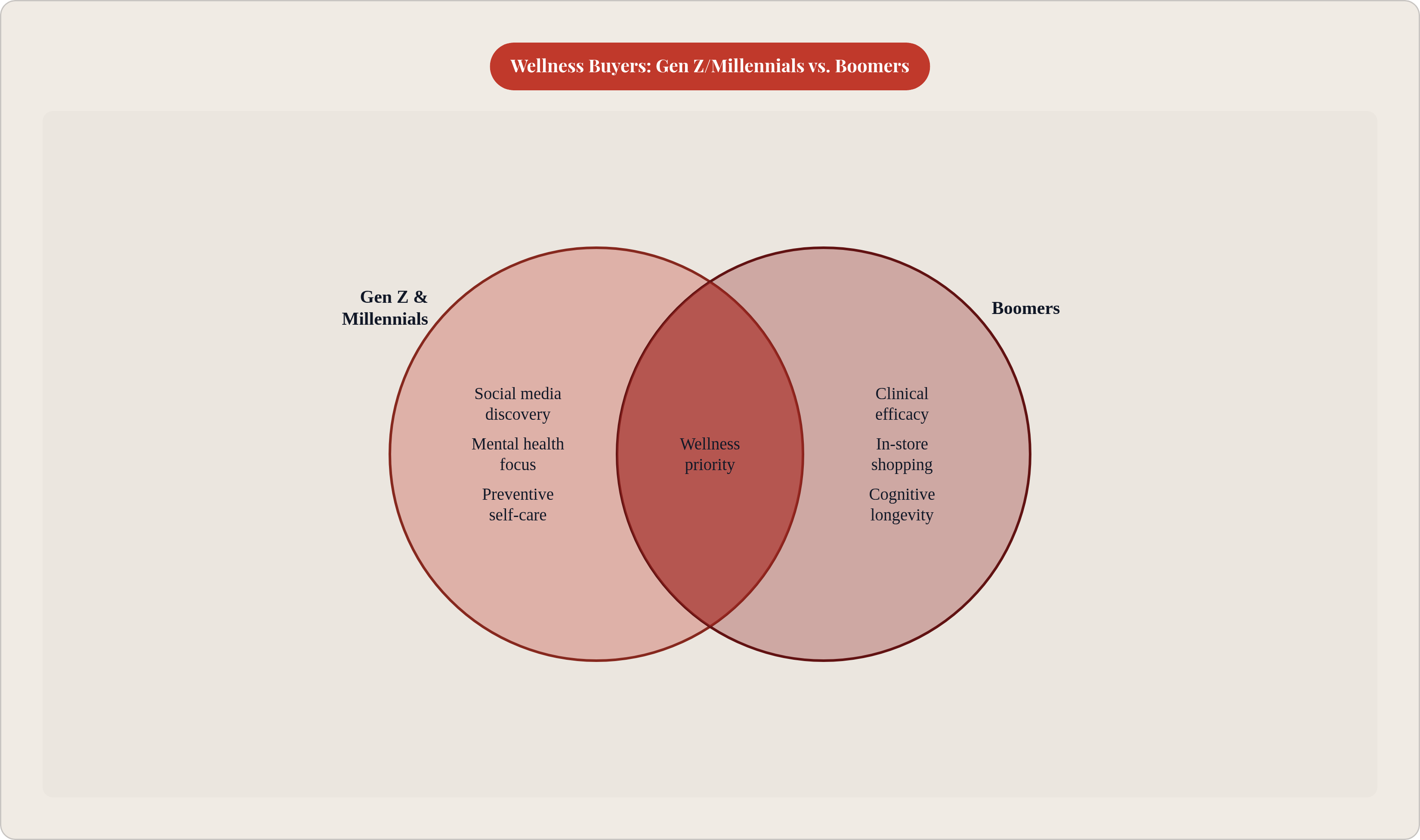
Generational dynamics compound this. Gen Z and millennials, per Circana's research, are driven by social media discovery, prioritize transparency, and lean heavily into preventive self-care and mental health. Nearly 30% of US Gen Zers and millennials, per McKinsey 2025, now prioritize wellness significantly more than they did a year ago. Boomers value clinical efficacy, prefer in-store shopping, and focus on cognitive function and longevity. These are not stylistic variations of the same buyer. They are different buyers, in different places, asking different questions, and no single campaign architecture can reach both of them well.
Why Knowing Which Segment You Serve Is the First Strategic Decision, Not a Later Refinement
Segment definition is not a deliverable that follows the product build. It is the product strategy, full stop. The brands that get this right know exactly who they are building for before a word of copy is written, and that specificity propagates into everything downstream: positioning, proof points, channel selection, content format.
McKinsey's 2025 research identifies five distinct wellness consumer segments. One worth naming explicitly is "confident enthusiasts," roughly 11% of consumers but approximately 15% of market spend. That gap between population share and spending share is the real signal. A smaller, more engaged segment can generate more revenue per marketing dollar than a broad audience campaign, because those buyers are already predisposed to purchase at higher frequency and higher ticket. Chasing reach at the expense of relevance is a volume game that rarely compounds into brand equity.
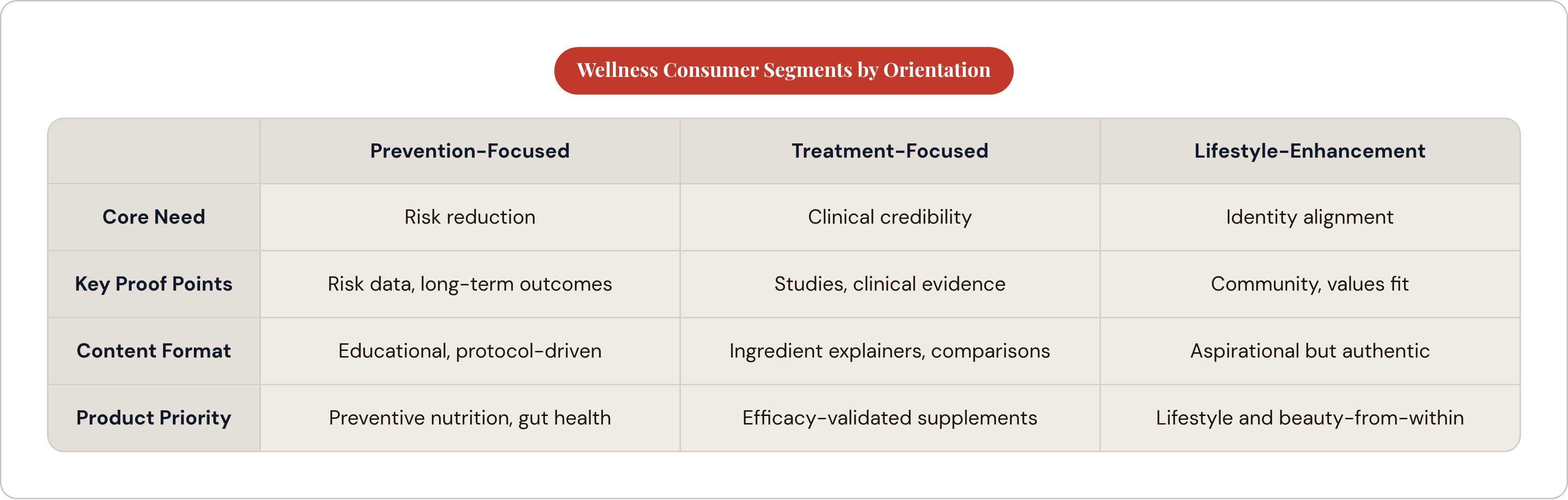
Beyond psychographics, consumers also cluster by orientation: prevention-focused, treatment-focused, and lifestyle-enhancement seekers. A prevention-focused buyer needs to understand risk reduction. A treatment-focused buyer needs clinical credibility. A lifestyle-enhancement seeker needs identity alignment. These are not the same argument with different aesthetics. They require structurally different proof points, different content formats, and honestly, different products.
The subcategories generating the most specific purchase intent right now: functional nutrition, healthy aging, beauty-from-within, in-person wellness services, weight management, and mental health. Mental wellness grew at 12.4% annually from 2019 to 2024, per the Global Wellness Institute. Gut health is producing concrete consumer behavior, not just category buzz: NielsenIQ's 19-country survey found 53% of consumers plan to buy more high-fiber foods in 2025. Those are people actively searching for specific products. Brands that have named their segment clearly show up in those searches; brands that have not remain invisible to buyers who are already ready to purchase.
Niche positioning feels like a constraint until you recognize it as the mechanism for product-market fit. Naming your segment explicitly, then building your product story, content, and channel mix around that segment, generates more signal per marketing dollar than speaking to "wellness consumers" in aggregate. The narrowing is not a limitation. It is the strategy.
How Ritual Built a $100M Brand by Making Transparency the Product, Not the Marketing
Ritual's founding story is worth examining because it resists the usual pattern. The founder could not find a prenatal vitamin with clear ingredient sourcing, so she built one, then marketed the sourcing story rather than the supplement. The product and the brand narrative were the same story from day one. By 2021, the company had surpassed $100 million in net sales.
What made this structurally durable is that transparency was never a campaign element bolted on after the fact. Every product page displayed ingredient sourcing and scientific validation as a permanent feature of the purchase experience. Copying that requires actual operational commitment: (i) supplier relationships, (ii) third-party verification, and (iii) ongoing documentation. A competitor cannot lift the messaging without lifting the underlying supply chain decisions. That is a real competitive moat, and it is one that marketing spend alone cannot manufacture.
The expansion sequence is underappreciated. Ritual built trust with a narrow initial audience, pregnant women seeking a clean prenatal vitamin, before moving into gut health and stress relief. Trust first, portfolio expansion after. A loyal niche becomes the platform for broader reach; attempting to build broad reach first and trust later does not work, because the audience acquired cheaply has no particular reason to follow the brand into new categories.
Brands that lead with lifestyle imagery while obscuring formulation details face elevated churn when skeptical buyers dig deeper and encounter the gap between what was marketed and what was delivered. That gap does not close on its own, and in wellness, buyers talk.
What a Trust-First Content Strategy Actually Requires in a Market Where 73% of Buyers Start on Google or YouTube
Quimby Digital's 2025 research puts 73% of wellness buyers beginning their purchase journey on Google or YouTube. That figure should end any internal debate about whether organic search and video are optional. They are not. They are where consideration starts, before a brand has any opportunity to run an ad, send an email, or make a direct pitch.
Educational content is the primary trust-building mechanism, not a supplementary one. Long-form blog posts, tutorials, and explainer videos that translate technical knowledge into plain-language guidance are what move a first-time visitor from passive awareness to genuine consideration. The goal is not simply ranking on page one; it is demonstrating expertise before a visitor has any particular reason to trust the brand, and doing it consistently enough that trust accumulates before intent converts.
Opensend's 2025 data puts 73% of wellness consumers researching on smartphones before purchasing. Mobile-first content format and load speed are baseline requirements. If your content experience degrades on a phone, you are losing consideration at the exact moment of highest intent, which is precisely the wrong place to introduce friction.
Science-backed storytelling is now expected, not impressive. Citing ingredients, sourcing, studies, or clinical evidence is table stakes in competitive subcategories. Brands that treat it as differentiation are a cycle behind; brands that do it selectively are generating doubt in exactly the buyers they most need to convert.
Content type should map to purchase stage deliberately. Top-of-funnel content addresses the questions buyers are already asking: symptoms, ingredient mechanisms, protocols. Mid-funnel content handles the credibility gap before it becomes a purchase blocker: ingredient explainers, comparison pieces, sourcing stories. Bottom-of-funnel content converts intent into action through social proof, documented user outcomes, and community validation. Broad wellness topic coverage produced for keyword surface area, without this kind of strategic intent behind it, is noise with a publishing schedule attached.
Why Micro-Influencers Outperform Celebrity Partnerships for Wellness Brands Competing on Trust
Influencer marketing grew from a $1.7 billion industry in 2015 to a projected $32.55 billion by 2025. That scale means brands cannot avoid the channel. It also means quality signals matter more now than when the space was smaller, because audiences have sharpened their ability to detect inauthenticity right alongside the industry's growth.
Platform dynamics deserve honest assessment before budget is committed. TikTok's average engagement rate in 2025 sits at 5.3%, compared to Instagram's 1.9%, per data cited by Shopify Enterprise. That is not a reason to abandon Instagram; it is a reason to calibrate expectations and content format by platform rather than assuming a single approach transfers cleanly across both.
For wellness specifically, micro-influencers with audiences between 1,000 and 100,000 followers outperform celebrity endorsements on both engagement and trust, per Quimby Digital's 2025 research, with ROI differentials exceeding 3x per dollar versus macro campaigns, per Stack Influence's data. The reason is structural. Wellness purchases are trust-dependent in a way that fashion or consumer electronics simply are not. When a creator has genuine lived experience with gut health or sleep optimization, and their audience has followed that journey over years, a product recommendation carries a different weight entirely. A celebrity saying your probiotic changed their life is about as convincing as a fish recommending swimming lessons. Audiences feel the difference even when they cannot articulate it.
AG1, formerly Athletic Greens, built credibility through podcast hosts and fitness influencers selected for authentic fit with brand values, not reach alone. The audience trusted the recommendation because they trusted the recommender. Production value was secondary to that underlying credibility.
Long-term creator partnerships compound this effect. Per an Aspire survey cited by SociallyIn in 2025, 63% of creators prefer sustained partnerships over transactional arrangements. That preference produces more authentic content and more credible product integration. Selection criteria for wellness partnerships should prioritize (i) lived experience in the relevant subcategory, (ii) audience alignment with your specific segment, and (iii) a demonstrated track record of honest, transparent review. Wellness audiences punish inauthenticity sharply and publicly, and the punishment rarely stays private.
How Community Turns a Wellness Brand's Marketing Investment Into Compounding Audience Equity
Lululemon crossed $10 billion in revenue and grew its membership base by 65% by treating wellness as a shared movement rather than a product transaction. Events, ambassador programs, in-store community classes: the brand became a platform for identity, and the product followed from that identity rather than preceding it. When a buyer's sense of self is connected to a community the brand built, the switching cost becomes social and psychological, not merely economic. That is a fundamentally different retention dynamic, and a much more durable one.
There is also a growing appetite for unfiltered wellness content among audiences fatigued by aspirational-perfection aesthetics. Real setbacks, skipped workouts, honest progress without transformation-before-and-after framing: per DesignRush's 2025 analysis, this kind of content generates stronger audience identification and higher engagement. People are tired of being sold a version of themselves that they do not recognize. They want company in the actual experience, not a highlight reel of the destination. As one brand strategist put it: the wellness industry spent years selling the mountaintop and forgot that most people are still looking for the trailhead.
Corporate wellness is an underutilized distribution channel. With 51% of professionals reporting burnout in the past year, per DesignRush's 2025 data, brands with relevant offerings in stress management, sleep, and nutrition have a clear pathway into employer wellness programs, reaching buyers in a high-receptivity context. Worth noting, though: GWI data shows global workplace wellness spending contracted 1.5% from 2023 to 2024. Brands entering this space need a differentiated angle and provable outcomes, not just category presence in a market where budgets are already tightening.
Subscription and loyalty mechanics function as community infrastructure in practice. Subscriptions create recurring contact, build anticipation, and enable product discovery that buyers would not have initiated independently. Loyalty programs reward the behaviors, repeat purchase, referral, sustained engagement, that community-minded buyers already exhibit. Each satisfied community participant carries a higher lifetime value and a lower acquisition cost than someone acquired through a paid channel, and that math compounds in a way that one-time paid acquisition simply does not.
Where AI Personalization Delivers Real Conversion Lift and Where It Creates Brand Risk
AI personalization offers real conversion lift for wellness brands, but deployed carelessly, it creates brand risk that can undo months of trust-building. In 2025, 55% of consumers purchased wellness products directly through social media or live-stream platforms, per NielsenIQ, and the discovery-to-purchase path has compressed significantly. Simultaneously, 34% of consumers are already using AI to streamline wellness shopping, with predictive algorithms and digital assistants shaping discovery before a brand's own content or ads have any opportunity to intervene. And 82% of customers cite personalized experiences as a key driver in brand choice, per MG Media Creative's January 2025 data.
The conversion opportunity is real. Companies implementing AI personalization effectively report meaningfully higher conversion rates, though figures from vendor-adjacent research should be read as directional rather than definitive. The more instructive example is at the product level. Whoop Coach translates biometric data, including HRV, sleep, strain, and recovery metrics, into direct adaptive guidance. That is a shift from tracking to advising, and it illustrates where AI personalization moves beyond a marketing tactic into genuine product differentiation. The tool is doing something demonstrably useful for the customer's actual wellness goals, not merely serving them a targeted ad.
The risk is equally concrete, and it deserves equal attention. Wellness buyers are increasingly aware of how their data is being used. Ninety-one percent of consumers believe AI-driven innovations can improve quality of life, per NielsenIQ's 2025 data, yet skepticism about data practices is rising in parallel. A brand that personalizes aggressively without a clear, visible data transparency policy will undermine the same trust its content strategy spent months building. Trust accumulates slowly. It does not erode slowly.
The real test is whether a customer, if they understood exactly how and why they were shown a particular recommendation, would feel served or surveilled. If you can answer that confidently, you are positioned to use personalization as a trust amplifier. If you cannot, you are accumulating a delayed liability, and in wellness, that kind of liability can surface publicly and at scale.
How to Sequence These Strategies Into a Coherent Go-to-Market Approach Rather Than a Checklist of Tactics
Trust, specificity, and audience alignment are sequential dependencies, not parallel workstreams that can be assembled in any order. The sequence runs: define the segment, build trust through transparent content, amplify through credible creators, deepen through community, extend with personalization. Each step creates the conditions for the next one to function. Skipping steps produces expensive misalignment. Influencer partnerships launched before the segment is defined generate reach without resonance. Personalization deployed before trust is established feels intrusive rather than useful. I have watched brands make both mistakes and spend considerable money learning what the sequence already tells you before the first dollar is committed.
The fastest-growing subcategories, mental wellness projected at 10.1% annual growth through 2029 and wellness real estate at 15.8%, per GWI's 2025 data, are not equally accessible to every brand. Growth rate alone is an insufficient reason to enter a category. The more durable question is whether your brand has genuine expertise and provable specificity in that space. Chasing growth without that foundation produces the middle-position problem: present in a hot category, indistinguishable from every other brand making the same move at the same time.
The market's bifurcation into premium trust and affordable volume means the strategic question is not how to reach more people. It is which position your brand can actually defend, and what proof supports that defense. An honest answer will often narrow your target audience, your channel mix, and your content focus simultaneously. That narrowing is not a concession; it is what differentiation requires.
Content velocity matters because wellness buyers research extensively before purchasing, and a brand absent from that research phase loses consideration before any paid campaign has the chance to reach them. Knowing what each piece of content must accomplish for which segment, before it is produced, is what separates brands that build durable search authority from those generating output without accumulating anything. Volume without strategic intent is noise with a publishing schedule.
The wellness market's scale makes it tempting to treat marketing as a volume game. The evidence argues otherwise, consistently. The brands that compound in this environment are the ones that resist speaking to everyone, and instead speak with precision, evidence, and consistency to the people who already need what they actually offer.