Strategic Marketing for Home Health Agencies
Separate your marketing into two distinct tracks: one for families, one for referral partners.

Every home health agency is marketing to two fundamentally different audiences at the same time, and most agencies handle this badly by collapsing both into a single message that resonates with neither.
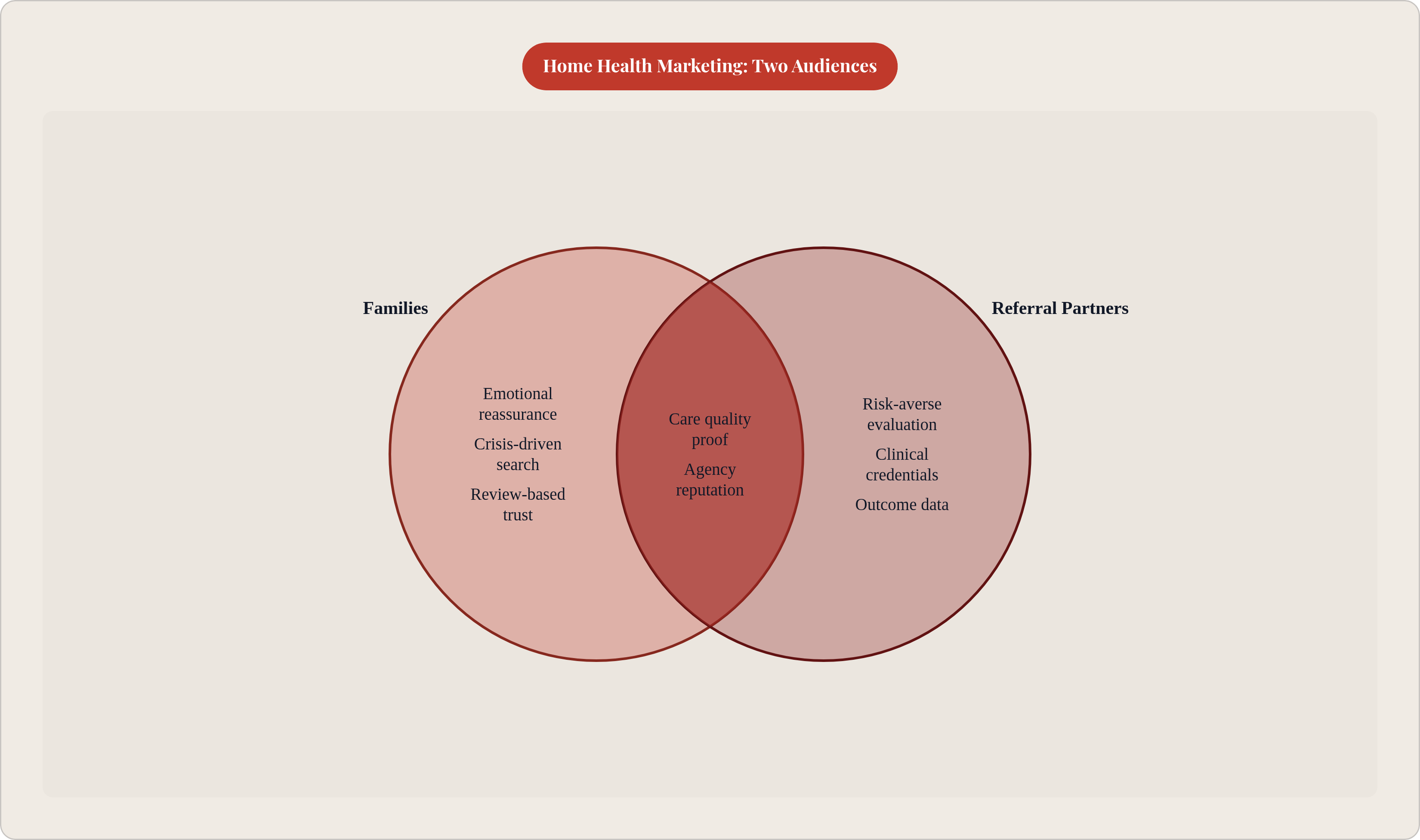
The first audience is families. Usually adult children, they are the primary decision-makers for consumer-facing marketing, even though they are not the ones receiving care. They arrive emotionally elevated, frequently in crisis, searching for reassurance and some signal that they can trust you with someone they love. They are not evaluating credentials the way a clinician would. They want to feel heard, and they want confidence that someone competent is taking the wheel.
The second audience is professional referral sources: hospital discharge planners, case managers, hospice coordinators, skilled nursing and assisted living facilities, rehabilitation hospitals, Area Agencies on Aging, and state Medicaid waiver programs. Each has different internal priorities, but they share a common disposition. They are risk-averse and credential-conscious. Brand warmth does not move them. What moves them is a harder, more pragmatic question: if I send this patient to your agency, will that patient be safe, and will I have made a defensible decision?
These two audiences require different channels, different content, and different relationship cadences. A brochure designed to reassure a frightened daughter in Omaha is not the right document to leave with a hospital discharge planner in the same city. A lunch-and-learn for a physician's office is not the right format for a family navigating a post-surgical care decision at midnight on a Tuesday. Trying to speak to both at once is like writing one letter addressed to both your grandmother and your bank — warmly confusing to everyone.
Every tactic in your marketing plan should be assigned, consciously, to one of these two tracks. Conflating them is how agencies end up with marketing that is universally inoffensive and universally ineffective.
Why Referral Relationships Are the Highest-Leverage Growth Channel, and How to Build Them Deliberately
Referrals are not just a warm lead source. At many agencies, they account for the majority of annual revenue, and they close at substantially higher rates, with lower acquisition costs and longer client relationships, than leads generated through paid channels. The economics are not close.
The reason is straightforward. When a discharge planner or physician recommends your agency, they transfer their own professional credibility to you. Families arrive already primed to trust. The question has shifted from "should I trust this agency?" to "when can they start?"
What referral partners are actually evaluating is something agencies frequently misread. A discharge planner is not evaluating your branding. She is evaluating whether the patient she is about to send you will be safe, stable, and unlikely to bounce back to the emergency department. A referral is a risk transfer. One poor outcome, one missed visit, one unreturned phone call when a family is panicking, and the relationship is functionally over. The whole arrangement runs on a single unspoken rule: don't make me regret this.
This is where the data gap becomes a genuine competitive opening. Only one in four providers can demonstrate care quality outcomes with actual data. Agencies that track and share referral-to-admission conversion rates, average time to start care, hospital readmission rates, and emergency department utilization are not just being transparent; they are speaking the professional language of their referral partners in a way that most competitors simply cannot.
Building a referral network at scale requires discipline. A reasonable floor for a stable agency is at least 20 solid referring sources, and reaching that floor means cultivating many more relationships than you intend to maintain. Attrition is relentless: staff turn over at partner organizations, patient populations shift, priorities change. A CRM is not optional here. Every visit, every communication, every outcome shared with a referral partner should be logged and tracked. Without that infrastructure, you are running a relationship business on memory, and memory fails at exactly the wrong moments.
The tactics that build referral relationships are less glamorous than most agencies expect. Quarterly lunch-and-learn sessions for physician offices, kept short and clinically relevant rather than sales-forward, demonstrate that your agency understands the context in which the referral partner works. Post-care summaries shared back to referring physicians close the loop in a way that almost no competitor does consistently. Proactive outreach to hospital discharge planners and rehabilitation facility social workers, done with genuine curiosity about what they need rather than a pitch, builds the kind of ambient credibility that activates when a referral decision is being made under time pressure.
A single well-nurtured physician partnership can yield dozens of referrals annually. Start there.
Building a Digital Presence That Earns Trust Before Families Ever Call
Families searching for home health care are not making a single query and picking the first result. They are moving through a progression: broad searches about care after a specific diagnosis or procedure, then location-specific searches, then checks on Medicare acceptance and insurance compatibility, and finally, reviews. Your digital strategy has to support the entire path, not just the moment of highest intent.
The review gap in this industry is a concrete competitive opportunity that most agencies ignore. An analysis of more than 64,000 home care agencies found that nearly 35% have zero Google reviews. In those markets, families doing reasonable due diligence are simply not calling those agencies. The bar for a competitive digital presence is not particularly high; most agencies just are not clearing it.
Local SEO is the foundation. Consistent name, address, and phone number across every platform. A fully claimed and optimized Google Business Profile. Location pages and sub-service pages written to match the geographically specific, condition-specific language families actually use when searching. An active, systematic process for requesting and responding to reviews. None of this is technically complex, but it requires consistent execution, and most agencies treat it as a one-time setup task and walk away.
AI search readiness is no longer a future consideration. Families are increasingly turning to Google AI Overviews, ChatGPT, Perplexity, and voice assistants rather than scanning traditional search results. A content architecture built around primary location pages and condition-specific service pages helps agencies surface in the responses those tools generate, not just in conventional rankings. This is where investment in content structure pays returns that outlast any single paid campaign.
Content marketing's job in this context is not volume; it is relevance. Pages and posts that answer the exact questions families are asking at each stage of their decision, written with enough specificity to actually be useful, accumulate trust over time. Generic content falls short.
Reputation management is an ongoing operation, not a quarterly audit. Build a systematic process for requesting reviews after care is delivered. Respond promptly and professionally to negative reviews. Silence in response to a complaint reads as indifference, and families notice.
Lead directories can serve as supplemental warm-lead sources. Treat them as a way to capture attention you have not yet earned organically, not as a substitute for building that organic presence.
Where Paid Digital Fits, and Where It Does Not Replace Organic Trust-Building
Paid digital advertising has a specific, valuable job in home health marketing, and understanding the limits of that job matters as much as executing it competently.
Google Ads excel at capturing high-intent users at moments of urgency: post-acute care searches following a hospitalization, immediate caregiver support needs, the kinds of queries that carry real time pressure. In those moments, organic ranking takes too long. Paid search fills the gap.
Retargeting serves a different but complementary function. Home health care decisions often span days or weeks. A family that visits your website, reads your service pages, and leaves without calling is not necessarily gone. They are still deciding. Retargeting keeps your agency visible in that window, surfacing reminders to an audience that has already demonstrated interest.
Streaming and video advertising are underused in this industry. Adult caregivers, the consumer decision-makers, are reachable on platforms like Hulu and Roku. Zip-code-level targeting makes streaming viable even for agencies with tightly defined geographic service areas. Creative that leads with narrative — a patient's recovery story, a caregiver's account of what the support meant for her family — consistently outperforms feature-list advertising for this audience. Emotional resonance is not a soft metric; it is the mechanism by which initial trust is established.
The compliance constraint that governs all of this is not optional. All paid digital advertising in healthcare must run in HIPAA-compliant environments. This affects platform selection, pixel use, and the architecture of retargeting campaigns in ways that require deliberate planning from the start, not a compliance checkbox at the end.
What paid advertising cannot do is build the referral trust, community reputation, or review volume that drives long-term organic growth. Agencies that over-index on paid while neglecting those foundations are renting growth. The moment the budget contracts, the pipeline contracts with it. Paid is an accelerant, not a foundation.
Community Presence and Non-Digital Relationship-Building That Compound Over Time
Home care is a local business conducted at the most intimate scale imaginable: inside someone's home, during some of the most vulnerable moments of their life. Community reputation is not a soft benefit. It is a background signal that either validates or contradicts everything families and referral partners read or hear about your agency from any other source.
The lunch-and-learn format deserves mention here again because it operates on both the referral track and the community presence track simultaneously. When a physician's office staff experiences your clinical team as genuinely knowledgeable and interested in patient outcomes, that perception spreads beyond that room. It is not a single conversation; it is the beginning of a pattern.
Strategic partnerships with non-competing services that serve the same population offer another high-leverage channel. Fall detection device providers, medical equipment suppliers, pharmacy delivery services, and discharge planning software companies are not competitors. They are adjacencies. An agency that co-refers with a fall detection technology company brings value to its clients while surfacing itself to that company's customer base. These arrangements are easy to structure, and when they work, they create referral flow that requires no ongoing marketing spend to maintain.
Senior living communities, Area Agencies on Aging, and local disease-specific support groups, including Alzheimer's associations and cardiac rehabilitation programs, are community presence channels that also operate at high trust. The families in those rooms are often exactly the ones about to make a home care decision. An agency that shows up consistently, that sponsors an educational session or provides a clinical speaker for a caregiver support group, is not perceived as a vendor. It is perceived as a resource. That distinction matters more than most agencies realize.
Consistency is what makes all of this work. Every community touchpoint either confirms or contradicts the digital reputation being built in parallel. An agency that markets compassion online while being transactional and hard to reach when someone actually calls will not sustain that contradiction for long.
Differentiating on Something Other Than "Quality Care," and Why This Matters for Every Channel
Here is the problem: when nearly every agency in a market claims quality care as its primary value proposition, quality ceases to function as a differentiator. It becomes a threshold expectation, like cleanliness in a restaurant. Families and referral partners assume it. It does not move the decision.
Real differentiation in home health looks like something concrete and verifiable. Specialized programs — dementia care protocols, post-surgical recovery pathways, pediatric home health — serve a defined population more effectively than generalist competitors can, and they are legible to both families and referral partners in a way that vague quality claims are not. Operational commitments that are measurable, guaranteed response times, named care coordinators, caregiver consistency metrics, carry weight because they can actually be held to. Cultural and linguistic alignment with specific communities in your service area is a differentiator that is both difficult to replicate and deeply meaningful to the families it serves.
None of this happens without competitive research. Who are your local competitors? What do they do well, and where are the gaps in their service model, their staffing, their response times, their specialization? Where is the unmet need in your market that their model is failing to address? That is where genuine positioning lives, not in a copywriter's adjective choices.
The differentiation message has to work on both tracks. For families, it needs to be clear, free of clinical jargon, and immediately answerable to the question: why this agency and not the one I found first? For referral partners, it needs to answer a harder question: what does this agency do that reduces my risk and improves my patients' outcomes? Different articulation, same underlying truth.
Differentiation that is provable with data — readmission rates, satisfaction scores, response time averages, repeat referral rates — is more durable than differentiation claimed through copy alone. Anyone can write a confident headline.
Why Caregiver Recruitment and Retention Are Marketing Problems, Not Just HR Problems
The U.S. faces a shortage of nearly 800,000 home health aides, according to Bureau of Labor Statistics projections, with demand expected to outpace workforce growth by 25% through 2030. Most agency owners I have talked with know that number. Fewer have actually restructured their operations around it.
Caregiver turnover in home care was 75.0% in 2024, an improvement from 79.2% the prior year. Even in an improving environment, three in four caregivers leave the average agency within a given year, and approximately 57% of that turnover happens within the first 90 days. The onboarding experience is not an administrative function. It is the single highest-leverage retention intervention available, and most agencies treat it like paperwork.
The connection to marketing is direct. An agency that cannot staff cases must turn down referrals. Referral partners who are turned down repeatedly stop sending referrals. The trust built through months of relationship development erodes faster than it was constructed. High turnover signals instability to families, undermining the reputation built through digital presence and community engagement. And because client turnover tracks closely with caregiver turnover, an agency caught in this cycle must constantly acquire new clients just to maintain its current census, not grow it. You end up running hard to stay in place — like a treadmill set just fast enough that slowing down is not an option.
The median hourly wage for a personal care attendant in 2024 was $16.25, according to the 2025 Activated Insights Benchmarking Report. When compensation is comparable across competing agencies in a market, wages stop differentiating you in recruitment. The conversation has to shift from filling a position to offering something with genuine career weight: growth paths, meaningful recognition, a culture that does not treat caregivers as interchangeable labor, and a mission that aligns with why many of them entered the field in the first place.
The external message and the internal experience must be coherent. An agency that markets compassionate, person-centered care to families while running a high-turnover operation with no career development and poor internal communication has built a contradiction that clients, caregivers, and referral partners will eventually identify on their own. They always do.
The Legal Boundaries That Shape What Home Health Marketing Can and Cannot Do
Two federal statutes define the boundaries of referral marketing in home health, and understanding them is not optional.
The Anti-Kickback Statute makes it a federal crime to knowingly offer, pay, solicit, or accept remuneration, including cash, gifts, free rent, event tickets, or consulting fees for minimal work, in exchange for referrals of items or services covered by Medicare, Medicaid, or other federal healthcare programs. The statute applies to everyone in the arrangement. The Stark Law prohibits physicians from referring Medicare and Medicaid patients for designated health services to entities with which the physician has a financial relationship, with limited exceptions.
Relationship-building tactics exist on a spectrum that has a legal boundary. A lunch-and-learn with genuine educational content sits comfortably on the compliant side. A paid advisory role with no substantive duties, or a catered event that quietly becomes an expected recurring benefit, can constitute a violation. The question regulators ask is not what you called the arrangement; it is whether value flowed to the referrer in a way connected to referral volume.
Compliant relationship-building looks like genuine educational value, transparent care coordination, and data sharing that improves outcomes for the partner's patients. Value that flows to the patient is the standard. Value that flows to the referrer's pocket is the line.
HIPAA adds a parallel constraint on digital tactics. Paid advertising, retargeting pixels, and any tracking tied to patient data must operate in compliant environments. This affects which advertising platforms are viable, how campaigns are architected, and what data can pass between systems. Building compliance into the structural design from the start is the only responsible way to run these campaigns, rather than treating it as an afterthought.
Agencies that understand these boundaries as working professionals, not just as warnings absorbed from a compliance officer years ago, earn credibility with hospital compliance teams and physician practices that less sophisticated competitors cannot match. That credibility is itself a referral asset.
Putting It Together: How the Channels Reinforce Each Other
The reason most home health marketing underperforms is not that any individual channel is wrong. It is that the channels are treated as independent initiatives rather than components of a single system.
Here is how a coherent system actually functions. Your referral development effort generates a steady flow of clients; those clients generate reviews and word-of-mouth that strengthen your digital presence. Your digital presence allows families to validate the referral they received, confirm your reputation, and arrive at intake already trusting you. Your community presence reinforces both, making your agency a recognizable name in the conversations referral partners are already having. Your caregiver stability, achieved through deliberate recruitment and retention practices, means you can actually accept the referrals you receive, deliver care that generates good outcomes, and share those outcomes back to the referral partners who need evidence that their trust is warranted. Your differentiated positioning gives every channel a consistent, specific story to tell rather than a generic claim that disappears into the noise.
Disruptions in any part of this system create cascading effects. High caregiver turnover breaks the care delivery that referral relationships depend on. Weak digital presence means families referred by a discharge planner cannot validate the recommendation and lose confidence before they ever call. Legal violations in referral marketing sever partner relationships that took years to build.
The agencies gaining market share right now are not the ones that have mastered any single channel. They are the ones that have built systems where every component reinforces the others, and where leadership understands the connections well enough to recognize when any part of the system is under stress. That is a different kind of organizational capability than most agencies are currently developing. It is also the one that compounds.