Home Health Marketing Strategies That Drive Referrals
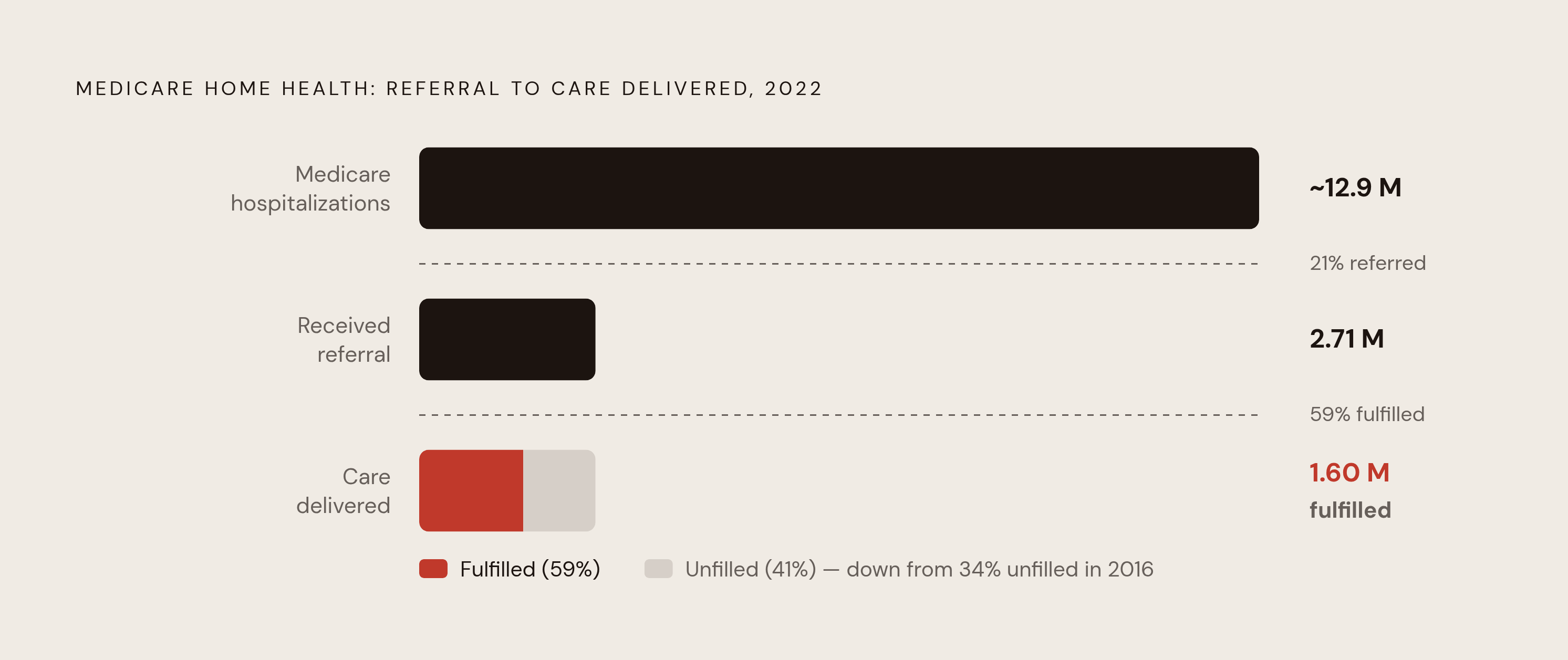
Nearly half of home health referrals never convert to actual care.

The U.S. home health market crossed $100 billion in 2024 and is tracking toward $176 billion by 2032. That growth isn't speculation; it's demographics. The population aged 65 and older hit 61.2 million in 2024, and the Bureau of Labor Statistics projects home health and personal care aide positions will grow 17% between 2024 and 2034, roughly double the average for any other occupation.
But here's the part that should actually concern agency operators: demand outpacing supply doesn't automatically translate into filled caseloads. More than 2.71 million hospitalized Medicare patients received a home health referral in 2022, representing about 21% of that population. Fulfillment rates dropped from 66% to 59% between 2016 and 2022. Nearly half of all referrals never converted to actual care. By 2024, adherence had recovered and exceeded pre-pandemic levels, partly because staffing pressures eased, but the underlying gap between referral volume and care delivery isn't self-correcting. It closes only when agencies build systems that close it.
Meanwhile, client turnover hit approximately 79.2% in 2024, a five-year high. At that churn rate, referral generation stops being a growth function and becomes something closer to a survival function — like trying to fill a bathtub while someone keeps pulling the drain. Agencies are running to maintain census, not expand it, and the ones with no deliberate intake infrastructure are the last to know when the pipeline is thinning.
The agencies that consistently win aren't simply the ones with the strongest clinical programs. They're the ones where referrals are treated as infrastructure, not something to address when census dips.
The Referral Source Map: Who Sends Patients and on What Basis
Not all referrals operate on the same logic, and treating them as a single program is one of the more expensive assumptions an agency can make.
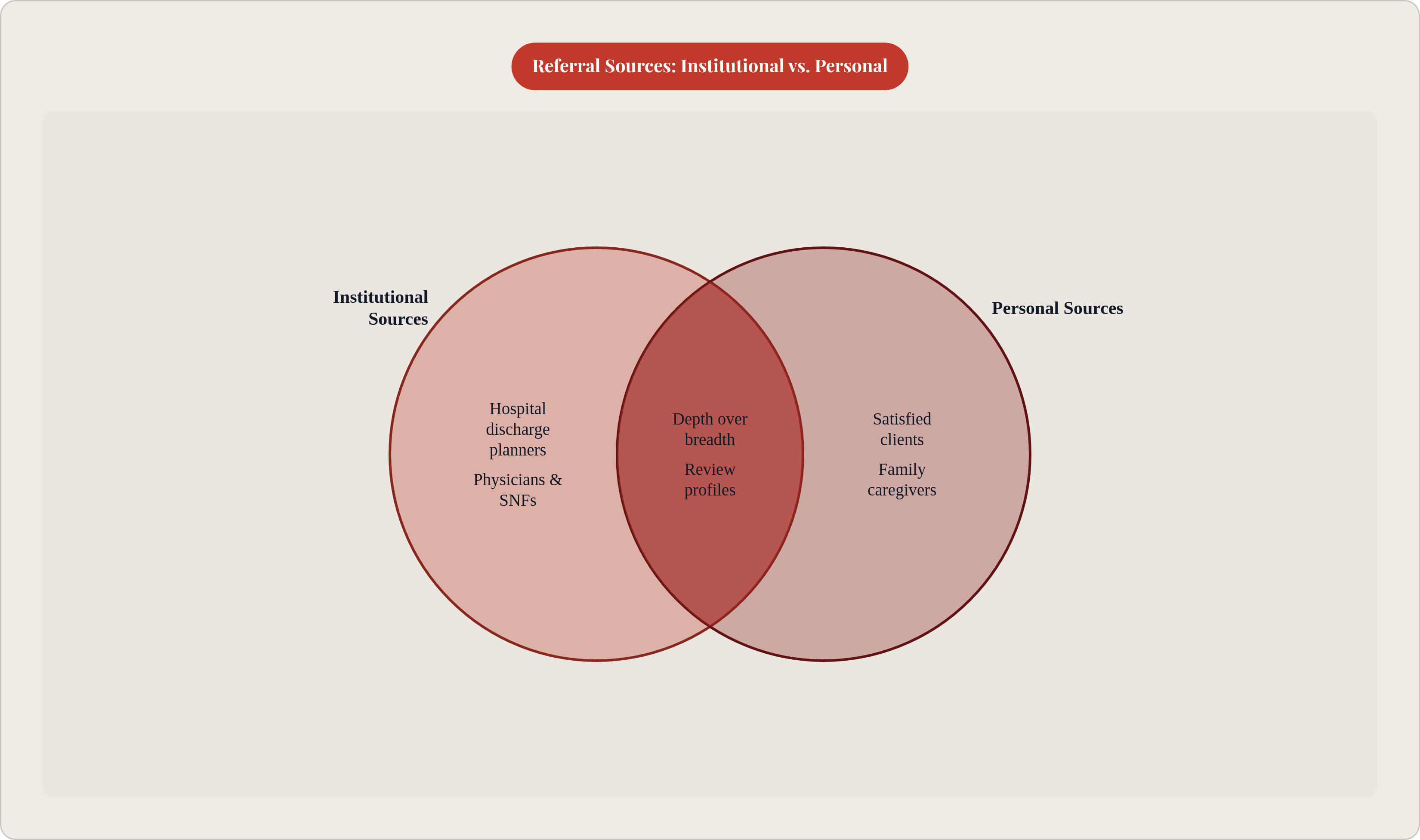
There are three broad source categories worth understanding separately. Institutional and professional sources include hospital discharge planners, case managers, physicians, skilled nursing facilities, assisted living facilities, hospices, rehab hospitals, and programs like state Medicaid waiver initiatives and Area Agencies on Aging. Community sources include senior centers, faith organizations, and local advocates. Personal sources are satisfied clients and their family caregivers. In many agencies, that last category accounts for the largest share of revenue, which surprises operators who assume the institutional channel dominates.
Institutional sources are making professional decisions and are accountable for downstream outcomes. They evaluate on reliability, outcomes data, responsiveness, and regulatory standing. Community sources respond to accumulated local visibility; they need to have encountered your name well before any specific moment of need arises. Personal sources respond to emotional trust, which is earned through the quality of care itself and, just as importantly, through the experience of the family navigating a difficult situation alongside the patient.
Marketing expert David Frey, cited by Activated Insights, makes a point worth internalizing: depth beats breadth. One well-tended physician relationship outperforms surface contact with ten. That principle holds across all three source categories. No single channel is sufficient, but agencies with the most durable pipelines have made a deliberate choice to diversify across all three rather than defaulting to whichever feels most accessible in a given quarter.
Building Physician Relationships That Generate Consistent Referrals
Physicians refer patients who need ongoing skilled support between office visits: wound care, medication management, physical therapy following a procedure. The patients aren't candidates for hospitalization, but they require coordinated attention the practice can't deliver alone. One well-developed physician relationship can generate dozens of referrals annually. That arithmetic is why relationship depth is the highest-return activity in physician marketing, not volume of outreach.
What physicians want from an agency partner isn't complicated. They want confidence that their patient is being managed properly, without that arrangement creating additional work for the practice. They want concise, timely care summaries, not documentation that buries the clinical picture under administrative language. They want a named person to call when something comes up. That's essentially the whole list.
Quarterly lunch-and-learn sessions at physician offices are low-cost, high-credibility touchpoints that position an agency as a clinical partner rather than a vendor. A standardized one-page care summary format, sent consistently after each patient update, signals professionalism and reduces friction for the physician's staff. Assigning a dedicated community liaison to a defined physician panel creates clear accountability; calls don't disappear into a general line.
What not to do is just as instructive. Generic outreach to large physician lists with no follow-up. Cold brochure drops with no relationship context. The implicit assumption that a single visit earns sustained referrals. None of that compounds. The relationship is the asset, and assets require maintenance.
Winning Referrals From Hospital Discharge Planners and Case Managers
Discharge planners and case managers maintain provider lists and guide patients and families toward specific agencies at a moment of acute stress and minimal independent research capacity. The family standing in a hospital room trying to absorb discharge instructions is not conducting a competitive analysis. They're following a recommendation, almost always.
The central pressure point for discharge planners is 30-day hospital readmissions, because facilities absorb financial penalties when patients bounce back. Planners are highly motivated to refer to agencies they trust to perform, and any agency that can document low readmission rates carries real currency in that relationship. Trella Health data from 2025 shows that patients who followed home health discharge instructions had measurably lower 30-day readmission rates than those whose referrals went unfulfilled. That gap is documentable and usable in referral conversations.
Speed is the other currency. Discharge planners work under timelines measured in hours. An agency that doesn't respond quickly or confirm capacity loses the referral to whoever picks up next. A written rapid-response protocol, guaranteeing intake contact within 24 hours of discharge, is a concrete differentiator that most agencies never bother to formalize.
The piece most agencies neglect is closing the loop. After accepting a referral, confirm with the discharge planner that the family was contacted, the case was accepted, and care started. A brief email handles this. When the next patient needs home health, that agency isn't a deliberate choice so much as the obvious one.
Using Quality Data and CMS Care Compare as a Referral Marketing Asset
For Medicare-certified agencies, CMS Care Compare makes quality ratings publicly visible to discharge planners, physicians, health systems, and payers who check these profiles before recommending an agency. Institutional procurement works this way, and an agency that doesn't manage its profile actively is ceding ground to competitors who do.
The 2024 Activated Insights Benchmarking Report found that only about one in four providers can prove their quality-of-care outcomes with data, and only about a quarter tracked their hospital admission rates. That's troubling from a care standpoint, but it's also clarifying from a competitive one: agencies that actively manage and communicate their outcomes data occupy a position the majority of competitors leave entirely vacant.
Effective July 1, 2025, CMS mandates OASIS data collection and submission for all patients regardless of payer. Agencies treating this as a compliance burden will fall behind agencies treating it as a marketing asset, because the data is now required anyway. You might as well use it.
Audit your CMS Care Compare profile regularly. Flag any metric below state or national benchmarks and build an improvement plan around it. Translate star ratings and outcome metrics into a one-page referral partner brief that a discharge planner or physician office manager can scan in two minutes. Use outcome data in leave-behind materials during outreach, not as a sales pitch but as a reliability signal. Professional referral sources know the difference between those two things, and they respond accordingly.
How Families Research Home Health Agencies Online and What Shapes Their Decision
Even when a physician or discharge planner names a specific agency, family members search online before calling. They're looking for confirmation, not a cold introduction. What they find in those first minutes determines whether they follow through on the referral or quietly look elsewhere, often without telling anyone they did.
The key digital touchpoints are predictable: Google search results and the local map pack, the agency's Google Business Profile, the agency's website, and third-party review platforms. These aren't separate channels; they form a single, interconnected first impression, and a weak link in any of them disrupts the whole sequence.
The emotional register here matters in ways it doesn't in most industries. Families contacting a home health agency are often inside a crisis. A parent just discharged from the hospital. A spouse with a new diagnosis. They're not evaluating service features; they're looking for calm competence and some signal that someone is actually going to handle this. Corporate distance, generic copy, and unanswered reviews communicate the opposite. Families notice even when they can't articulate exactly why they kept scrolling.
Digital presence is the validation layer for every referral an agency earns through relationship-building. The offline relationship opens the door. The digital presence determines whether the family walks through it.
Local SEO and Google Business Profile as the Foundation of Digital Referral Capture
Most home health searches are local and service-specific. "Home health agency near me." "In-home physical therapy in [city]." Local SEO is the primary battleground here, and getting it right doesn't require a significant budget. It requires precision and consistency, which are less common than they should be.
Google Business Profile is the starting point. Accurate name, address, and phone number, consistent across all directories. Service categories set correctly as "home health care service" rather than a generic healthcare designation. Service area geography configured to match actual coverage. Regular posts, updated hours, and answered Q&A that signal an active, legitimate operation. These details are unglamorous and they matter more than most agencies realize.
Review volume and recency both factor into Google's local ranking algorithm. An agency with a handful of reviews from several years ago will lose ground to a competitor with a larger volume of recent ones, even if the older agency is clinically superior. Recency signals that the agency is actively operating and actively earning trust, and Google weights it accordingly.
Website fundamentals compound over time in ways that aren't immediately visible. Location-specific service pages for each geography served outperform a single generic services page. Clear calls to action, including a visible phone number and an accessible intake form, reduce friction at the moment families are ready to act. Page speed and mobile optimization aren't optional; most family searches happen on a phone, often in a hospital waiting room, and a slow-loading site loses the visit before the family has read a single word.
Get these basics right and you create the infrastructure that every other digital tactic builds on. Skip them and nothing else compounds the way it should.
Online Reviews as a Referral Signal, Not Just a Reputation Metric
Reviews are the closest digital equivalent of a personal recommendation. A prospective client reading twelve reviews from different families is receiving twelve separate trust signals simultaneously, and that aggregated weight is nearly impossible to manufacture any other way.
Professional referral sources check reviews too. Discharge planners and physicians who have options will look at an agency's online reputation before committing to an ongoing referral relationship. A weak review profile creates friction in institutional relationships that agencies often don't realize is there, because no one calls to explain they chose someone else.
Systematic review generation is the difference between agencies with strong profiles and agencies with good intentions and inconsistent execution. The best moment to ask is shortly after a positive care milestone: a successful discharge, the completion of the first week of care, the resolution of a difficult situation that went well. Make the ask easy by sending a direct link to the Google review page via text or email. Assign this step to a specific person or workflow, because ad hoc processes produce ad hoc results.
Responding to reviews, positive and negative, signals to future readers and to Google that the agency is attentive and accountable. An unanswered negative review is not a neutral presence; it's an active liability in the minds of families doing their research.
Real client language, used with permission, belongs in website copy, social posts, and referral partner materials. It consistently outperforms agency-written descriptions of service quality because it carries credibility that polished copywriting cannot replicate.
One explicit practice to avoid: review-gating, which means routing review requests only to clients likely to respond positively. This violates FTC guidelines and produces a fraudulent profile. Solicit reviews through a consistent process applied to all clients.
Content and Community Presence That Builds Referral Trust Before Anyone Is Ready to Call
Most families and professional referral sources are not in active decision mode most of the time. The agency that has stayed visible in the background earns the call when the moment finally arrives. Content and community presence are how that visibility accumulates without a direct sales interaction.
For professional referral sources, useful content looks like short educational posts or emails on topics physicians and discharge planners actually care about: managing care transitions for patients with congestive heart failure, fall prevention protocols for post-surgical patients, recognizing medication adherence problems at home. This isn't content marketing in the generic sense. It's demonstrating clinical fluency in a format that's easy to consume and easy to forward within a practice or facility.
For families, useful content addresses the questions they're too overwhelmed to ask: what does the intake process look like, how is a care plan developed, what happens if a caregiver calls in sick. These are the anxieties that quietly stop families from following through on a referral. Answering them proactively removes friction before the first phone call ever happens.
Community presence operates on a slower timeline and builds a different kind of trust. Consistent visibility at senior centers, faith organization events, and community health fairs creates the familiarity that functions as a passive referral asset. People recommend agencies they recognize, and recognition requires repetition. Repetition requires showing up before there's an obvious reason to.
Agencies that invest in visibility before the crisis are the ones families and professionals think of first when the crisis does.