Healthcare Marketing Trends Reshaping Patient Acquisition

Patient acquisition in healthcare has crossed a threshold. The digital signals patients emit before they ever call a practice (the searches, the review reads, the social media scrolling, the portal visits) now constitute the primary arena where provider consideration and selection happen. That shift isn't speculative. Sixty-five percent of patients search online before contacting a doctor. More than sixty percent use social media to look for health information. And yet nearly forty percent of conversions still close over the phone, which tells you something important: the journey is digital even when the close isn't. Healthcare marketers who understand the full shape of that journey can build acquisition strategies that genuinely compound. Those who treat digital as supplemental will keep losing patients at the handoffs they can't see.
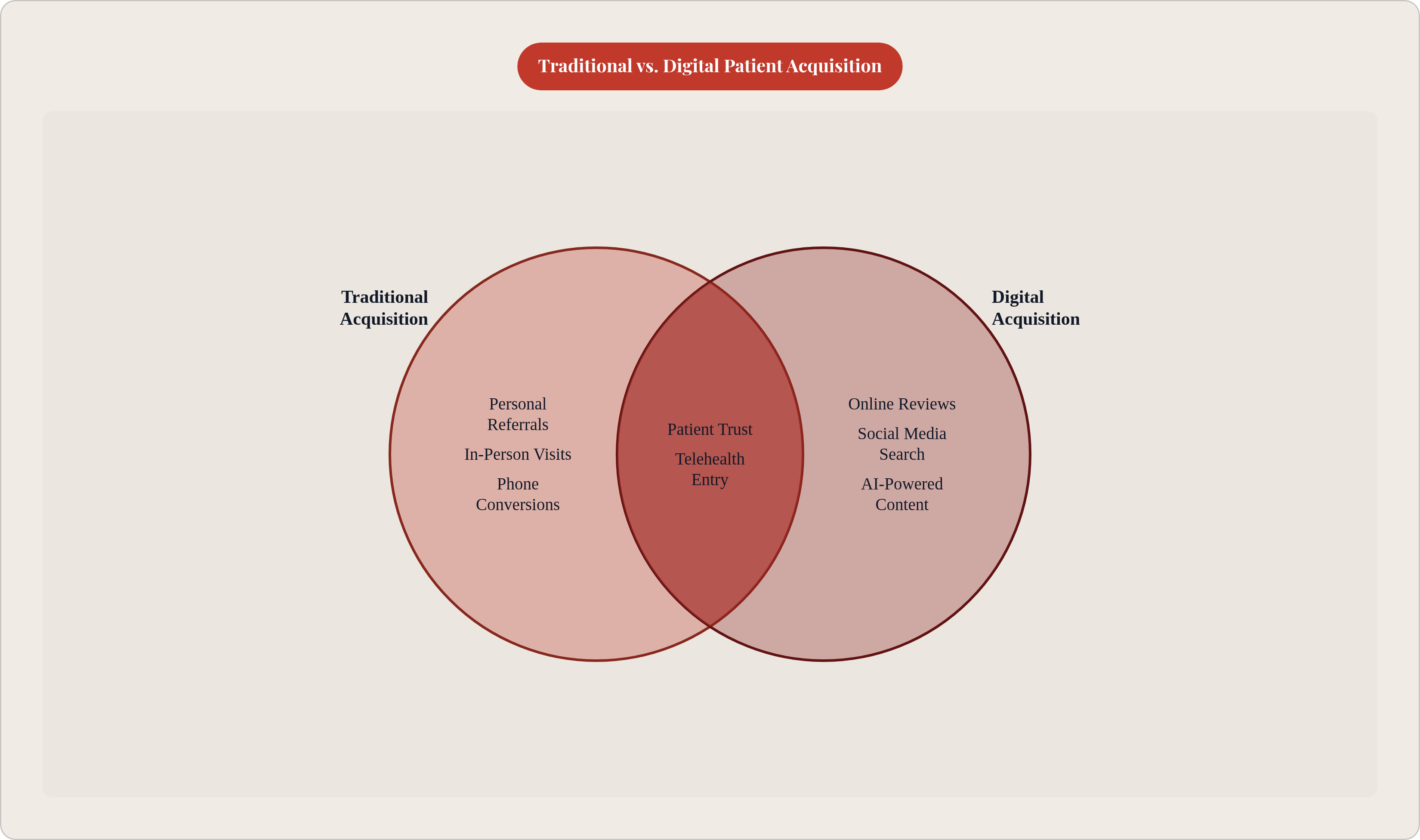
The Scale of Spending Shift Behind These Trends
The budget data makes the directional argument plainly: 72.2% of total healthcare and pharma media ad spending now flows to digital ads. U.S. healthcare advertising is projected to grow from approximately $22.4 billion in 2025 to $29.2 billion by 2028. Nearly half of healthcare marketers planned to increase budgets in 2024, which means the majority are moving money toward digital, not deliberating about it.
Within that spend, paid digital advertising leads channel allocation, followed closely by social media. Those rankings tell you where peers are concentrating resources, and they matter because healthcare marketing has real competitive geography. If your acquisition strategy isn't present in the channels where patients are actively considering providers, that spend is showing up in a competitor's favor.
The figure to interrogate, though, is this: budget growth does not guarantee acquisition performance. Spending more on channels that aren't connected, or that create compliance exposure, or that reach the right audience at the wrong friction point, just accelerates waste. The spending shift establishes the stakes. The rest of the picture is about where that spend needs to go, and what it has to account for.
Why Omnichannel Orchestration Now Determines Whether Campaigns Convert
A patient doesn't encounter a practice in one place. They find it in a search result, revisit it on social, receive a reminder email, navigate a patient portal, and eventually pick up the phone. That's not a funnel. It's a network of handoffs. Each handoff is an exit point if the experience degrades.
The expectation data from Tebra's 2025 Patient Perspectives report is instructive: 92% of patients prefer digital intake forms, and 91% expect responses to portal messages within 24 hours. Those numbers are often filed under "patient experience," but they belong in your acquisition brief. A patient who sends a portal message and waits three days is not a patient who books. That responsiveness expectation is part of the omnichannel contract.
The conversion implications of a smooth digital path are concrete. Online scheduling lifts new patient volume by 26%, and patients who schedule online average meaningfully more services over the following six months. Acquisition and lifetime value both move when the path is clear.
One dimension that is underappreciated is portal activation. Health systems that treat portal activation as a marketing goal (not an IT handoff) see substantially higher adoption rates than those that approach it passively. The portal is where a one-time patient becomes a recurring one. Treating it as a marketing surface, not a technology footnote, is an organizational decision with measurable downstream effects.
The infrastructure requirement this creates is real: your CRM, marketing automation, analytics, and content management need to be integrated enough that campaigns across search, paid, social, and content are measurable end-to-end. Omnichannel isn't about presence across every platform. It's about not losing patients in the seams between them.
What AI-Powered Personalization Can Actually Do in Healthcare Marketing. And Where It Breaks
The adoption numbers here are no longer emergent. Seventy-nine percent of healthcare organizations already use AI in some capacity. Ninety-three percent of healthcare and life science companies plan to increase AI investment in 2025. Among those already using it, 80% reported improvements in measurable marketing metrics. The ROI data is specific: for every dollar spent on AI, healthcare organizations save $3.30, with most reaching that return within fourteen months.
What AI enables, in practice, is genuinely useful: hyper-personalized content delivery at scale, behavioral forecasting that improves campaign targeting, and 360-degree patient journey mapping that can identify where and why patients disengage. These aren't hypothetical capabilities; they are functional features in current platforms.
The break point is where it gets instructive. A BCG study found two-thirds of consumers globally reported receiving personalization that felt invasive or inaccurate. In healthcare, where the subject matter is someone's body, their diagnosis, their anxiety about a procedure, the sense of invasiveness is significantly amplified. Personalization that correctly infers a health condition and surfaces it back to someone who never explicitly disclosed it doesn't feel helpful. It feels like surveillance.
The practical resolution is also the compliant one: calibrate personalization to health interest groups and behavioral signals, not individual health data. For example, someone who has read three articles about managing type 2 diabetes can be served relevant content about endocrinology without any PHI changing hands. That distinction is both the ethical line and the legal line, which connects directly to the compliance pressures covered later in this piece.
Telehealth as a Patient Acquisition Funnel, Not Just a Service Line
By early 2024, 54% of Americans had used telehealth. A significant majority of physicians intend to continue using it, and by 2026, between a quarter and a third of all medical visits are projected to occur via telemedicine. The infrastructure is expanding regardless of what any individual practice decides. The question is whether practices are positioned to use it as an acquisition channel.
The behavioral logic here is sound. A patient who is uncertain about a new provider faces real friction around scheduling an in-person visit. They don't know the experience, the wait, the bedside manner. A virtual visit reduces the commitment required to find out. Lower friction at first contact produces better conversion rates, and practices treating telehealth as an acquisition funnel are acquiring patients at substantially lower cost than those treating it as a standalone service line.
The marketing implication follows naturally. Campaigns positioning telehealth as an entry point into your practice, rather than as a product feature to promote, are solving the right problem. The messaging task is reducing first-contact anxiety, not explaining how video visits work. Patients understand video calls. What they don't know is whether this provider is worth their time. Telehealth answers that question at lower stakes for everyone.
The market trajectory reinforces the structural argument: the telehealth market is projected to grow from roughly $186 billion in 2025 to approximately $286 billion by 2030. This funnel will be larger and more competitive. Practices that instrument it now will have an acquisition advantage that becomes harder to replicate as adoption matures.
Online Reputation Is Now Patient Acquisition Infrastructure
Eighty-four percent of patients check online reviews before choosing a provider. Sixty-one percent now prioritize those reviews over personal referrals from friends and family. Let that land for a moment: a stranger's posted review carries more weight in the selection decision than a trusted friend's direct recommendation. Reputation isn't a soft metric anymore. It's infrastructure.
The search behavior data from RepuGen's 2025 survey of over 1,200 patients tells you where to invest: 73% start their provider search by reading reviews, with Google dominating at 78%. WebMD and Healthgrades remain meaningful. The practical implication is clear. Your Google Business Profile is the first impression for the majority of prospective patients.
The rating threshold has tightened. BrightLocal's 2026 data shows 68% of consumers will only engage with a business rated four stars or higher, up from 55% the prior year. Nearly a third won't go below 4.5 stars. Those thresholds are moving in the direction that makes reputation management more, not less, operationally demanding over time.
Response behavior matters more than most practices realize. BrightLocal's 2025 research found that 88% of consumers would use a business that responds to all its reviews, versus 47% who would use one that doesn't respond at all. The act of responding, not just the content of the response, functions as a conversion signal.
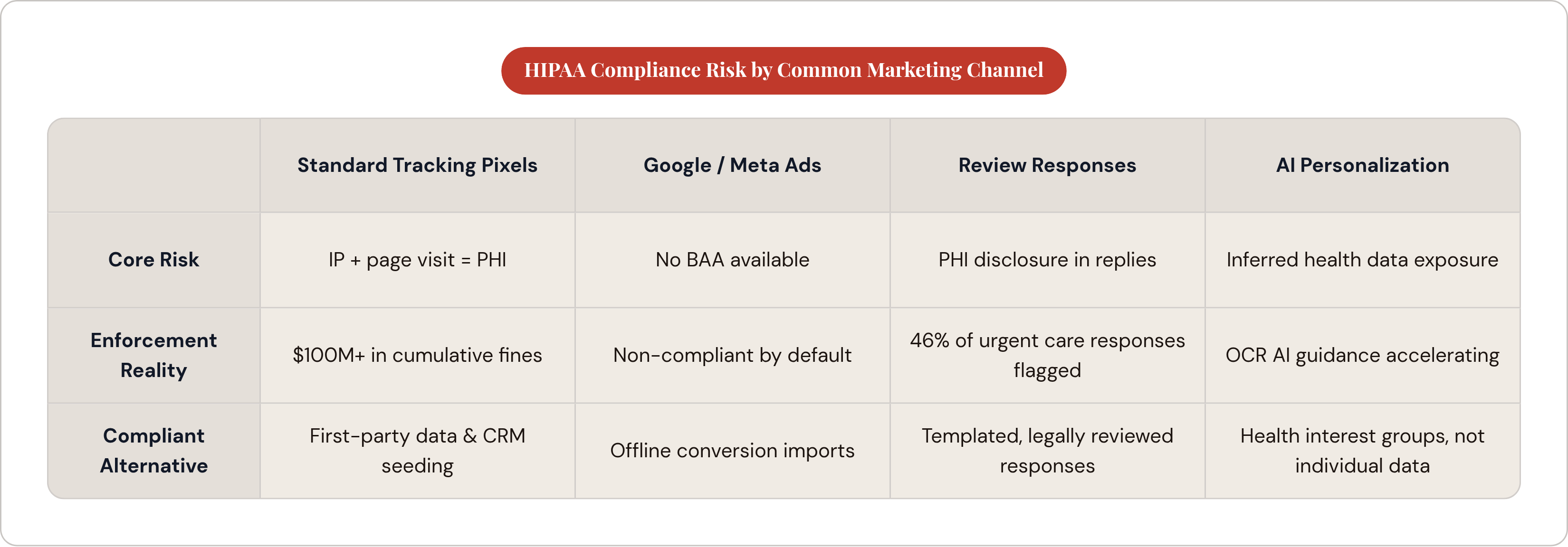
Then there is the HIPAA dimension, which is where reputation management becomes a compliance liability. A 2025 Chatmeter assessment of responses from 2,400 urgent care providers found that 46% contained HIPAA violations. The documented penalties are concrete: a dental practice received a $50,000 fine for disclosing protected health information in a Google review response; another provider paid $10,000 for similar disclosures, per Bass, Berry and Sims' 2026 analysis of HHS OCR enforcement cases.
The discipline required is specific. Your response templates need legal review. The goal is acknowledging a reviewer's experience without confirming any appointment, condition, or treatment detail. It is entirely possible to respond graciously, professionally, and in compliance with HIPAA simultaneously. It just requires a template and a process, not improvisation.
HIPAA Compliance and Digital Tracking Are Now in Direct Conflict. And Marketers Are Liable
This is the section that makes some marketing leaders uncomfortable, but the facts don't have a softer version.
HHS OCR issued guidance in December 2022, updated it in June 2024, and has actively enforced it through 2026. The position is unambiguous: standard third-party tracking pixels on patient-facing web pages constitute HIPAA violations, regardless of intent. The pixel doesn't need to transmit a diagnosis. An IP address combined with a page visit to a mental health services page is, under that guidance, protected health information.
The financial exposure is real. Pixel tracking violations have cost U.S. healthcare providers over $100 million in cumulative fines. In early 2025 alone, settlements totaled more than $15 million, including a $6 million settlement with HealthPartners and a $2.85 million settlement with University of Rochester Medical Center. These are not boutique penalties against small practices. They are penalties against major health systems with legal and compliance teams.
The platform gap is particularly clarifying. Facebook, Google, and LinkedIn Ads do not sign Business Associate Agreements. Google Analytics 4 and Adobe Analytics do not offer BAAs and explicitly prohibit PHI in their products. The standard martech stack that most healthcare organizations have built is non-compliant by default. That is not an exaggeration; it's the accurate starting position for most teams.
In June 2025, a federal court in the Southern District of New York denied a motion to dismiss in a website privacy class action, allowing eight of twelve claims to proceed, including a federal wiretapping claim. Consent-based defenses are not reliable. The compliance question is no longer theoretical.
The compliant path forward is also, practically, a better marketing path. First-party data strategy (meaning structured email acquisition, CRM-based audience seeding, and offline conversion imports) reduces PHI transmission risk while improving attribution accuracy. Marketing by health interest group rather than individual behavioral tracking produces campaigns that are both scalable and defensible. Content-driven engagement strategies that build audiences through blogs, webinars, and decision tools generate durable relationships that pixel-dependent retargeting cannot replicate.
OCR issued more AI-related guidance in 2025 than in the previous five years combined. The regulatory environment is accelerating in the same direction as AI adoption, not trailing it.
Local SEO and the Geography of How Patients Actually Choose Providers
Practice location is a deciding factor for 59% of patients choosing a healthcare provider, per Tebra's 2025 Patient Perspectives report. That figure has tactical implications, because search algorithms now heavily prioritize localized results even when a patient types no geographic terms. A search for "back pain specialist" surfaces results shaped by where the searcher is sitting. The patient doesn't have to intend a local search for location to govern the outcome.
The tactical requirements follow directly: (i) location-specific landing pages, (ii) consistent name, address, and phone data across directories, (iii) geo-targeted advertising, and (iv) Google Business Profile optimization. None of these are particularly exotic, but all of them require coordination, because location data errors typically originate in practice management systems, not in marketing tools. An address discrepancy in the scheduling system propagates across directories and degrades local SEO performance in ways that never show up on a campaign dashboard.
The intersection with reputation is operationally important. Local pack search results surface star ratings alongside location data. A practice's review score and its local SEO ranking appear together in the patient's first glance, making them functionally inseparable in the consideration moment. A well-optimized local listing with a 3.8-star rating is competing against a less-optimized listing with a 4.7. The rating often wins.
The CMO-level implication is that local SEO is not an SEO team task. It requires coordination between content, paid media, and operations. Treating it as a technical function rather than a campaign-level priority is a consistent source of underperformance.
How AI-Generated Search Results Are Changing What Healthcare Content Needs to Do
Google AI Overviews have grown by 115% since March 2025. More than a third of the pages cited in AI-generated summaries are top-ranking pages. Getting cited in an AI Overview is now a distinct goal from ranking on page one, and the two do not always overlap. A piece of content can rank organically and still not appear in the summary that 37% of consumers are reading instead of clicking through to search results.
The generative AI traffic concentration is significant: ChatGPT and Gemini command more than 85% of global generative AI traffic as of May 2025. Consumer use of AI for health-related questions has stabilized at 37%, with adoption strongest among patients aged 18 to 34. The patient cohorts most comfortable with AI-mediated health search are the ones entering their prime acquisition years.
What changes for content strategy is fundamental. The goal shifts from ranking for a keyword to being the authoritative source an AI summary cites. That rewards content that is structured, specific, and demonstrably expert on narrow topics, over content that covers broad keyword territory shallowly. A detailed, well-structured answer to a specific clinical question (such as what to expect in the first 72 hours after a knee replacement) has better citation potential than a generic orthopedics overview page.
In practice, Generative Engine Optimization means (i) clear entity markup, (ii) FAQ-style answers to specific questions patients actually ask, and (iii) a content architecture that demonstrates depth on defined clinical areas. The content team's question changes from "what keyword does this target?" to "what question does this answer completely?"
The compliance connection is not minor. AI Overviews pull from indexed content. Inaccurate or outdated clinical information that gets cited in an AI-generated summary creates both reputational risk and potential liability exposure in a healthcare context. Content governance, including regular audits of clinical accuracy, is no longer just a quality concern. It's a risk management function.
Short-Form Video as a Patient Acquisition Channel With Real Conversion Implications
The fastest-growing healthcare practices on social media share a consistent pattern: they produce short-form vertical video. Instagram Reels, YouTube Shorts, and TikTok videos in the 30-to-90-second range are now the dominant format for health information discovery among patients under 45. More than 60% of people use social media to search for health information, and video is what surfaces in those feeds.
The content formats that convert are specifically the ones that reduce uncertainty. Condition explainers that answer common pre-visit questions. Provider introduction videos that let patients see who they'd be meeting before they book. Procedure walkthroughs that demystify what a visit actually looks like. Patient experience narratives, with proper written consent, that make the practice feel familiar rather than clinical and distant. All of these address the same friction: patients hesitate to book with providers they don't know. Video shortens the distance.
The compliance overlay applies to this channel with the same force it applies everywhere else. Patient testimonials require written HIPAA authorizations before they're posted. Before-and-after content carries specific FTC and platform-level restrictions. Any health claim made in a video is subject to the same regulatory standards as written content, which means it needs the same review process.
The strategic frame is this: short-form video's acquisition value is concentrated at the top of the funnel. It reduces unfamiliarity, not objection. It is the video equivalent of the telehealth first-visit effect, in that it lowers the perceived risk of engagement before any commitment is required. The acquisition impact is real, but it's earned through volume, consistency, and relevance, not through production value.
What Separates Acquisition Strategies That Compound From Those That Plateau
None of these trends operates in isolation, and that's the point.
Reputation affects local SEO rank. Local SEO rank determines whether a provider appears in AI Overviews. AI Overviews affect whether video or content drives a first click. First-party data strategy is the compliance bridge that makes personalization possible without PHI exposure. The telehealth entry point feeds the CRM, which enables the email nurture, which activates the portal, which is where acquisition becomes retention.
The practices and health systems most likely to outperform over the next three years are the ones that treat patient acquisition as a coherent system rather than a portfolio of disconnected channel tactics. Every section of this landscape rewards integration. Every gap between channels is a place where patients exit.
The compliance pressures, which are accelerating, are not constraints on ambition. They are a forcing function toward first-party data strategies that produce better attribution and more durable audience relationships than pixel-dependent approaches ever reliably did. The legal risk and the performance argument point in the same direction.
The audit framework for marketing leaders is straightforward: check each of these dimensions not just for presence, but for integration. Is the telehealth funnel instrumented into the CRM? Have review response templates been through legal review? Is content being structured for citation in AI-generated summaries, not just for keyword ranking? Is the local SEO infrastructure coordinated between marketing and operations? Is short-form video connected to a conversion path, or producing engagement with nowhere to go?
Those are operational questions, not strategic ones. The strategies that compound are the ones that answer them.