Health IT Vendor Marketing to Hospital Procurement Committees
Hospitals evaluate health IT through six parallel gatekeepers, not one champion.

A Hospital procurement committee includes 12 to 18 stakeholders. Almost every Health IT vendor keeps selling to one committee member, but the single-champion approach is why a win that seems certain early on later falls apart. Content has to speak to skeptics every bit as much as champions do, because skeptics are the people who determine if it closes. In practice, you're mapping each piece of clinical evidence, every technical spec, the ROI case, and the paperwork template to whoever gatekeeps that step.
Big Health IT sales in 2026 move along a predictable path, though each system stretches or compresses the calendar. Vendor evaluation takes several months. Over those months, either an RFP that's formal or a bake-off that's informal narrows the field to a shortlist of vendors, and clinical evaluation plus technical assessment run alongside security review and analysis of financial matters rather than in sequence. Committee review runs for several additional months, involving IT governance plus clinical informatics, along with the finance committee, and at the biggest systems, trustees too. Contracting, including BAA signing, SLA negotiation, and coverage needs, takes additional time. Setting things up takes another month or two. In total, closing a contract runs 9 to 18 months after initial outreach, while some health systems may extend the timeline beyond 18 months.
The timeline isn't a single forward march. The timeline moves along parallel paths, and here’s where many vendors miss it: they shape content as though a gatekeeper finishes ahead of another begins. In a single seven-day stretch, the CMIO checks FHIR integration proof, finance leads run TCO numbers, and security wants penetration results. Roll out assets in sequence (clinical case study, technical brief after that, ROI calculator last) and one of them will keep waiting. They began evaluating alongside the clinical champion from day one.
Regulatory deadlines also complicate procurement calendars. CMS Interoperability plus Patient Access Final Rule, ONC's info-blocking rule, and Medicare authorization updates all cause spikes beyond the usual budget cycle. When Vendors who prepare for compliance ahead of deadlines capture procurement urgency while the RFP cycle stays uncrowded, they capture procurement urgency while the RFP cycle stays uncrowded. For GPO channels, the procurement process requires dedicated relationship-building and content. Vendors lose actual deals when they fold GPO into the buying committee as just another subset. GPO demands dedicated relationship-building plus dedicated content, period.
Your content library, covering 9 to 18 cycle, needs to follow the timeline, step by step. A straight path where someone starts and finishes in one go falls apart when steps run parallel like this.
Mapping the six personas who control the decision and what each requires
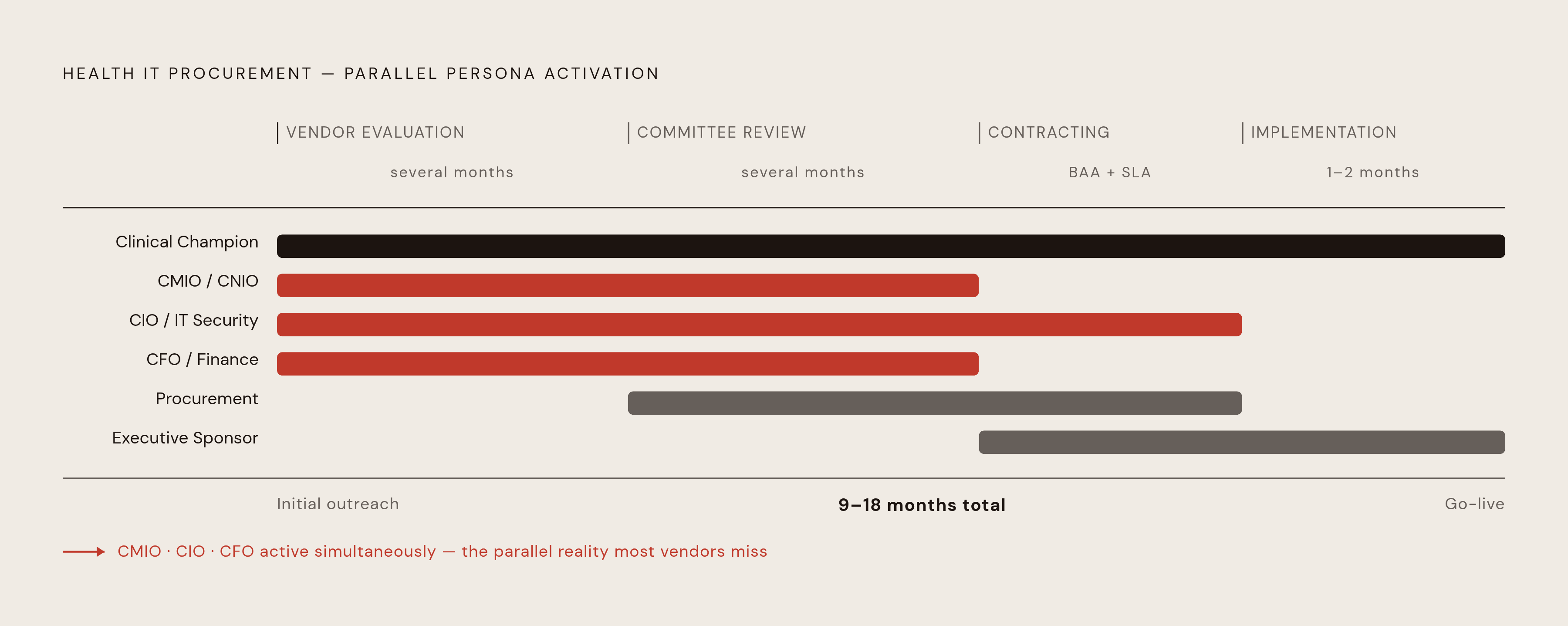
Six personas can veto any Health IT deal, and each reviews a vendor for its own reasons in its own stage of the cycle.
A champion from the clinical side, like a physician or head RN, shows up earliest to kick off the evaluation. They want workflow effects, patient harm, what peers have found, and how much extra work the product creates for the team. Decks do not help here; persuasion comes from peer-authored case studies, physician testimonials tied to named reference accounts, plus specialty-specific workflow assessments.
Once clinical evaluation and IT governance begin, the CNIO or CMIO steps in, making EHR integration the top buying objection across the whole cycle. Epic, MEDITECH, and Oracle Health (once Cerner) dominate inpatient care, yet ambulatory practices lean on athenahealth and other major EHR platforms. Even if the tool itself is great, any vendor lacking a named integration, an Epic Showroom spot, or involvement with Cerner's CODE gets cut at this stage. This is how a superior offering gets beaten by one that's weaker but has superior plumbing.
Alongside clinical work, CIO plus IT security handle the technical assessment plus the security review. This evaluation looks at HIPAA compliance design, governance, security certifications, and uptime SLAs. Each vendor says they're HIPAA compliant, so that alone convinces no one. A signed, executed BAA tied to a major named health system like Kaiser Permanente, HCA Healthcare, or Mass General Brigham carries more value than any online compliance claim, and that is what moves the persona.
The finance committee and CFO arrive during financial analysis and remain until committee review concludes, seeking multi-year projections, ROI modeling grounded in benchmark numbers, and lifetime price. In 2026, one issue needs naming: procurement groups may require documentation of financial stability. Proof of financial stability now counts as its own piece of CFO content. That work is not done in silence during diligence with no record kept.
Procurement leadership manages GPO coordination alongside the contracting phase and RFP work, which manages GPO coordination alongside the contracting phase and RFP work. This persona looks for RFP response templates pre-loaded showing compliance, BAA documentation drawn from peer health systems, plus GPO purchasing status. A named reference from one top-tier health system gets a vendor shortlisted sooner than logos pulled from mid-market clients can, and vendors going for bulk rather than prestige here throw away their shot.
At final sign-off, the final decision-maker focuses on high-level goals rather than technical details. They need a concise summary tied to strategic objectives, and competitive positioning. Without exceptions, a Brief, visually simple summary always wins over something thorough here.
Building the content library: asset types, formats, and which persona each serves
Nearly all vendors end up with a single content library aimed at the clinical champion, because that persona is the easiest to serve. Doctors care about results plus peer validation, so that content stays comparatively easy to make. The CFO, procurement teams, and the CIO receive zero materials made for them. That missing piece most often makes a sure thing stalls during committee review, yet is avoidable, though many vendors only learn after a few losses.
Your library works when every gatekeeper gets separate assets, rather than a single asset stretched to reach them all. Peer-authored case studies of similar hospitals, plus specialty-specific workflow assessments, ideally backed by physician testimonials that cite named reference accounts, best serve clinical champions. CMIOs and CNIOs need EHR integration one-pagers that name the specific platform and integration program, plus HL7 FHIR certification summaries. CIOs, along with security staff, get technical system diagrams, SOC 2 and HITRUST certification files, plus access documentation a reviewer can check point by point. Give CFOs multi-scenario calculators for ROI plus TCO estimates benchmarked using named options. Procurement requires ready-made RFP response blocks plus executed BAAs signed with major health systems. Sponsors want a brief, two-page summary tied to one regulatory or value-based care program.
How you present content can count as much, or more. If an app breaks down at a hospital, it carries clinical danger instead of simple inconvenience, which is why Healthcare buyers remain skeptics. Marketing language that signals naivete about that stakes level, "disrupt your workflow" is the classic offender, kills credibility before a committee conversation even starts. You must back up each clinical statement with verifiable proof. Compliance should come across as a credibility asset rather than a disclaimer bolted on at the end. Also, PHI can't turn up in case studies, testimonials, or ads without signed patient authorization; anonymized results with hospital attribution are a compliant route, though PHI remains okay where a patient agrees.
A couple of items consistently build committee credibility alongside the content alone. Named reference accounts tied to top-tier health systems carry more weight than many mid-market logos across the whole cycle. Peer-authored content, say a physician co-authoring one clinical case study, carries extra pull among clinical champions versus the vendor-authored kind, however polished the vendor piece looks.
One gated whitepaper plus a few scattered assets doesn't make a library. Those pieces have their place at specific stages for specific personas, but none of them, alone or stacked together, will carry a 12 to 18 stakeholder committee through a cycle that runs the better part of a year and a half.
Where buyers research before they contact anyone, and how to be present before the RFP
In healthcare, most buying occurs well before any vendor hears a word from prospects. Once the formal evaluation kicks off, buyers mostly have their vendor picked already, and staying invisible through the research phase compounds into a gap that's tough to close. You face exclusion from the RFP long before anyone starts outreach.
So where is that research taking place? KLAS Research leads that work: the KLAS Research is the primary third-party validation source procurement committees cite. Trade shows matter more here than in most B2B categories. HIMSS Global Health Conference draws thousands of attendees, ViVE gets roughly 8,000, while specialty events from HFMA plus AHIMA, with AONL, fill the calendar. A vendor that skips content before, during at-show events, or post-show pays a heavy price, because Health trade shows produce deal percentages bigger than nearly every other B2B field. Physician peer groups plus specialty society outlets count too, because clinical champions believe fellow doctors more than any vendor. For CMIO and CIO roles, along with CFO leaders, online channels play a key role.
Most vendors still underregister how much the newer channel shifts things. Procurement teams now start their comparative searches on Perplexity, ChatGPT, and Google Overviews. "Which EHR-integrated patient engagement platforms have executed BAAs with major health systems" is exactly the kind of query a CMIO now runs before contacting anyone. A large share of Americans use AI tools to research purchases, and B2B buyers pick up the habit even sooner than regular people. More than a quarter of all searches now end without a click at all, which means if a vendor's answer never surfaces in the AI-generated response, the buyer may never reach that vendor's website, even ranking first in traditional organic search won't save it. But there's an upside, too: a click from an AI response converts meaningfully better than one from ads or normal Google results, so the vendors winning a mention and getting clicked enjoy stronger outcomes.
Most of the work already covered in the content playbook applies directly to AI visibility. You're doing identical tasks for another kind of audience. When picking what to pull into a generated reply, AI systems lean on credibility signals like clear author credentials, reputable citations, and steady, up-to-date content. Much of it comes down to strategy: consistent positioning, showing up in the KLAS directory and HIMSS directory, and named EHR integrations said the same way wherever they appear. Mentions from Health Affairs, from Modern Healthcare, and from Becker's Hospital Review give AI credibility, roughly as they do for procurement committees. What you write for those six personas mostly earns AI citation too, as long as it always carries obvious authorship plus consistent signals wherever you publish.
Sequencing content deployment across the buying cycle: who gets what, and when
When content goes out counts as much as making it, and a bad sequence burns through assets that were hard to create. During this earliest phase, roughly six months into a vendor's visibility push ahead of any formal RFP, aim for the clinical champion plus a CMIO and CNIO. They tend to kick off the project on their own, before the procurement team is even aware it's started.
During the earliest phase, you need specialty-specific clinical content shared via physician peer networks, a booth inside HIMSS plus your main specialty society event, and a solid KLAS rating people keep citing often, with pieces carrying credentials from a named author that smart systems can find and show to buyers. At this point, the aim is just to make the shortlist. You want to surface hesitations while open questions remain addressable, so they never harden toward flat refusals down the line, and the champion already sees you among a few vendors when presenting to their committee. At that point, formal evaluation is already under way, with or without that vendor there to witness it.