HIPAA Constraints on Healthcare Digital Advertising
Federal guidance on tracking pixels has made most healthcare websites non-compliant by default.

The legal exposure hiding inside most healthcare marketing stacks is not a gray-area compliance question. It is a specific, operational problem created by default technology configurations that nobody reviewed against a clear legal standard. HIPAA's constraints on digital advertising are not vague. They govern exactly where patient data is collected, how it moves through a martech stack, and who receives it on the other end. Healthcare marketers who understand those mechanics can run effective campaigns. Those who don't are accumulating liability with every page view — like a slow leak in a pipe that nobody checks until the ceiling caves in.
How the HHS OCR Tracking Technologies Bulletin Rewrote the Rules for Website Analytics and Pixels
Before December 2022, most healthcare marketing teams treated website analytics as a separate domain from HIPAA compliance. That separation ended with a single bulletin.
HHS Office for Civil Rights issued guidance that year with a finding that reframed the entire analytics category: when a covered entity deploys tracking tools like Google Analytics or Meta Pixel, and those tools transmit individually identifiable health information to a third party without authorization, that transmission constitutes an impermissible PHI disclosure. The guidance did not carve out a special case for marketing technology. It applied HIPAA's existing framework to tools that had been running on healthcare websites for years, largely unexamined.
The practical effect was significant. Most standard analytics deployments on healthcare sites fell out of compliance, not because of anything new the sites had done, but because a federal agency had clarified in writing what the law already required.
Seven months later, in July 2023, HHS OCR and the FTC sent coordinated warning letters to a substantial number of hospitals using third-party tracking technology. That move was not guidance. It was a signal that federal attention had moved from advisory to adversarial.
A revised bulletin followed in March 2024 and introduced the clarification practitioners most needed: an IP address alone does not automatically qualify as individually identifiable health information. But the combination of an IP address with a visit to a condition-specific webpage, where the visit reflects a person seeking care, does constitute PHI. Disclosing that combination to a third party without a Business Associate Agreement or patient authorization remains a violation.
That clarification set up a legal challenge. In June 2024, the U.S. District Court for the Northern District of Texas, in American Hospital Association v. Becerra, vacated the specific guidance as it applied to IP addresses combined with visits to unauthenticated public webpages about health conditions. HHS voluntarily withdrew its appeal in August 2024, leaving the court's limitation in place.
The ruling was narrow. It addressed one specific combination, on one category of page. Everything else in the bulletin remained operative. More importantly, the ruling left untouched the obligations on authenticated pages: patient portals, telehealth platforms, health plan portals. These pages hold diagnoses, prescriptions, billing data, appointment information, and medical record numbers. Any tracking technology deployed on an authenticated page has access to substantial PHI, and the legal standard there has never been in dispute.
The authenticated versus unauthenticated distinction is now the operative legal line. That is where every healthcare marketing team should be orienting their compliance posture.
Where PHI Actually Appears in a Standard Digital Ad Workflow
The data points that create PHI in a digital advertising context are rarely dramatic on their own. The danger is combinatorial — think of it as a puzzle where no single piece reveals the picture, but assembled together, they expose everything.
A single IP address is, under current guidance, insufficient to constitute PHI by itself. That same IP address, paired with a page path that reveals (i) a health query, (ii) an oncology service line, (iii) a fertility treatment page, or (iv) an addiction recovery intake form, can create a linkage between an identifiable individual and a health condition. That pairing is PHI, and transmitting it to a third-party ad platform without authorization is a violation.
This combination problem runs through every layer of a standard healthcare martech stack.
Appointment scheduling pages capture intent and identity signals simultaneously. Patient portals contain some of the most sensitive data in existence, and any pixel or tag deployed on a portal page has potential access to all of it. Symptom checkers and condition-specific content pages create a health inference from the page path alone, before a user types a single character. Session replay and heatmap tools can capture what users type into form fields, including health information entered but never submitted. Dynamic number insertion for call tracking connects an online session identity to a phone call, tying a person to whatever health query prompted the call. Tags and SDKs embedded in mobile health applications follow the same logic as browser pixels and carry identical exposure.
Remarketing list construction deserves particular attention because it is one of the most common digital advertising tactics and one of the clearest violations in a healthcare context. Building an audience from visits to pages about a specific medical condition and retargeting those users is not a configurable-away problem. The act of constructing that audience from health-adjacent behavior is the violation, regardless of which platform executes it or how the data is routed.
The risk is not only regulatory. Research published in PNAS Nexus in 2025 found that third-party pixel use significantly increases data breach risk among hospitals. The advertising technology that creates compliance exposure also creates security exposure. Those are not separate concerns.
How Widespread Non-Compliance Actually Is Across Hospital and Health System Websites
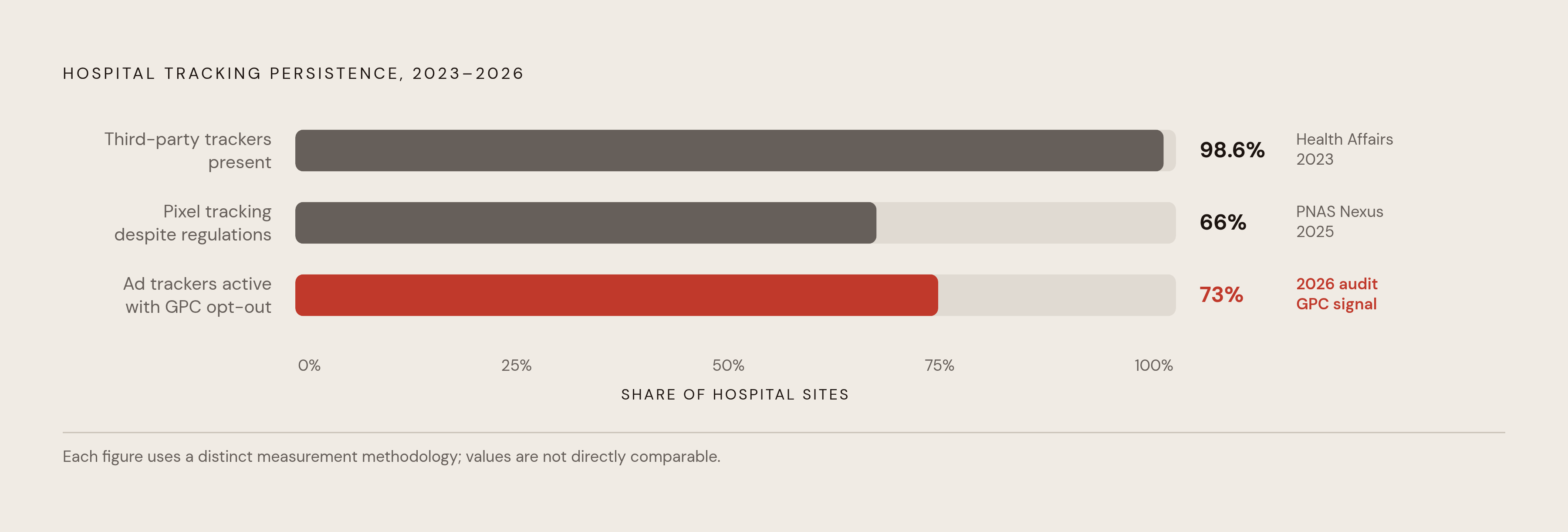
The compliance problem in healthcare digital advertising is not a fringe issue. It is the default condition.
A study published in Health Affairs in April 2023 found third-party tracking present on 98.6% of U.S. nonfederal acute care hospital websites, with data transfers reaching technology companies, social media platforms, advertising firms, and data brokers. That figure was established before the regulatory escalation of mid-2023 through 2024. The relevant question is whether intensified federal attention changed behavior in any meaningful way.
The evidence suggests it did not change much. A 2026 audit of major U.S. hospital and clinic websites found advertising trackers still running on 73% of sites even when crawled with an active Global Privacy Control signal, the legal opt-out mechanism recognized across multiple U.S. states. GPC signals are supposed to halt tracking automatically upon detection. The audit found most sites did not honor them. That is not a policy failure alone; it is a technical implementation failure, meaning the decision to comply existed somewhere in the organization but never reached the code.
A 2025 PNAS Nexus study analyzing Wayback Machine data from 2012 through 2023 found that 66% of the hospital sample employed pixel tracking despite stringent privacy regulations, and that usage continued rising through 2023 even as regulatory attention intensified.
What this data describes is not a population of organizations that are unaware of the rules. The Health Affairs study, the HHS/FTC warning letters, and the AHA litigation all generated substantial industry coverage. The persistence of non-compliance through a period of explicit regulatory signaling points to a structural problem: the people building and deploying martech stacks and the people responsible for legal and compliance functions are not working from the same map of the same technology.
Business Associate Agreements as the Gating Mechanism for Every Vendor Relationship
A Business Associate Agreement is the legal instrument that makes it permissible for a covered entity to share PHI with a vendor. Without one, the disclosure is unauthorized. That is the rule, and it applies to digital advertising vendors exactly as it applies to billing processors or IT infrastructure providers.
What practitioners sometimes miss is that a BAA is necessary but not sufficient. Data minimization requirements and server-side routing obligations exist independently. Signing a BAA with an analytics vendor does not resolve a problem created by a browser pixel that passively captures PHI and sends it before any server-side controls can intervene. Both the contractual layer and the technical configuration layer must be correct.
Meta does not sign BAAs. That is not a negotiable point or a temporary policy position. It means there is no lawful path to sending PHI to Meta's advertising infrastructure. Compliant Meta advertising is still achievable, but it generally requires a specific architecture: (i) strip PHI from all data before it reaches Meta; (ii) route conversion data server-side through an intermediary that has signed a BAA; (iii) keep the Pixel entirely off sensitive and condition-specific pages; and (iv) never upload patient lists that include identifiable health data. The compliance path exists; it just requires building around Meta's constraints rather than assuming the standard pixel deployment is acceptable.
Google occupies a different position. Google offers BAAs for its advertising and analytics products, which means compliant configuration is achievable. The preferred method is server-side conversion tracking or offline conversion import rather than browser-based pixels that may capture PHI passively during page rendering. A BAA with Google does not make a misconfigured browser pixel compliant. It creates the legal foundation; the technical configuration still has to hold.
The BAA audit should reach every vendor in the stack that touches health-adjacent data: analytics platforms, CRM systems, email service providers, call tracking vendors, customer data platforms. The practical discipline this requires is doing the vendor inventory before any campaign architecture is designed. A BAA gap discovered after a pixel has been live for six months is a retroactive violation problem, and retroactive problems in HIPAA enforcement accumulate by each disclosure, not each incident.
Platform-Level Advertising Restrictions That Operate Independently of HIPAA
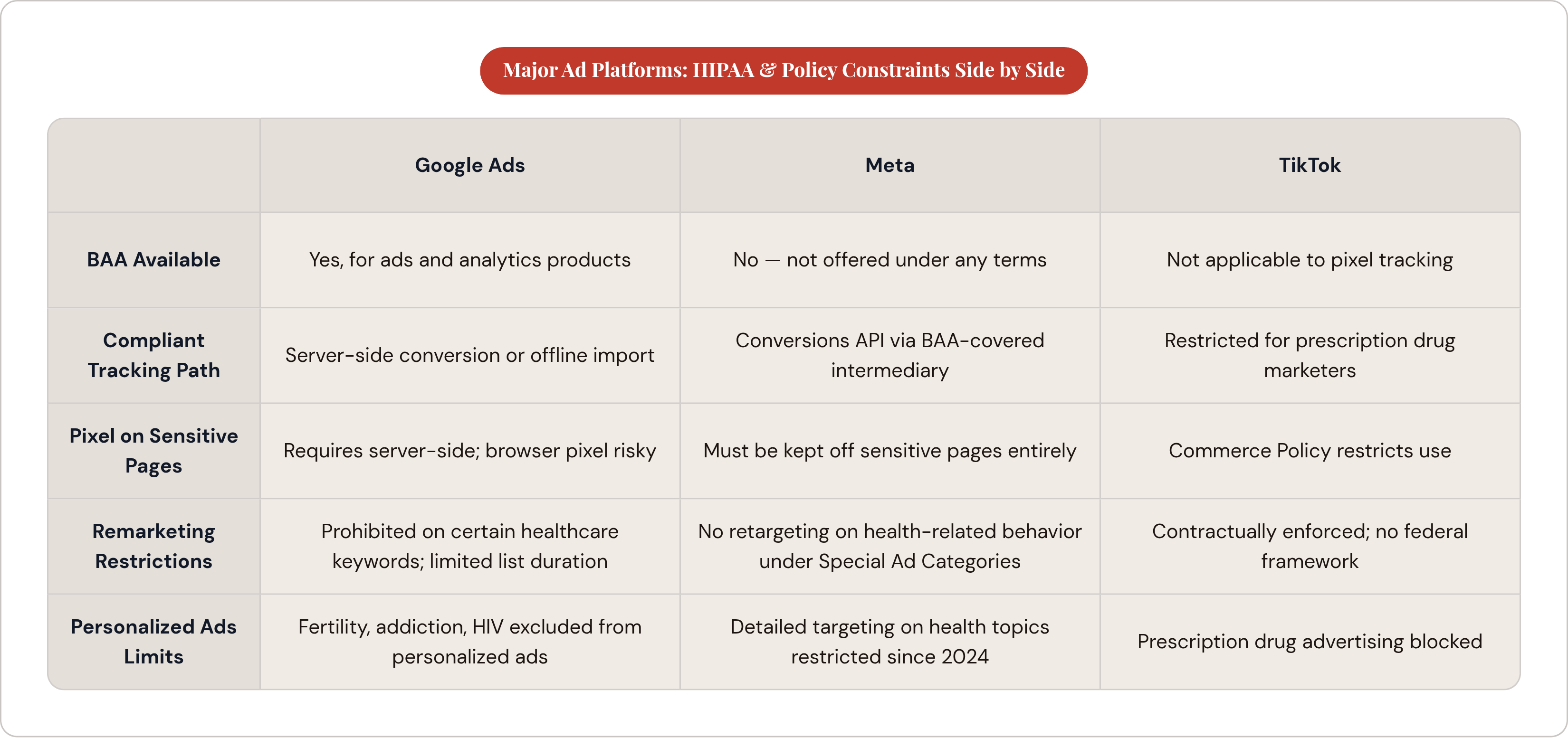
Healthcare marketers navigating HIPAA compliance sometimes reach a compliant configuration and then discover that the ad platform won't run the campaign anyway. Platform policy restrictions operate on a separate track from HIPAA, enforced by the platforms contractually through account action, not by federal regulators. They are not HIPAA enforcement, and they are not resolved by legal authorization or a signed BAA. They simply exist alongside HIPAA, and both tracks require simultaneous review.
Google Ads (i) prohibits remarketing on certain healthcare keywords; (ii) prohibits personalized advertising on topics including fertility, addiction, and HIV; (iii) limits remarketing list duration for healthcare advertisers; and (iv) restricts prescription drug advertising to certified advertisers in approved geographies.
Meta restricted targeting options for sensitive health topics during 2024. Advertisers using Special Ad Categories, which include healthcare services, cannot use detailed targeting or retargeting based on health-related behavior. Custom audiences derived from off-platform activity face more stringent consent requirements than standard audiences.
TikTok's Commerce Policy restricts pixel-based conversion tracking for prescription drug marketers. The restriction is contractual and enforced through account policy, not through any federal framework.
The operational implication is direct: a campaign that satisfies every HIPAA requirement, has appropriate BAAs in place, uses server-side routing, and strips PHI from all outbound data may still be blocked or penalized at the platform level. Compliance review has to run both tracks, HIPAA and platform policy, in parallel. Running them sequentially, where legal clears the campaign and then the media team discovers a platform restriction, is an inefficient architecture for a function where time and budget both matter.
What Enforcement Has Actually Looked Like: Penalties, Settlements, and the Cases That Set the Pattern
The civil monetary penalty range as of January 2026 runs from $145 to $2,190,294 per violation category, per year of non-compliance. A single pixel firing across hundreds of pages thousands of times each year stacks violations rapidly. At the upper range, the liability calculation becomes existential for a health system's operating budget. Criminal exposure reaches up to ten years imprisonment for cases involving intent to sell, transfer, or use PHI for commercial advantage. Across 2023 through 2025, hospitals, telehealth platforms, and digital health applications paid over a hundred million dollars in penalties and settlements tied specifically to tracking technologies.
Two settlements deserve attention because they established precedents that reshaped how regulators, courts, and plaintiffs' attorneys think about health data and advertising technology.
GoodRx settled with the FTC in 2023 for unauthorized disclosure of consumers' health information to advertisers through advertising tracking technologies. It was the first-ever FTC enforcement of the Health Breach Notification Rule and established that FTC jurisdiction runs parallel to HHS OCR and reaches companies that are not traditional HIPAA covered entities. The settlement also generated class-action exposure from prescription data disclosure, separate from the federal action, demonstrating that a single enforcement event can produce multiple liability streams.
BetterHelp settled with the FTC in 2023 under circumstances that added a new dimension to the enforcement picture: the settlement required financial restitution to affected consumers, the first time such relief was included in a settlement of this type. The alleged conduct involved sharing sensitive consumer data with major social platforms. The significance is that regulators and courts are beginning to treat the consumer's privacy injury as financially compensable, not merely as a regulatory infraction between the company and the government. That framing changes the plaintiffs' litigation calculus substantially.
What both cases share with each other and with the broader pattern of enforcement is the nature of the underlying conduct. In neither case was the violation a deliberate organizational decision to expose health data. In each, the violation was a default technology configuration, a pixel deployed with standard settings, a data integration built without a legal review, a tracking tag that no one had mapped against applicable law. The enforcement risk in healthcare digital advertising lives in the technology stack and its default behaviors, not in organizational intent. That is the clearest operational signal the enforcement record provides.
How to Build a Compliant Digital Advertising Workflow in Practice
The audit comes before your campaign architecture, not after it. Before you deploy any pixel or construct any audience, map every point where user data is collected across your healthcare digital properties and trace where that data travels. The mapping exercise should distinguish authenticated pages from unauthenticated public pages from the outset; different legal standards apply to each. Every third-party vendor receiving data from those pages needs to be cross-referenced against your signed BAAs. A gap in that cross-reference is a problem you must resolve before the next campaign brief is approved.
Server-side tagging is the structural solution to the browser-pixel exposure problem. Moving data collection off the browser and through a controlled server layer allows PHI to be stripped or hashed before any data reaches an ad platform. For Google, this enables compliant conversion tracking without browser-pixel exposure. For Meta, the server-side Conversions API, routed through a BAA-covered intermediary, keeps the Pixel off sensitive pages entirely while preserving the ability to measure campaign performance. Neither configuration eliminates the need for correct legal agreements and careful audience strategy. Both configurations make compliance operationally achievable.
Audience strategy requires a different conceptual frame in healthcare than in other verticals. Condition-specific retargeting is not a configuration problem with a compliant solution. It is a category of targeting that is prohibited regardless of how the technical architecture is built. The audience construction, not just the delivery mechanism, is where the violation originates. What remains viable: (i) contextual targeting based on content adjacency rather than individual behavior; (ii) first-party data collected from non-health contexts with appropriate consent; and (iii) lookalike audiences built from compliant seed populations, for example, service-line inquirers who explicitly opted in through a process that meets HIPAA's authorization standard.
Consent architecture in healthcare has to go beyond cookie banners. Implied consent does not satisfy HIPAA. Any communication that qualifies as marketing under HIPAA's definition requires explicit opt-in. The privacy policy must name what is collected, how it is used, and with whom it is shared; generic boilerplate does not constitute disclosure. Global Privacy Control signals need to be honored technically, not just acknowledged in policy. The 2026 audit finding that 73% of major hospital sites failed to honor active GPC signals is, at its core, a gap between written policy and technical implementation.
Call tracking should use aggregate reporting or hashed identifiers rather than dynamic number insertion configurations that create a linkage between a session identity and the health query that prompted the call.
The workflow that avoids enforcement exposure is one where marketing and legal/compliance teams share ownership of the martech stack from the beginning of campaign planning. Not a handoff where legal reviews a completed campaign brief, but a joint architecture review before any technology is deployed. The enforcement record demonstrates, repeatedly, that violations accumulate through default configurations that nobody reviewed against the legal standard. The remedy is structural: make the legal review part of the technology deployment process, not a checkpoint after the technology is already live.