Digital Therapeutics for Chronic Pain Management
FDA-cleared digital tools offer evidence-based alternatives to opioids for managing chronic pain.

The term "digital therapeutic" gets used loosely. That looseness costs people clarity, and sometimes appropriate care.
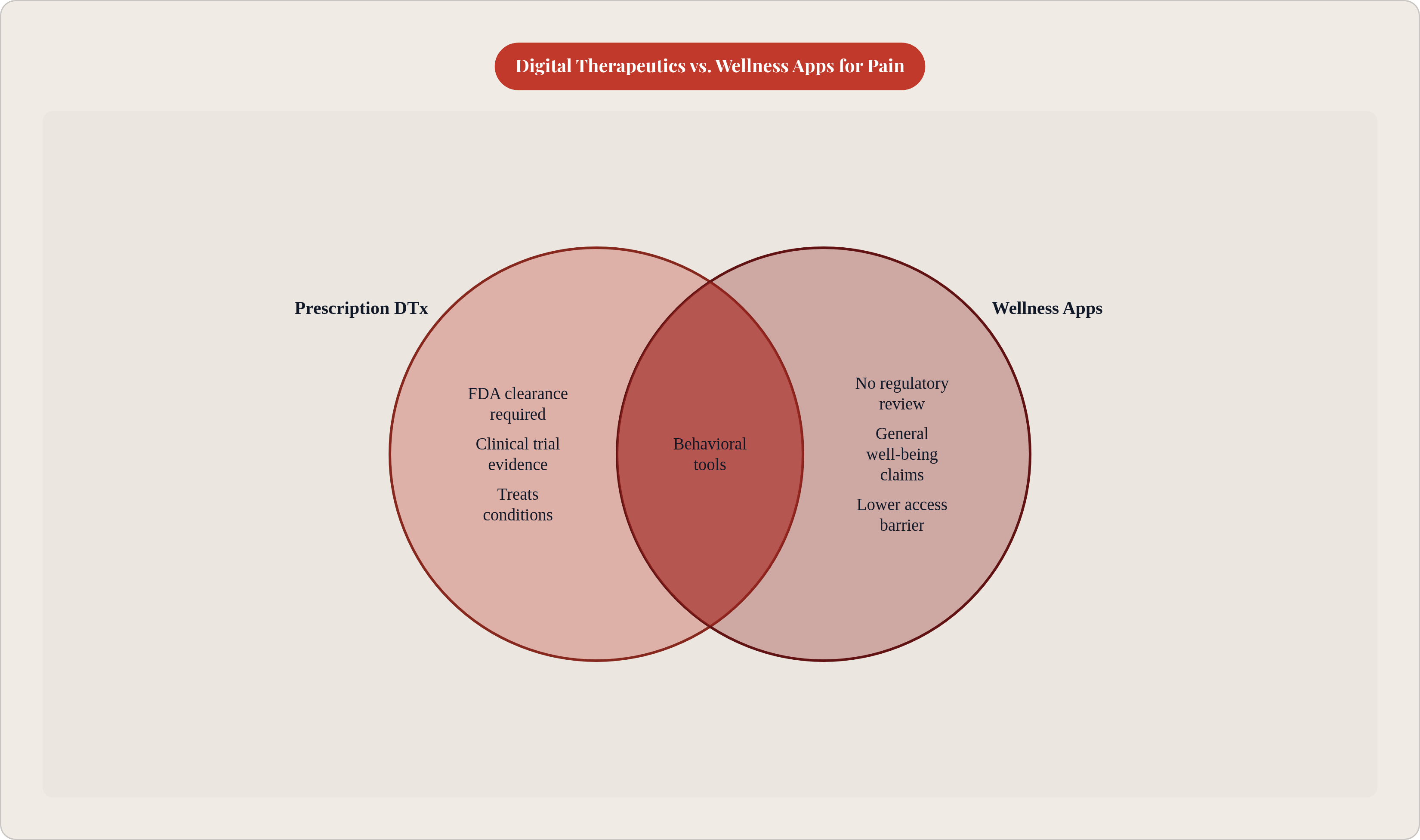
A digital therapeutic, in the formal regulatory sense, is a software-based intervention that delivers an evidence-based treatment for a specific medical condition. It is classified as Software as a Medical Device. It requires marketing authorization from a regulatory agency. In the United States, that means FDA clearance or De Novo authorization: processes that demand clinical trial evidence of safety and efficacy. The same evidentiary standard applied to a new drug or an implantable device applies here.
A wellness app makes no clinical claims. It requires no regulatory review. It can say it helps you relax or sleep better or feel more mindful, and those are fine things to offer. But it cannot say it treats a condition. That distinction is not semantic. It is the entire architecture of accountability. One structure holds weight; the other just looks like it does not.
For chronic pain specifically, the DTx category is built on a biopsychosocial model: the recognition that pain is simultaneously sensory, emotional, and cognitive, not purely a tissue signal being transmitted up a nerve. That reconceptualization is what opens the door to behavioral and psychological interventions as genuine medical treatments, not adjuncts, not coping tools.
The modalities inside the DTx category for pain are broader than most people expect. Cognitive-behavioral therapy delivered via app. Acceptance and Commitment Therapy structured across a smartphone program. Pain neuroscience education. Guided movement programs with remote monitoring. Biofeedback. Immersive virtual reality environments designed not to distract but to retrain how the brain processes pain signals. Remote electrical neuromodulation through wearable devices. AI-personalized symptom tracking that adjusts treatment in real time.
What unites all of these is that they intervene on behavioral and neurological pathways, not on peripheral biochemistry. They are not trying to block the pain signal at its origin the way an opioid or an anti-inflammatory does. They are working on the system that interprets, amplifies, and responds to that signal.
The practical question most people ask is reasonable: "Is this a real medical treatment or a glorified app?" The answer depends entirely on the specific product and its authorization status. Regulatory standing is the line that separates the two. Nothing else reliably does.
The neurological and behavioral pathways these tools target
Here is what chronic pain actually is, neurologically. It is not acute pain that forgot to resolve. It is a condition in which the nervous system itself has been remodeled, a process called central sensitization, in which the system becomes amplified, generating or magnifying pain signals in the absence of proportional tissue injury or ongoing damage. The alarm is firing not because the building is burning, but because the alarm system itself has gone haywire.
That distinction matters for treatment. If the problem were purely peripheral, the logical response would generally be to target the periphery: block the receptor, reduce inflammation, cut the nerve. But when the central nervous system is the site of pathology, behavioral and psychological interventions are not a consolation prize. They are mechanistically appropriate.
CBT for pain works primarily by targeting catastrophizing, the cognitive pattern most strongly correlated with pain severity and disability. Catastrophizing is not weakness. It is a predictable output of a nervous system that has learned, through repeated pain experiences, to treat sensation as existential threat. CBT interrupts that loop: patients identify the thought patterns amplifying their pain experience and systematically restructure them. Behavioral activation, the practice of deliberately re-engaging with avoided activities, counters the deconditioning and withdrawal that compound functional decline.
ACT operates differently. Rather than challenging pain-related thoughts, it builds psychological flexibility. Patients learn to hold the experience of pain without letting it organize every decision, every avoidance, every identity. For conditions like fibromyalgia, in which pain is diffuse and not fully explained by structural pathology, ACT's approach is particularly defensible. There is no discrete lesion to fix. The work is in how the person relates to an experience that will not fully resolve.
Pain neuroscience education is more specific than it sounds. It is a structured curriculum teaching patients how the nervous system produces pain, and how learned associations, threat appraisal, and central sensitization contribute to the experience they are having. Reconceptualizing pain as a nervous system output rather than a damage report demonstrably reduces its threat value, and that reduction has measurable downstream effects on disability and fear-avoidance behavior.
Virtual reality for pain is frequently misunderstood as distraction. It is not, or at least not only. Immersive VR environments engage attentional and emotional systems that modulate how nociceptive input is processed. The brain inside a VR environment is doing real perceptual work, and that work competes with and modifies pain processing. This is not placebo in the dismissive sense. It is an intervention on the mechanisms by which the brain converts signals into experience.
Remote electrical neuromodulation uses peripheral nerve activation to engage the descending pain inhibition pathways: the nervous system's own capacity to suppress pain signals. This is a hardware-software combination, not a behavioral intervention in the strict sense, but it is still working on the central pain-modulating system rather than blocking peripheral input.
Biofeedback gives patients real-time physiological data, muscle tension, heart rate variability, and other markers that correlate with pain flares. The therapeutic effect is self-regulation: patients learn to modify internal states they previously could not perceive, let alone control.
Movement and exercise programs address the deconditioning-pain cycle directly. When movement hurts, people stop moving. When they stop moving, deconditioning sets in, and deconditioning makes movement hurt more. Guided digital programs that progressively reload the body lower the barrier to breaking that cycle.
All of these interventions share a common logic. They work upstream of the pain signal's effect on the person, not by chemically blocking the signal at its source.
What the clinical evidence actually shows — and where the gaps remain
Digital therapeutics for chronic pain work. The effect sizes are real but not uniformly large. The category is supported, not proven infallible, and anyone telling you otherwise is selling something.
A 2025 systematic review analyzing 22 studies found that digital health interventions significantly outperformed control groups in reducing pain. That is a meaningful aggregate signal. It tells you the category has clinical substance.
A subsequent systematic review and meta-analysis added necessary nuance: while DTx contribute to reductions in pain intensity, effects on physical function and psychological outcomes remain inconsistent. High heterogeneity across studies (different platforms, different populations, different comparators) makes it difficult to generalize from pooled data to any individual product or patient. A 2024 scoping review found that digital interventions show promise in reducing pharmaceutical usage and deferring surgical procedures, with most studies reporting positive pain outcomes and associated mental health benefits. That directional consistency across different review methodologies carries weight, even where precision is limited.
VR evidence has matured enough to take seriously. A 2025 crossover trial published in npj Digital Medicine found that a five-week VR program significantly reduced pain intensity, anxiety, and pain interference while improving mood and sleep quality compared to matched audio-content controls. Matching to audio content controls for engagement and attention, and still finding a significant effect, strengthens the case that VR is doing something mechanistically specific.
Where the evidence is weakest is in long-term follow-up, and this deserves plain acknowledgment. Most trial designs examine outcomes at six to twelve months. What happens after that is largely unknown. Physical function and return-to-work outcomes are measured inconsistently across studies, which matters enormously for payers and employers trying to evaluate total cost of care. The field has not solved that measurement problem.
The engagement problem is structural. The 2025 JMIR review identified low engagement and retention as the binding constraint on DTx's full potential. These tools work well for the people who actually use them. But dropout is endemic across digital health, and chronic pain populations carry significant psychological burden that compounds adherence challenges. A tool that works at week four for adherent users is only as good as its ability to keep people through week twelve.
For pelvic pain, the evidence base is still early. A 2025 systematic review of randomized controlled trials found that digital health technologies produced significant pain reduction in experimental groups across six studies. The direction is consistent with broader evidence. The volume is not yet sufficient to anchor clinical guidelines.
The evidence supports DTx as a clinically meaningful option for chronic pain, not as a replacement for comprehensive care. Effect sizes justify inclusion in a treatment plan. They do not justify telling patients that an app is all they need.
Three FDA-cleared products that show what "regulated DTx for pain" looks like in practice
As of 2025, only 12 FDA-cleared digital pain therapeutics exist. That number is striking given the scale of the population they are designed to serve. It reflects both the rigor of the regulatory pathway and the genuine earliness of the market.
RelieVRx (AppliedVR): chronic low back pain
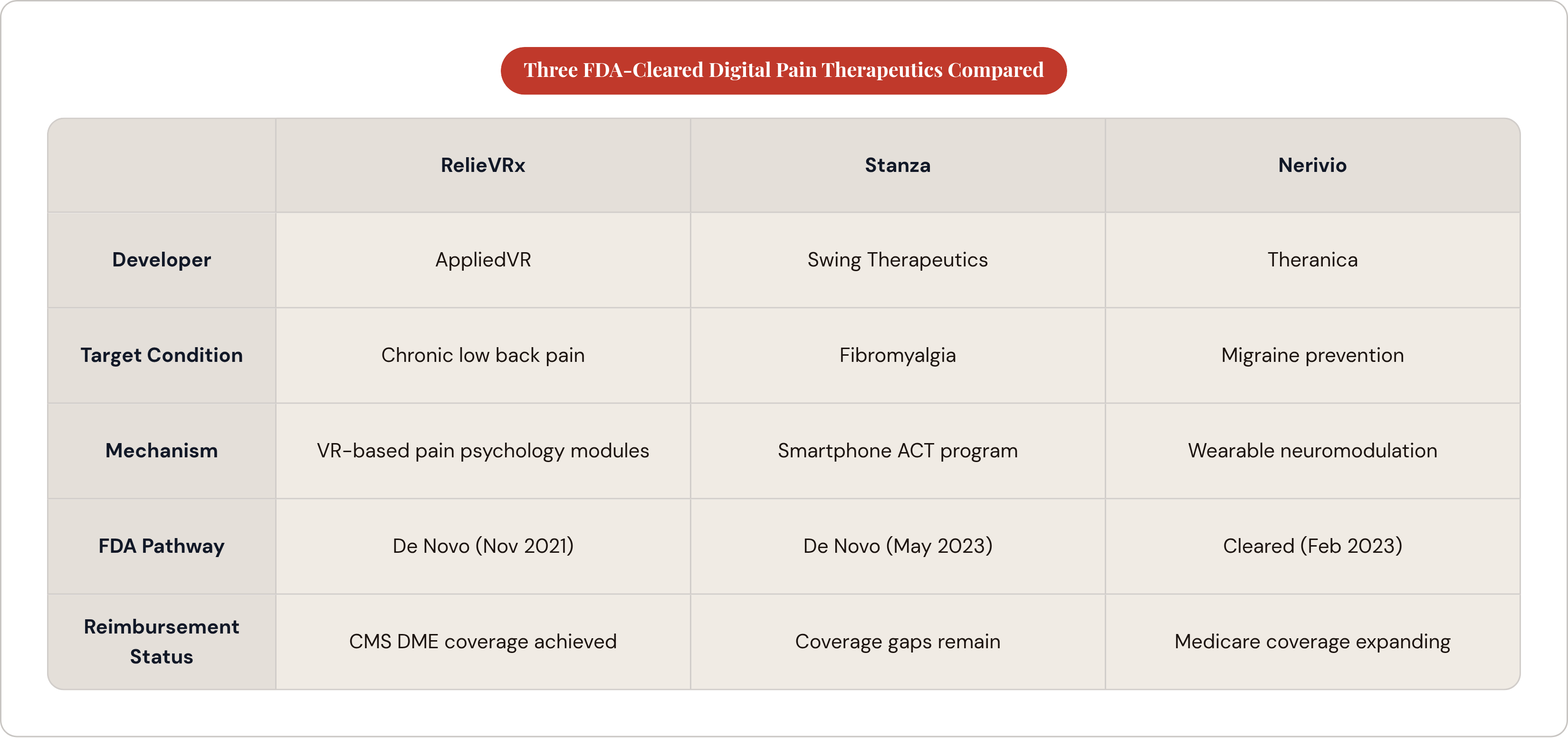
RelieVRx is a VR-based skills program for chronic low back pain. Patients complete structured modules on pain psychology, relaxation, and cognitive reframing via a headset, progressing through a defined course with logged milestones. It received FDA De Novo authorization in November 2021, making it one of the earlier cleared DTx in this category. CMS subsequently approved it as Durable Medical Equipment under a specific HCPCS code, making it one of the first DTx for pain to achieve reimbursement.
The CMS DME pathway is the structural win here. It established that a software-delivered behavioral therapy can move through coverage channels originally designed for hardware. That precedent matters for the entire category.
Stanza (Swing Therapeutics): fibromyalgia
Stanza is a smartphone-based twelve-week ACT program for fibromyalgia. It received FDA De Novo clearance in May 2023, validated through a trial described as the largest device trial ever conducted for fibromyalgia treatment. The condition is specifically relevant because pharmacological options for fibromyalgia are limited and frequently inadequate. The behavioral and neurological pathway is not a fallback here; it is often the most defensible primary approach. A cleared DTx for this population fills a genuine gap that medications have not closed.
Nerivio (Theranica): migraine
Nerivio is a wearable device delivering remote electrical neuromodulation, cleared by the FDA in February 2023 for preventive migraine treatment in patients twelve and older. It represents the hardware-software hybrid category: a physical device whose therapeutic effect comes through neuromodulation of peripheral nerves to engage descending pain inhibition, not through behavioral content or VR. In 2025, digital therapeutics delivering CBT-based migraine prophylaxis modules reached U.S. Medicare coverage, broadening access for older patients within this indication.
Taken together, these three products illustrate that DTx for pain is not one thing. It is VR, app-based psychotherapy, and wearable neuromodulation, each targeting a different mechanism, designed for a different patient, navigating a different reimbursement pathway.
The reimbursement landscape remains uneven. RelieVRx's DME pathway is the clearest win the category has produced. Most cleared DTx still face coverage gaps that limit patient access regardless of their clinical evidence.
How the major digital MSK and pain platforms differ from prescription DTx
The largest patient-facing segment of digital pain management is not FDA-cleared prescription digital therapeutics. It is employer- and payer-deployed musculoskeletal platforms, a distinct category that does not require De Novo authorization because these products do not make device-level clinical claims. They operate under a different regulatory posture, and that distinction shapes everything about how they are sold, contracted, and evaluated.
The major platforms in this space include Hinge Health, Sword Health, Kaia Health, Omada Health, and Biofourmis. Each combines some mix of guided exercise, remote physical therapy, health coaching, and wearable sensor feedback. The shared architecture is app-delivered movement programming, often with human clinician or coach involvement, outcomes tracking, and personalized adjustment based on progress data.
What distinguishes them from each other matters for anyone evaluating options. The degree of human-in-the-loop clinical oversight varies substantially. Some platforms offer synchronous sessions with licensed physical therapists; others operate on asynchronous coaching or are largely self-guided. Sensor reliance also differs: some require proprietary wearables, while others are phone-camera-based or sensor-optional, which affects both cost and adoption friction. Condition focus ranges from narrow (back and joint pain) to broad, covering the full MSK spectrum including post-surgical rehabilitation.
Sword Health's sponsored claims analysis found its digital care program associated with meaningful annual per-person savings in MSK care costs. The sponsorship disclosure is relevant context. Sponsor-funded studies in this space should be read with the same critical eye applied to pharmaceutical industry-funded trials: not dismissed, but weighted appropriately alongside independent evidence.
On a different tier, consumer-facing platforms like Curable and Twill offer pain neuroscience education and psychological techniques without employer contracting or clinical integration. The barrier to access is lower. The regulatory scrutiny is also lower. These tools can serve a meaningful role for patients who cannot access employer-sponsored programs or who want to begin working on their pain psychology before engaging formal care.
If you are evaluating options, the question is not only whether something is FDA-cleared. It is what the product is actually delivering, who is overseeing care, and how it connects to the rest of a treatment plan.
The market's size and the gap between growth projections and current patient access
The dedicated digital therapeutics for chronic pain market was valued at roughly $3 billion in 2024. Projections place it near $23.6 billion by 2034, a compound annual growth rate of approximately 23%. That is fast growth by any sector standard.
The broader digital health market for musculoskeletal care, a partially overlapping segment, was valued at several billion dollars in 2024, projected to reach well into the tens of billions by 2030. Investment capital concentrated sharply in this space in 2024, with the digital MSK sector raising hundreds of millions of dollars, nearly double the prior year. Investors see a large, underserved population and a category beginning to demonstrate scalable evidence.
For context, the overall chronic pain treatment market across pharmaceutical, device, and digital categories combined was valued near $78 billion in 2024 and is projected to roughly double by 2035. Digital therapeutics are a fast-growing but still small fraction of total pain care spending. The growth rates are impressive in isolation. They look different placed against the total market they are trying to address.
The access gap is the central tension. Projections suggest that a substantial share of chronic pain therapy encounters will involve a digital therapeutic component within the next several years. That projection implies either a dramatic scaling of the cleared product set or a broadening of what counts as a digital therapeutic component in a care encounter. Neither is implausible; both require significant infrastructure development to materialize.
North America leads the current market, supported by digital health infrastructure, wearable adoption rates, and the most developed reimbursement environment. Even so, coverage for cleared DTx within the United States remains inconsistent. A product can receive FDA authorization and still be inaccessible to most patients because payers have not established coverage policies. Capital is flowing in. Patient need is enormous. The regulatory and reimbursement pathways that would connect products to patients at scale are still being constructed, and that construction is moving slowly relative to the growth narrative investors and vendors are projecting.
Where digital therapeutics fit — and don't fit — in a chronic pain care plan
Digital therapeutics for chronic pain are not a replacement for clinical care. They are a component of it, one that works best when placed with precision, matched to the right patient at the right stage of care.
The conditions where DTx fit most defensibly are those where pharmacological options are limited, insufficient, or contraindicated. Fibromyalgia is the clearest example: medication provides partial relief at best for many patients, and the behavioral and neurological pathways that DTx target are mechanistically central to the condition's maintenance. For chronic low back pain without clear surgical indication, the evidence for behavioral and movement-based interventions is strong, and the risk profile is substantially more favorable than long-term opioid use. For migraine prevention, neuromodulation and CBT-based programs now have both regulatory clearance and emerging reimbursement, offering meaningful options alongside or instead of daily preventive medications.
Where DTx fit poorly is when they are used to avoid necessary evaluation. Chronic pain that has not been properly characterized (in which structural pathology, red flag symptoms, or underlying systemic conditions have not been ruled out) is not a population to be routed to an app. The biopsychosocial model is not an argument for skipping diagnosis. It is an argument for broadening treatment once the clinical picture is established.
The engagement constraint is real at the individual level. A patient who is deeply depressed, highly skeptical of psychological framing for their pain, or functionally overwhelmed is not well positioned to benefit from a twelve-week ACT program, regardless of the evidence base behind it. Patient readiness, therapeutic alliance, and access to human support when digital engagement falters all shape outcomes in ways that population-level trial data cannot fully capture. I have seen this play out repeatedly: the clinical evidence holds, and the individual patient still cannot get traction because the scaffolding around the tool is absent.
The strongest version of digital therapeutics in a chronic pain care plan looks like this: a cleared or clinically grounded product, matched to a patient's specific condition and readiness, integrated with physician or physical therapist oversight, and connected to outcome monitoring that informs whether the intervention is working. Not deployed in isolation. Not positioned as a cost-saving substitute for care. Positioned as a treatment, because for many patients, that is precisely what it is.
The 24.3% of American adults living with chronic pain in 2023 represent a population that existing tools have not adequately served. The pharmacological ceiling is well-documented. Digital therapeutics, used with precision and regulatory honesty, are becoming a structural part of the chronic pain treatment landscape. The field is early, the coverage gaps are real, and the gap between what is clinically possible and what most patients can actually access remains wide. Closing that gap is the work.