Prescription Digital Therapeutics Reimbursement Challenges
Medicare's 1965 statute lacks a benefit category for software, leaving PDTs in limbo.

Medicare was designed in 1965. The benefit categories written into that statute reflect the care delivery assumptions of that era: physician services, hospital stays, durable medical equipment, drugs. Software prescribed as a treatment did not exist. So there is no provision for it, and that absence is not a gap CMS can paper over through internal rulemaking. The categories are statutory. Changing them requires Congress, which means a different timeline, a different political process, and a fundamentally different order of difficulty than waiting for an agency to update guidance.
The immediate consequence lands on Medicare and Medicaid beneficiaries, often the populations with the greatest clinical need and the fewest alternatives. A product can be cleared by FDA, prescribed by a physician, supported by a robust body of peer-reviewed research, and a Medicare beneficiary still has no guaranteed pathway to receive it. That is not a coverage gap in the conventional sense. It is a structural exclusion, like building a door with no frame to hang it in.
What follows from this exclusion is the pharmacy-versus-medical-benefit ambiguity, which anyone who has tried to commercialize a PDT knows as an exhausting, recurring negotiation. Because there is no dedicated home, payers route PDTs by default into whichever existing category they find most defensible. Some run through the pharmacy benefit, treated analogously to drugs. Others go through the medical benefit, treated as devices or services. The same product, in documented cases, moves through the medical benefit for a handful of major insurers and through the pharmacy benefit for the rest. Without consistency, there is no scalable commercialization logic. Every contract becomes its own argument about what the product fundamentally is.
PDTs are software-as-a-medical-device, a regulatory classification with precise meaning at FDA and no clean translation anywhere in the reimbursement world. Without a dedicated benefit category, every coverage decision is ad hoc: negotiated product by product, payer by payer, starting from first principles each time.
How the Coding Infrastructure Compounds the Benefit Category Gap
Assume a PDT has navigated the benefit category problem and found a payer willing to cover it. The next obstacle is billing. And the billing infrastructure for PDTs is, at present, genuinely broken in ways that are easy to underestimate until you are actually inside it.
Even where HCPCS codes exist for digital therapeutics, those codes are non-specific. One code covers all products regardless of price point, so a product priced at $100 and a product priced several times higher carry identical billing identifiers. Price differentiation becomes impossible for payers. Cost justification becomes structurally incoherent for providers. Revenue predictability becomes impossible for manufacturers. That is not a minor inconvenience; it collapses the business logic of the entire category.
The coding failures extend further. Products have received behavioral health billing codes even when treating entirely different clinical conditions, simply because the available codes are too blunt an instrument. EHR integration remains limited, so clinical data generated by a PDT often does not flow cleanly back into the patient record, creating documentation gaps that complicate billing and erode provider confidence. Providers who would otherwise prescribe face real workflow disruption because the prescribing and billing process doesn't fit how their practices actually operate.
CMS's processing speed compounds everything. The median time from FDA approval to a national coverage determination has been documented at 17 months. For PDTs, which lack a clear benefit category, that determination often doesn't arrive at all. The result: a product that is legally prescribable, clinically supported, and practically impossible to bill for at any consistent scale.
Why FDA Clearance Doesn't Move Payers the Way the Industry Expected
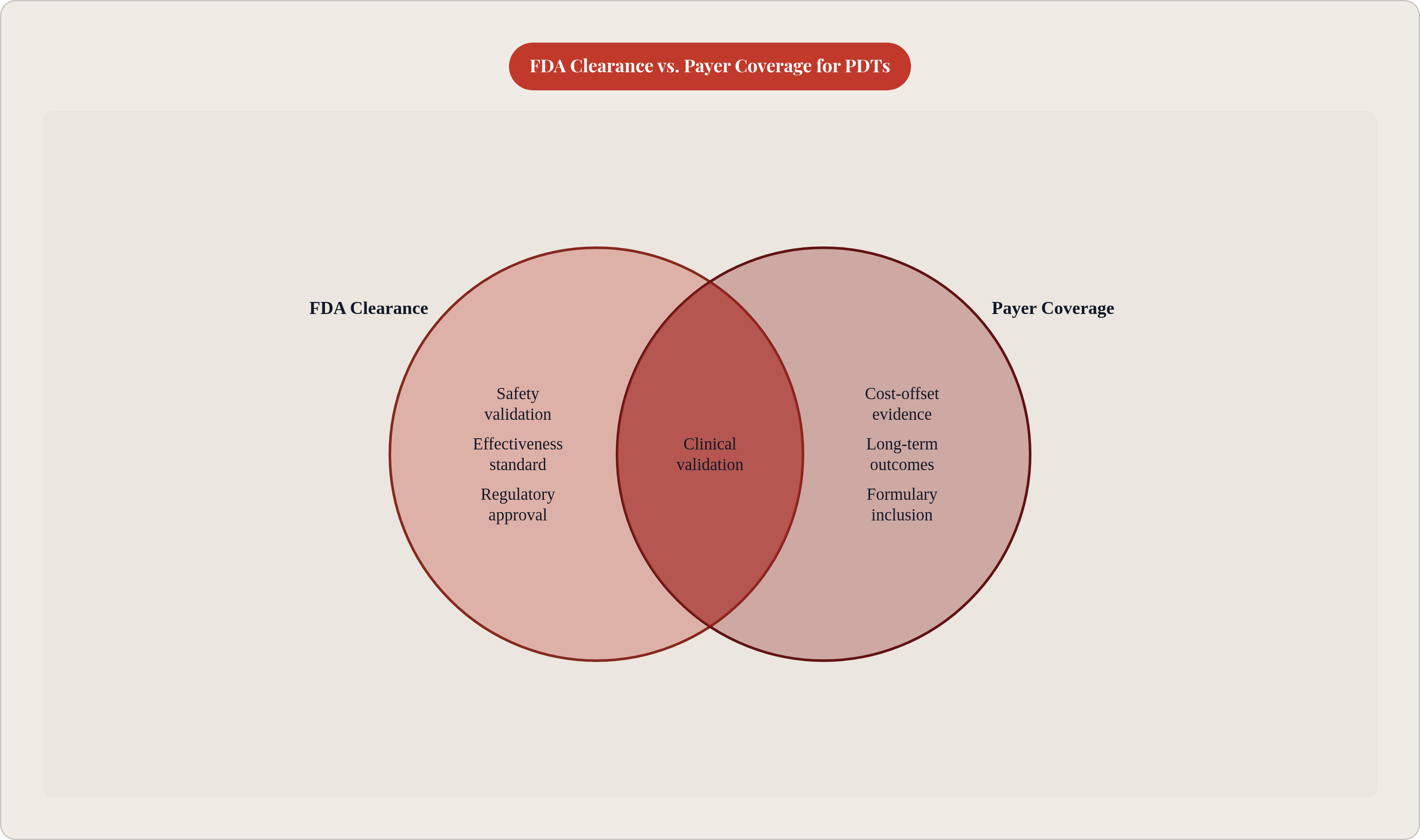
FDA clearance establishes safety and reasonable effectiveness for the intended use. That is what the regulatory standard requires, and that is all it establishes. It is not a cost-effectiveness determination. It is not a statement about long-term durability. It is not a signal that the product is worth covering at the manufacturer's chosen price. Payers have operated on a different evidentiary standard for as long as payers have existed, and they have been explicit about it.
Aetna, for instance, has listed many digital mental health tools as experimental, investigational, or unproven, citing insufficient peer-reviewed literature, even when those products held FDA clearance. What payers actually require is evidence of long-term cost offsets: reduced hospitalizations, fewer emergency department visits, less utilization of more expensive downstream treatments. That is the real question, and it is a different question than the one FDA answers.
That kind of evidence is structurally difficult to generate for newer technologies. You need deployment at scale, sustained over time, with rigorous outcomes tracking. Which requires coverage. Which requires the evidence. The access-evidence loop is the actual mechanism by which newer PDTs stay trapped, and the frustrating part is that it is not the result of bad faith on anyone's part. It is just how the incentives and timelines interact.
The industry spent years assuming FDA clearance would function as a payer signal the way it functions in the drug world, where formulary inclusion often follows approval as a matter of standard process. That assumption was wrong. FDA's clearance standard and payers' coverage standard are different instruments, measuring different things, operated by institutions with different mandates and different financial incentives. The companies that figured this out early restructured accordingly, building health economic modeling and payer engagement into product development from the beginning rather than treating them as post-clearance commercial functions. The companies that did not figure it out early have a more difficult story.
What Happened to Companies That Built on the Assumption That Clearance Would Unlock Coverage
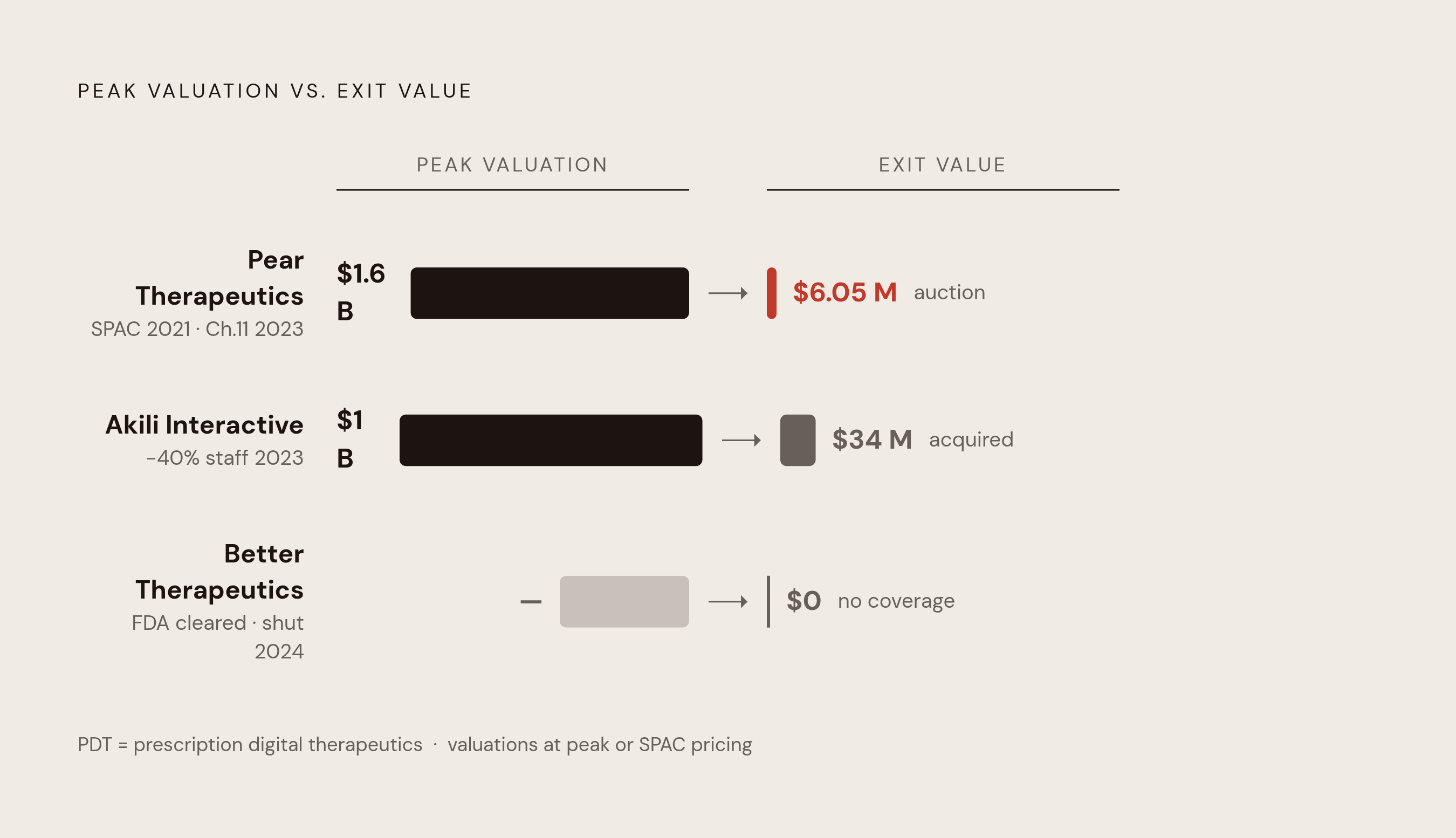
The cautionary record here is not speculative. It is documented.
Pear Therapeutics was the first company to receive FDA clearance for a prescription digital therapeutic, in 2017. It had cleared products addressing substance use disorder, opioid use disorder, and insomnia, all areas of genuine and substantial clinical need. By 2022, its products were priced above $1,000 and payers had not followed. That year's annual report showed $12.7 million in revenue against more than $136 million in expenses. Pear filed Chapter 11 in early 2023, laid off more than 90% of its remaining staff, and sold its assets at auction for $6.05 million. The company had gone public via SPAC in 2021 at a valuation of $1.6 billion.
Better Therapeutics received FDA authorization for a type 2 diabetes application and shut down in March 2024 after failing to secure commercial coverage. Akili Interactive, once valued at roughly $1 billion, cut 40% of its staff in September 2023 before being acquired by Virtual Therapeutics for $34 million, having pivoted away from the PDT model entirely.
These are not stories about bad products or conventional execution failures. The common thread is the structural reimbursement gap. Each company built a financial model on the assumption that clinical validation plus regulatory clearance would produce payer coverage. It didn't, and the consequences were total. Pitchbook data cited in MedCity News showed digital health funding stabilizing at roughly $1 billion across nearly 80 deals per quarter in early 2024, well below prior peak levels, with reimbursement uncertainty explicitly cited as a contributing factor.
The venture community absorbed the lesson quickly. Whether the policy and payer communities move fast enough to prevent that lesson from calcifying into a permanent structural deterrent to investment in the category is, genuinely, an open question.
What the 2025 Medicare DMHT Codes Actually Do, and What They Don't
In November 2024, CMS approved three new HCPCS codes, G0552, G0553, and G0554, for digital mental health treatment devices, effective with the 2025 fee schedule. Seven applications currently qualify under the relevant device classification, including SleepioRx, Daylight, Rejoyn, reSET, and reSET-O. This is the first time CMS has created dedicated reimbursement infrastructure for PDTs. That matters. It proves the category-creation approach is viable and sets a procedural precedent worth building on.
But the structural problems these codes don't solve deserve equal attention.
The reimbursement rate for G0552, the device supply payment, was not set at launch. CMS acknowledged difficulty pricing across a diverse set of products. Rate ambiguity is not a technical footnote; it is a direct impediment to financial planning for manufacturers and providers alike. The codes also use a buy-and-bill model, in which providers pay upfront and submit claims for reimbursement. That is standard in certain medical specialties. It is not standard for mental health professionals, and asking a psychologist or clinical social worker to front costs for a digital product before reimbursement arrives is asking them to fundamentally restructure how they run their practice. Many won't.
Coverage is also conditioned on use within an ongoing behavioral health treatment plan, prescribed by a diagnosing practitioner. PDTs prescribed by social workers or psychologists who don't hold traditional prescribing authority do not qualify. That is a meaningful access constraint in a clinical landscape where much of mental health care is delivered by non-prescribing practitioners. And the codes apply only to Medicare. Commercial payers are not bound by them and have not uniformly followed.
This is genuine procedural progress for a specific slice of the PDT category, incomplete even within its own scope, with limited direct impact on metabolic, neurological, and non-behavioral-health PDTs.
How the Commercial Payer Landscape Is Moving, and How Unevenly
Commercial movement on PDTs exists, but it is not systematic. Awareness of PDTs among chief medical information officers at major hospital systems remains limited, even as familiarity with AI-driven clinical applications has grown substantially. That knowledge gap has direct coverage implications. You cannot advocate for coverage infrastructure you don't have a clear conceptual model for, and that problem runs deeper than most manufacturers want to acknowledge.
What currently exists in the commercial space is early-stage and episodic. Some state Medicaid programs are exploring coverage through pilot programs. Managed care organizations are experimenting with digital formularies or folding PDTs into care management bundles. None of this constitutes durable, scalable coverage infrastructure. It constitutes a collection of experiments, some of which will be renewed and some of which will not, and distinguishing between them in advance is more art than science.
The clearest signal came in September 2025, when Cigna Healthcare announced it would begin covering FDA-approved digital therapeutics. The specifics of what Cigna covers, under what clinical conditions, and at what reimbursement rates will determine the actual impact. But the directional signal is real.
The Medicare DMHT codes function as a reference point in commercial negotiations, the way Medicare reimbursement has historically helped establish a product's legitimacy and given commercial payers a pricing anchor. Whether that dynamic holds for PDTs at the same pace it has held for devices and drugs is an open question, and the answer will probably vary considerably by clinical category.
Commercial coverage will grow through individual payer decisions and negotiated arrangements, not systemic reform. That means PDT manufacturers face years of product-by-product, payer-by-payer work absent significant legislative action. Even where coverage exists in pockets, the structural access gap persists for the majority of patients who have clinical need.
What Would Actually Resolve the Structural Misalignment, and What's in Motion
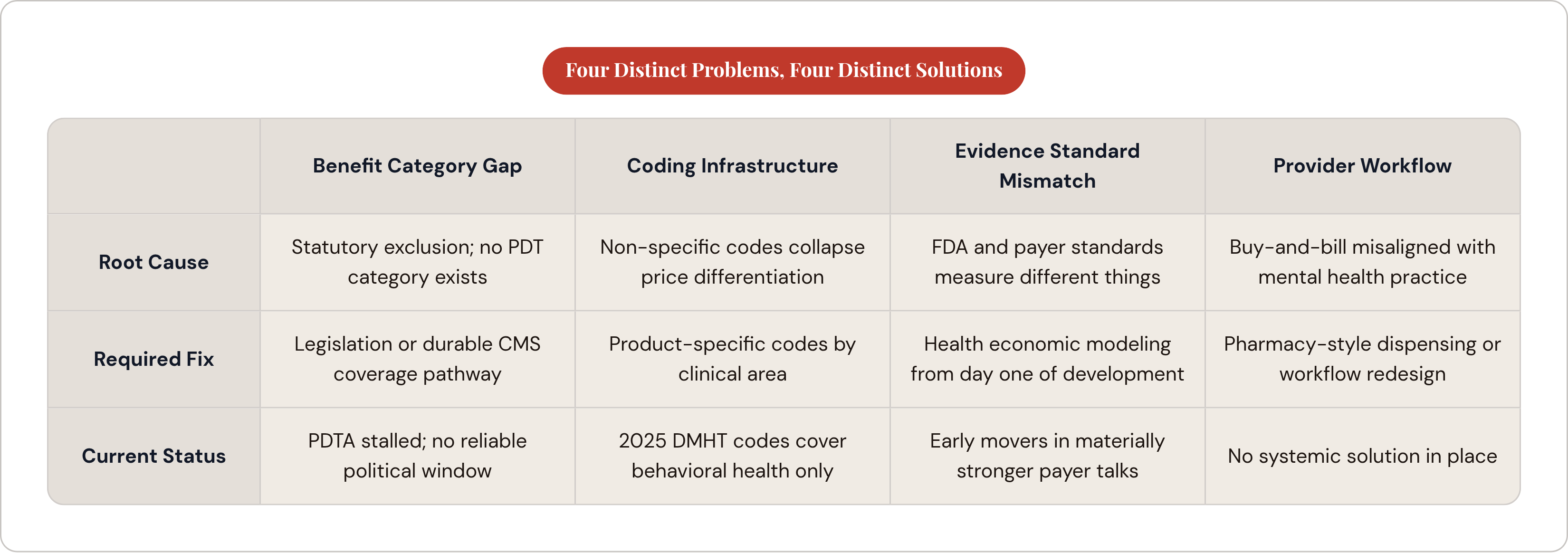
There are distinct problems here, and they require distinct solutions. Treating them as one undifferentiated reimbursement challenge is how companies waste years.
The benefit category gap requires either legislative action or a durable CMS coverage pathway that doesn't demand a product-by-product determination for every new PDT. Legislation aimed at this, including the PDTA and similar proposals, has been introduced and has stalled repeatedly. The political conditions for that kind of legislation are not reliably present, and you should not build a five-year commercialization strategy around its passage.
The coding infrastructure problem requires product-specific codes that allow meaningful price differentiation. The 2025 DMHT codes are a workable model, but they cover only one clinical area. Extending that model to metabolic, neurological, and other non-behavioral-health PDTs requires additional CMS action, additional advocacy, and additional time. The precedent exists. The infrastructure does not.
The evidence standard mismatch requires manufacturers to treat health economic modeling and payer engagement as core product development activities from the beginning, not post-clearance tasks. That means designing trials to generate the cost-offset evidence payers actually require, not just the clinical efficacy evidence FDA requires. It means engaging payers during trial design, not after results are published. The companies that have done this are in materially different conversations with payers than the ones that haven't.
The buy-and-bill workflow problem for providers is practically separate but no less real. It requires either meaningful workflow redesign within health systems or a policy shift toward pharmacy-style dispensing for eligible PDTs, analogous to how specialty drugs move through the system.
The Cigna announcement and the Medicare DMHT codes together represent the first real reimbursement infrastructure for PDTs. That infrastructure covers a narrow slice. The rest of the category remains in a pre-infrastructure phase, where every deal is bespoke and every coverage conversation starts from first principles. This resolves layer by layer, not through any single policy action. Which is exactly why understanding each layer separately is more useful than hoping the whole thing eventually sorts itself out.