Wearable Health Sensors in Clinical Trial Data Collection
Smartwatches and patches are reshaping how trials capture continuous patient data.
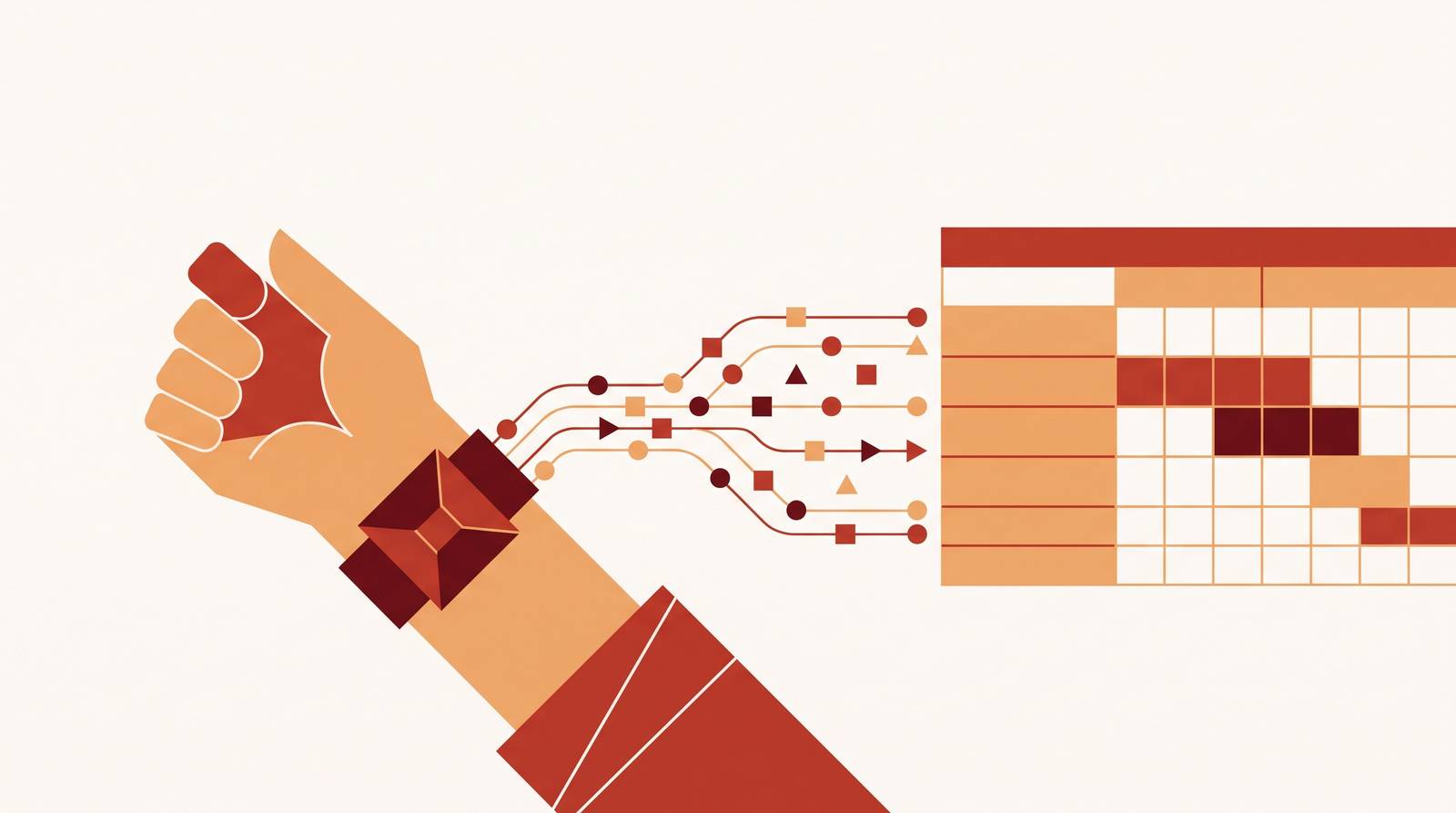
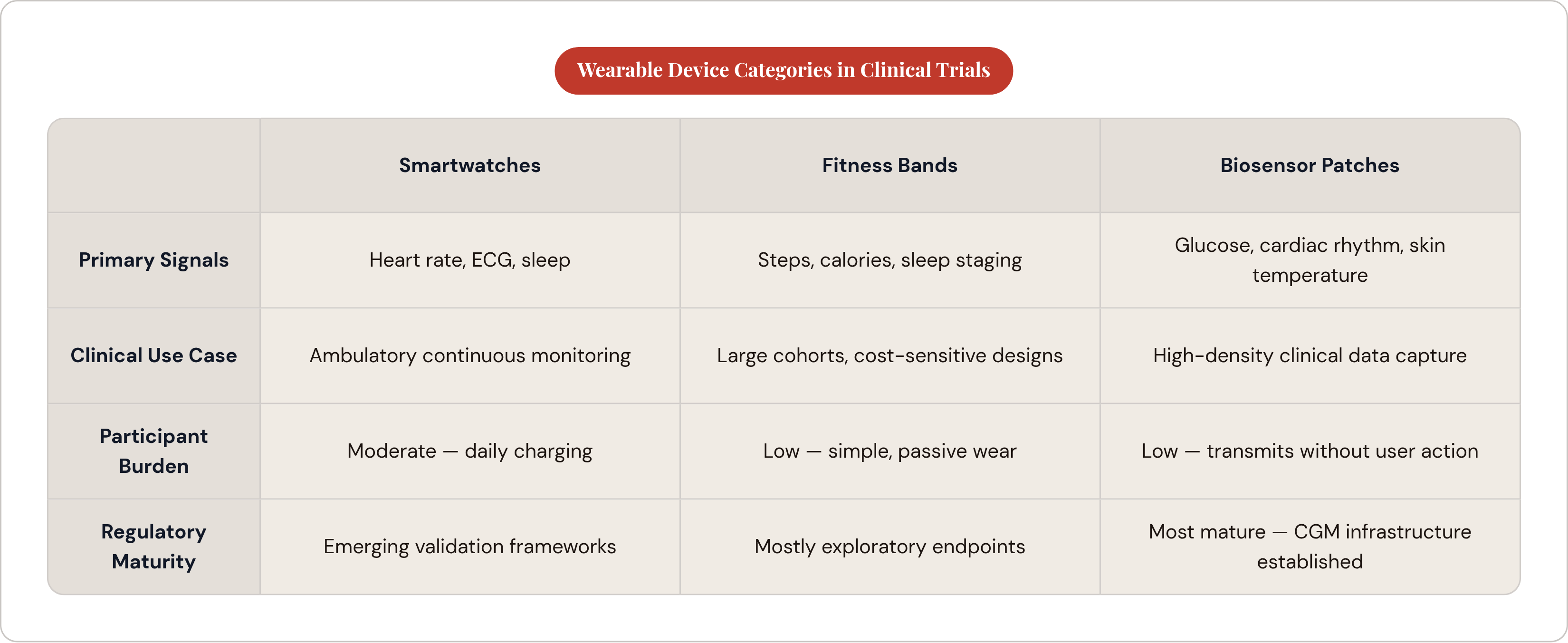
Three device categories dominate active trial deployments, each suited to a distinct clinical use case. Smartwatches capture heart rate, ECG, and sleep; they suit longer ambulatory monitoring where passive, continuous data collection is the goal. Fitness bands handle steps, calorie estimates, and sleep staging at lower cost, making them practical for large cohorts where per-participant expense matters. Biosensor patches, the most clinically dense category, deliver continuous glucose monitoring, cardiac rhythm capture, and skin temperature, transmitting directly to cloud platforms without any action required from the participant.
Watches and bracelets collectively account for the largest share of wearables used in clinical studies. Within that group, inertial measurement unit sensors are the dominant modality: a 2025 systematic review conducted under PRISMA guidelines, drawing from PubMed, Scopus, and Web of Science through March 2025 across thirty studies, found IMU-based sensors present in 67% of studies, with wrist-worn devices representing 65% of IMU deployments. Continuous glucose monitors hold a substantial portion of the wearables market in pharma and biotech, reflecting the mature adhesive patch infrastructure built on decades of diabetes applications.
What makes these sensors clinically interesting isn't just heart rate. It's the signals that have no analog in a lab draw: circadian rhythm disruption, gait deterioration, activity fragmentation across a full twenty-four hours. These are behavioral and physiological signatures that disease produces continuously, and that clinical assessments capture only in snapshots taken months apart. You cannot reconstruct a patient's functional trajectory from four clinic visits a year — the wearable is like a witness that never sleeps, running when the clinician isn't looking, which is most of the time.
Machine learning converts raw sensor output into interpretable clinical signals. Random forest models appeared in 20% of studies in that 2025 systematic review; deep learning in 17%. The transformation from motion data to a clinical endpoint is not automatic. It requires deliberate methodological choices, and those choices carry regulatory implications most sponsors underestimate until they're already in trouble.
One distinction worth establishing clearly: consumer-grade and clinical-grade devices are not interchangeable. A device validated for general wellness tracking was designed for different standards of accuracy, reliability, and traceability than a trial endpoint demands. That gap is where many wearable strategies collapse before generating a single usable data point.
How Fast Wearable Adoption in Trials Has Actually Grown
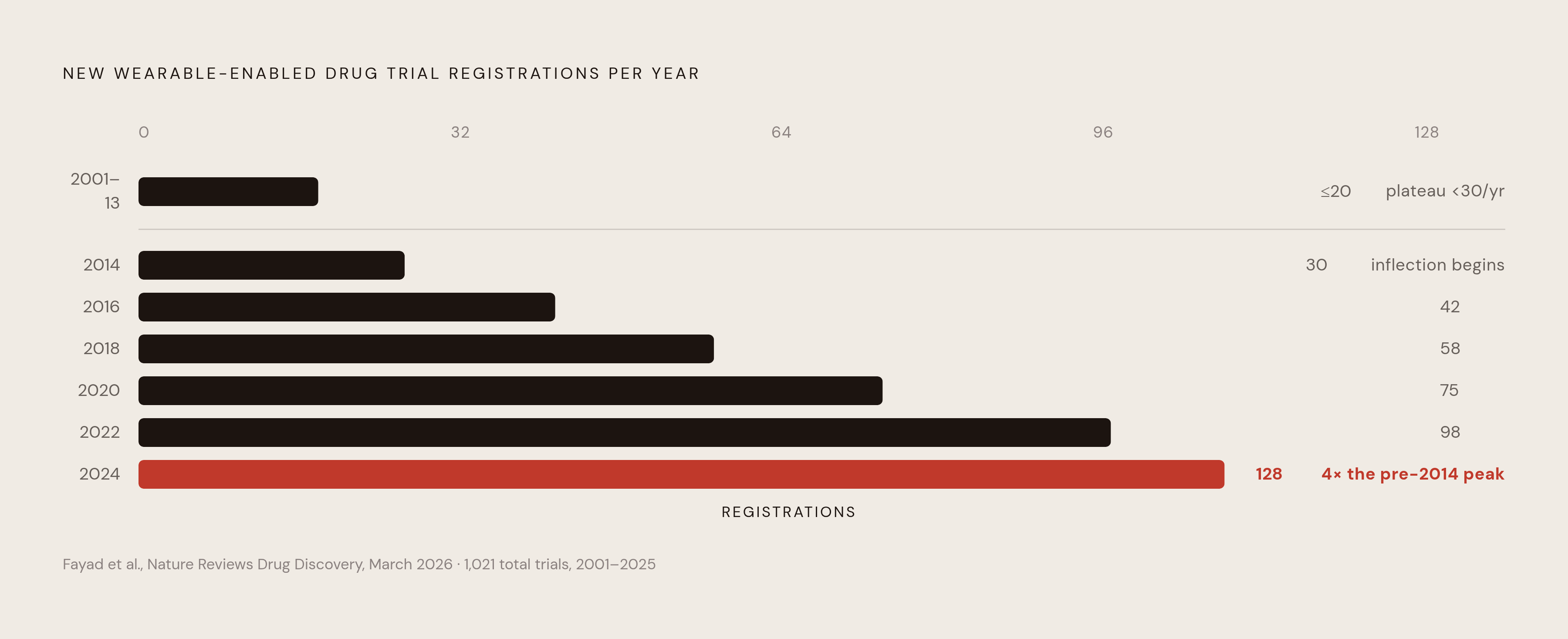
The numbers tell a story of slow accumulation followed by sudden, almost disorienting acceleration. A March 2026 review published in Nature Reviews Drug Discovery, authored by Fayad and colleagues, identified 1,021 interventional drug trials registered between 2001 and 2025 that incorporated wearable-derived data. The growth shape matters more than the total count. Fewer than thirty new wearable studies were registered per year through 2014. In 2024 alone, that figure reached 128. A decade compressed an adoption curve that would normally span a generation — call it the clinical equivalent of going from a flip phone to a smartphone overnight.
The clinical trials segment now holds the largest share of the wearables-in-pharma-and-biotech market, ahead of drug delivery and other pharma applications. The market itself, scoped specifically to pharma and biotech rather than the broader consumer universe, was valued at $3.35 billion in 2025, with projections placing it near $10 billion by 2031 at a compound annual growth rate above 20%.
Three forces drove this. The pandemic made remote monitoring a necessity rather than an innovation, creating regulatory openings for decentralized trial elements that would have taken years to negotiate otherwise. Sensor hardware matured in the same window: battery life, miniaturization, and data transmission reliability all improved substantially. And regulatory agencies began producing formal guidance frameworks, signaling that wearable data could, under the right conditions, support regulatory submissions.
The distribution of adoption is uneven. Roughly 85% of wearable studies focus on patients with chronic diseases, with neurodegenerative diseases most prevalent. About 15% target disease diagnosis, primarily in cardiovascular contexts. Sponsors in oncology, metabolic disease, and neurology are leading this shift; other therapeutic areas are largely still watching from a distance.
Where Trials Are Actually Deploying Wearables: Therapeutic Area Patterns
Diabetes and metabolic health represent the fastest-moving territory. Abbott's FDA clearance in June 2024 for Libre Rio, the first over-the-counter CGM for adults with Type 2 diabetes not on insulin, signals how far the consumer-to-clinical boundary has shifted. Dexcom's $75 million investment in Oura in November 2024, oriented toward integrating CGM with smart-ring lifestyle analytics, reflects the same convergence arriving from the opposite direction. The validation infrastructure for CGM is more mature than for almost any other wearable modality, which is precisely why CGM-enabled trial designs carry more regulatory weight than most.
Cardiology offers evidence of a different kind. A systematic review and meta-analysis of twenty-three studies through March 2025 found that wearable-enabled cardiac rehabilitation produced a statistically significant mean difference of 1,060 steps per day favoring the wearable intervention, with a 95% confidence interval of 650 to 1,460 steps. That is a clinically meaningful behavioral signal, quantified through continuous monitoring. A clinic-visit model would have required substantially more participants and longer follow-up to detect the same effect, if it detected it at all.
Oncology presents the most complicated picture. A systematic review of twenty-five wearable studies in cancer clinical trials found breast, gastrointestinal, and lung cancers most represented, with chemotherapy as the primary treatment context. Physical activity was tracked in nineteen of twenty-five studies; circadian rhythm in eight; sleep in six. The data is biologically interesting. The compliance story is less so: device-wearing adherence ranged widely across studies, but evaluable sensor data days, the metric that actually determines whether an analysis is possible, ranged substantially lower across studies. Wearing the device and generating usable data are different things. That gap has real protocol design consequences, and most sponsors discover it too late.
Neurodegenerative diseases are the most prevalent category in chronic-disease monitoring studies. Parkinson's disease has generated the most sophisticated wearable endpoint development, partly because gait and movement sensors map directly onto the disease's clinical expression, and partly because that work produced the only formally qualified wearable-derived endpoint in the world.
The pattern across therapeutic areas is consistent: where wearable endpoints have strong biological face validity, the evidence of clinical impact is strongest. Where the connection between sensor signal and clinical state is more indirect, results remain exploratory, sometimes indefinitely.
The Core Validation Problem: Why More Data Does Not Automatically Mean Better Evidence
More data is not better evidence. Sponsors excited about the technology collapse this distinction constantly, and it is the most consequential mistake in wearable trial design. Mistaking data volume for data quality is like mistaking a loud noise for a clear signal.
A sensor-derived measure used as a trial endpoint must be shown to reliably capture what it claims to capture: in the population being studied, under real-world wear conditions, across the range of clinical states that population actually experiences. Does the sensor accurately measure the underlying physiological signal? Does that measured signal correspond to a meaningful clinical state? Does the relationship hold outside a controlled laboratory, across diverse participants and varying compliance levels? All three questions must be answered. Most wearable studies answer one, and sometimes only superficially.
The 2025 systematic review illustrates the design gap plainly: only 8% of wearable studies in that dataset were randomized trials, yet 67% showed clinical impact. Wearable data is clearly biologically informative. But the trial designs capable of supporting a regulatory submission are still rare. High-quality sensor data collected within a weak study design produces an exploratory finding, not a primary endpoint. The strength of the signal doesn't compensate for the weakness of the design.
The consumer-versus-clinical-grade distinction compounds this in ways that aren't always obvious until you're deep in a data review. Sensors validated in healthy adults may perform differently in patients with peripheral edema, movement disorders, or significantly altered body composition. A CGM calibrated on normoglycemic volunteers cannot be assumed to maintain the same accuracy in a patient whose interstitial glucose fluctuates dramatically and rapidly. The validation package must account for the actual patient population, not an idealized proxy.
As of 2024, there is no widely accepted minimum validation standard for novel sensor-derived endpoints. Each sponsor largely constructs its own evidence package. This creates redundant work across the industry and produces regulatory uncertainty that slows adoption even when the underlying science is sound.
What the Regulatory Frameworks Currently Require, and Where They Leave Sponsors Without Clear Guidance
Regulatory frameworks for wearable data in trials have advanced meaningfully in recent years, but they leave sponsors without clear guidance on some of the most practically important questions. The FDA issued two consequential documents in close succession: the December 2023 final guidance on digital health technologies for remote data acquisition in clinical investigations was the first comprehensive federal framework for wearable data in trials. It defines digital health technologies as systems using computing platforms, connectivity, software, and sensors, and it outlines regulatory expectations for device selection, validation, use, and oversight. The September 2024 final guidance on conducting clinical trials with decentralized elements explicitly incorporated DHTs as data-collection infrastructure and addressed the "bring your own device" question directly: sponsors must make provisioned devices available to participants who lack their own, and BYOD data is acceptable when collected in accordance with the 2023 DHT guidance.
These documents are meaningful. They are also incomplete in ways that matter practically.
The FDA's Biomarker Qualification Program has accepted sixty-one projects over its history and formally qualified eight biomarkers. None of those eight is sensor-derived.
The EMA's record is modestly better. It has established its own qualification guidance for digital technology-based methodologies, and the one formal regulatory qualification of a wearable-derived endpoint that exists anywhere in the world belongs to the EMA: SV95C, the 95th percentile of stride velocity, qualified for use in Parkinson's disease trials. That qualification was the product of sustained dialogue between sponsors, patient advocates, and regulators over several years. It represents what is possible. It also represents how much concentrated effort a single qualified endpoint requires. Sponsors should sit with that for a moment before designing a pivotal trial around a novel sensor-derived primary endpoint with no prior qualification in the indication.
The practical consequence is that wearable-derived endpoints are overwhelmingly used as secondary or exploratory outcomes, not primary endpoints, because sponsors cannot yet rely on them to carry a regulatory submission. The sensors are technically ready. The qualification infrastructure is not. The Food and Drug Omnibus Reform Act of 2022 acknowledged this gap in Sections 3606 and 3607, requiring FDA to publish additional guidance on modernizing trials through decentralized elements and digital health technologies. That guidance is still in progress.
Compliance in Practice: How Long Participants Actually Wear the Devices
There is no universal compliance threshold for sensor-based trial data. The eCOA Consortium review published in Clinical and Translational Science in November 2024 notes this explicitly: no commonly accepted thresholds exist. Published research suggests rates in the upper-seventies to eighty percent range are generally considered satisfactory and rates above the low nineties are considered high, but these benchmarks are informal and largely inherited from patient-reported outcome conventions rather than derived from sensor-specific evidence.
The longitudinal decay problem is concrete and unforgiving. Compliance decreases over time in long-duration studies; one breast cancer fitness tracker study recorded a decline to well below 20% at day 180 of a six-month follow-up. At that level, the data stream is effectively broken. The statistical analysis plan may specify a continuous monitoring endpoint; the actual data may be too sparse to support it. That mismatch is a protocol design failure that became visible too late to fix.
Multiple factors drive drop-off, and they interact in ways that are genuinely hard to anticipate in a planning meeting. Device discomfort is most commonly cited. Battery management, particularly for devices requiring daily or twice-daily charging, creates a behavioral burden that compounds across weeks. Participants with episodic conditions sometimes perceive wearing a device between symptomatic periods as irrelevant. Privacy concerns around always-on accelerometer data produce withdrawal in some populations.
A specific tension shapes compliance strategy: participants consistently want their individual sensor data returned to them during the study. Returning data in real time could improve engagement. But real-time biofeedback also risks modifying the behavior the endpoint is trying to measure. Current best practice holds data sharing until after study completion. Sponsors who explain this rationale clearly, and offer a defined post-study data-return plan, tend to see better retention than those who treat it as a footnote in the consent form.
Compliance planning belongs in the protocol design phase, not in a site-monitoring amendment after enrollment has begun. The oncology compliance data, with evaluable sensor days lagging wearing rates by a meaningful margin, demonstrates that participation and data quality are distinct problems requiring distinct solutions.
Integration and Data Infrastructure: What Sponsors Need Beyond the Device Itself
The device is a sensor. What turns sensor output into a trial endpoint is infrastructure, and that infrastructure is where wearable programs most commonly fail without anyone noticing until the analysis phase.
Biosensor patches and CGMs transmit directly to cloud platforms for real-time analysis. That pipeline requires interoperability between the sensor, the data management platform, and the clinical data repository. Three integration problems arise with predictable regularity.
The first is data format heterogeneity: different device manufacturers use different output formats, and without deliberate harmonization decisions made at vendor selection, data integration becomes manual reconciliation work at scale. The second is signal processing: raw accelerometer or heart rate data is not a clinical endpoint, and processing pipelines must be pre-specified and validated alongside the device itself. Changing the processing algorithm after data collection has begun is a regulatory problem, not an analytical adjustment. Third is missing data handling: when participants miss wear days, how that missingness is addressed analytically must be defined in the statistical analysis plan before unblinding. Post-hoc decisions about missing sensor data are difficult to recover from during regulatory review.
BYOD adds another layer. Participant-owned devices vary by model, firmware version, and calibration state. Sponsors must define acceptable device specifications and verify data quality in a way that is documented and auditable. The 2024 FDA guidance on decentralized trials addresses this at a framework level; the specific quality-verification methodology is the sponsor's responsibility.
Machine learning models applied to sensor output are passive analysis tools sitting downstream of the data in appearance only. The algorithm is part of the endpoint. It must be validated as part of the evidence package, with its performance characterized in the relevant patient population. Treating the model as a black box that produces a number is a regulatory vulnerability that reviewers will identify.
Phase 4 and post-market surveillance contexts may be where the integration infrastructure delivers its clearest return. Long-term naturalistic follow-up is precisely where clinic-visit models fail; the logistical barriers of sustained site attendance drive dropout and can make safety signals invisible for years. A continuous wearable data stream surfaces those signals faster and at a fraction of the operational cost.
How Trial Sponsors Are Building Wearable Strategies That Hold Up to Scrutiny
The sponsors doing this well start with the endpoint, not the device. What signal must be captured to answer the primary or secondary research question? Device selection follows from that specification. Working in the opposite direction — picking a device because it's familiar and then searching for an endpoint it can support — is like choosing a map and then deciding where you want to go. It produces a protocol misaligned with its own measurement tools. This happens more often than anyone admits publicly.
Given the current qualification landscape, the practical strategy is to deploy wearables as secondary and exploratory endpoints now while building the validation evidence necessary for primary endpoint use later. This matches the regulatory reality rather than fighting it. A sponsor who uses a wearable to generate compelling supportive data in a Phase 2 program is accumulating the evidence base for Phase 3 qualification. A sponsor who places a novel sensor-derived measure as the primary endpoint of a pivotal trial, without prior qualification, is taking a risk that the agency may decline to accept regardless of data quality.
Validation evidence should be pre-specified and documented before FDA review, not assembled in response to an information request. Sponsors who treat analytical validity, clinical validity, and ecological validity as design requirements, each with a documented evidentiary strategy either within the trial protocol or in a companion validation study, avoid the remediation work that is expensive and demoralizing to do under submission pressure.
Early engagement with both FDA and EMA is not optional. Both agencies have pre-submission pathways. The SV95C qualification at the EMA took years of sustained dialogue; sponsors who treat regulatory engagement as a late-stage activity will not replicate that outcome. The qualification gap persists partly because sponsors have not engaged at sufficient scale. The agencies have signaled willingness to work through these questions collaboratively. That opening may close as the landscape matures.
Compliance strategy belongs in the protocol from day one. The decay curves observed in oncology studies are not inevitable; they are the consequence of insufficient design attention to device burden, participant communication, and wear-schedule specification. Pilot work before pivotal trial launch, testing device wear burden and charging requirements in the actual patient population, is among the highest-return investments a wearable-enabled program can make. It is also among the most frequently skipped, usually because the timeline feels tight and the pilot feels like a delay. It isn't. It's insurance.
Consortium models are beginning to emerge as a structural response to the validation duplication problem. When multiple sponsors face the same analytical validity questions about the same sensor modality, sharing that evidentiary work reduces cost and accelerates the path to qualified endpoints. The industry has not yet built this infrastructure at scale. The sponsors who help build it early will benefit disproportionately when it matures.
The qualification frameworks are still catching up to the technology. The sponsors who will use wearables to carry regulatory submissions, rather than merely to enrich study data, are already treating validation, infrastructure, and regulatory engagement as design requirements from the first protocol draft.