Telehealth Patient Acquisition and Retention Strategies
Behavioral health dominates telehealth, but most providers target the wrong patients.

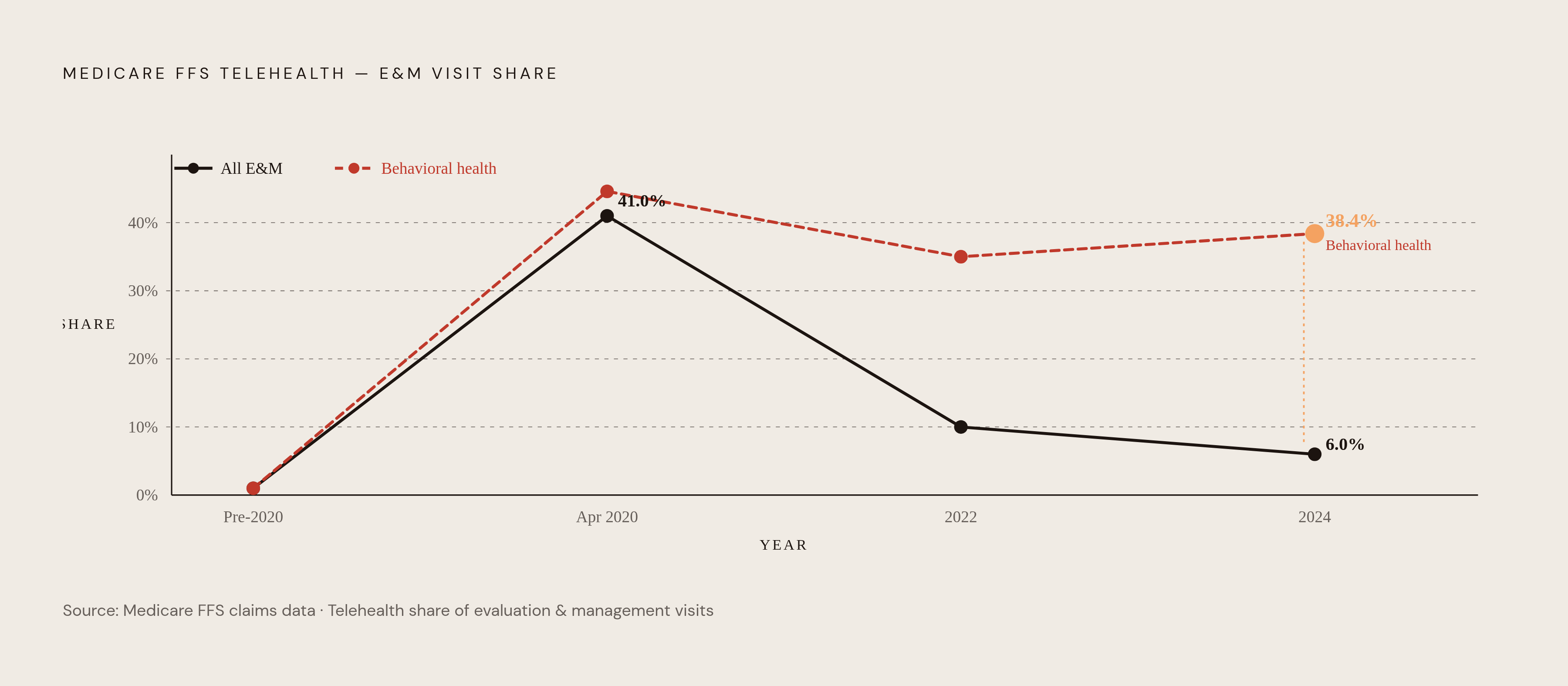
Among Medicare fee-for-service beneficiaries, telehealth utilization for evaluation and management visits peaked at 41.0% of all visits in April 2020, then settled to 6.0% by 2024. Most coverage reads that as a collapse. It isn't. The 6.0% figure represents durable adoption, the level at which behavior persists without a public health emergency propping it up. That's the floor, not the ceiling.
But averages hide the story that actually matters. Behavioral health is the outlier: 38.4% of all behavioral health evaluation and management visits were delivered via telehealth in 2024, against a national average hovering near 6%. That gap isn't accidental. Stigma suppresses in-person appointment adherence. Symptom-based conditions are often manageable without physical examination. The population seeking these services skews toward higher digital fluency. The concentration reflects structural demand, not a temporary blip.
So who, exactly, is the telehealth patient? FAIR Health data puts adults aged 19–30 at nearly 24% of all telehealth claims, with adults aged 31–40 contributing another 23%. Together, those two cohorts account for roughly half the patient base. On the payer side, approximately 51% of U.S. telehealth revenue in 2025 came from privately insured patients.
The targeting implications are blunter than most providers want to admit. Medicare-focused acquisition strategies are misdirected for most direct-to-consumer telehealth brands. The core patient is working-age, privately insured, and digitally native. Behavioral health providers are operating in a structural demand environment that most other telehealth specialties simply aren't, and their patient pool is larger and stickier by design. Insurance acceptance is an acquisition lever, not merely a billing decision, because half of prospective patients will check network status before they book anything.
A mobile-unfriendly booking experience aimed at the 19–40 cohort isn't a minor oversight. It's a structural mismatch between who the patient is and what the provider built for them.
Building a paid acquisition engine that can actually scale
Digital advertising now accounts for approximately 76% of total healthcare ad spend, per Insider Intelligence estimates reported by Matchnode. Digital health companies spent roughly $26 billion on advertising in 2024 to acquire patients. Before any budget is approved, that figure should prompt a question: what, concretely, differentiates this campaign from the dozens of others targeting the same patient at the same moment?
Meta and Google have steadily narrowed health-related audience targeting options, particularly for behavioral health brands. The effects compound: providers who built their acquisition architecture entirely on social and search retargeting are now operating with progressively less precision, and the trend shows no clear sign of reversing. A diversified channel mix, including connected television, programmatic display, and podcast advertising, isn't a strategic luxury. It's a structural hedge.
It is also worth considering the geographic dimension, which most providers systematically underweight. As of September 2024, 66.33% of primary care Health Professional Shortage Areas were located in rural regions. Providers marketing into those geographies face structurally lower competition; the dominant players have concentrated their paid spend in high-density urban markets and largely left rural demand underserved. That's an opening.
The caveat matters immediately, though: each state where a provider sees patients requires state-specific licensure. Paid traffic that converts in unlicensed states inflates customer acquisition cost and creates compliance exposure simultaneously. Map licensed states before scaling geo-targeted campaigns. Not after.
Trust signals belong in ad creative, not just on landing pages. Phrases like "HIPAA-compliant, secure virtual consultations" address the patient's primary anxiety directly. That anxiety doesn't resolve by the time a patient reaches a booking page if the ad didn't begin addressing it earlier. And 71.4% of physicians used telehealth weekly in 2024, up from 25.1% in 2018, per AMA data reported by Evokad. A physician's face and name in an ad performs differently than stock imagery, particularly in behavioral health, where the treating relationship is functionally the product. Provider credibility in creative is the most underused lever in the category.
The HIPAA compliance problem hiding inside your attribution stack
U.S. healthcare organizations paid over $100 million in HIPAA fines between 2023 and 2025 for pixel-tracking violations, with individual penalties reaching up to $2.1 million for willful neglect. The mechanism is worth understanding precisely because it is so easy to trigger accidentally: standard Meta Pixel or Google Analytics tags placed on patient-facing pages transmitted protected health information to third-party ad platforms without a valid Business Associate Agreement. The tag fires, the URL or form data travels with it, and the violation is complete before anyone in marketing or legal notices it happened.
The regulatory picture is genuinely unsettled. HHS updated its tracking guidance on March 18, 2024. The AHA v. Becerra ruling then vacated portions of that bulletin on June 20, 2024. Attribution stacks built before either of those dates reflect assumptions that no longer hold. That uncertainty is itself an argument for over-engineering toward compliance rather than optimizing for the minimum viable interpretation.
Compliant attribution requires server-side event routing rather than client-side pixels on patient-facing pages; data minimization, meaning passing only what's necessary for measurement rather than everything the tag can capture; and signed Business Associate Agreements with any ad platform that handles patient data.
The legal team flagging the pixel problem six months after marketing has built the entire stack around it is a common pattern. The rebuild is expensive, the historical data is compromised, and attribution is dark during the transition. The case for building compliant measurement infrastructure during campaign architecture, not retroactively, is straightforward. Providers who can't see which channels are actually performing can't optimize. This is a growth problem before it's a compliance one.
How content and SEO build the patient trust that paid ads can't manufacture
Telehealth patients aren't just evaluating price and convenience. They're deciding whether to share sensitive health information with a company they encountered through a Google ad or an Instagram scroll. That's a genuinely high bar, and no ad format fully clears it. Content does work here that paid channels structurally cannot.
Why exactly does this matter more in behavioral health than in other telehealth specialties? Because the research-to-action gap is longer. A patient searching for a hypertension medication refill is closer to booking than a patient searching "how do I know if I have ADHD." The latter has more to work through before trusting anyone with their information. Content is the mechanism for being present and credible across that entire process, not just at the moment of conversion.
Eighty-three percent of clinicians support telehealth use, per SecureVideo. That endorsement is an underused content asset. A cardiologist explaining how a telehealth visit compares to an in-person one is more persuasive than marketing copy making the same argument. Provider-authored material carries credibility that brand copy doesn't, and the gap between the two is wider in healthcare than in almost any other consumer category.
For telehealth specifically, content strategy should include condition-specific landing pages tied to licensed service areas, which connects directly to the state-licensing constraint from the paid channel section; FAQs around data security, insurance acceptance, and visit logistics; and provider profiles that communicate clinical personality, not just credentials. Publishing velocity matters. Providers building content libraries fastest are establishing topical authority that takes competitors months to displace. Letterstory specializes in healthcare content and can help telehealth providers develop and test copy that embeds compliance language naturally into the patient value proposition, rather than treating trust signals as a regulatory checkbox bolted onto existing creative.
Why the onboarding experience determines whether acquisition investment pays off
The growth loop breaks here most often, and most quietly. A patient acquired through a well-optimized paid campaign drops off during registration or intake. Customer acquisition cost is spent; lifetime value is never realized. The failure is common and the math is unforgiving.
Per OpenLoop Health, first impressions form well before the first virtual visit with a provider. A confusing registration or intake process causes disengagement before any clinical relationship is established. A structured onboarding sequence should do three things: confirm the patient's decision to book, which reduces cold-feet cancellations; set expectations for how the visit will work, including technology requirements and who they'll see; and begin the relationship before the appointment, which lowers the perceived distance of a virtual-only provider.
Platform friction is a silent dropout driver. A clunky scheduling flow or a portal that doesn't render on mobile quietly pushes patients out before they fully engage. Given the 19–40 demographic concentration, mobile-first design isn't optional. It's demographic alignment.
But what if the acquisition message and the onboarding experience feel like they came from different organizations? The trust signals and tone established during paid or content-driven acquisition need to carry forward through registration and intake. Discontinuity there breaks the patient's confidence before any clinical interaction occurs. Consistency across stages isn't branding discipline for its own sake. It's retention mechanics, and the distinction matters because it determines whose budget owns the problem.
Onboarding is also the moment to capture communication preferences: channel, cadence, and content type. Capture it once, use it repeatedly.
What actually keeps patients returning after the first visit
Overall patient satisfaction with direct-to-consumer telehealth providers was 730 out of 1,000 in J.D. Power's 2024 study. That is not a high bar. The strategic implication is straightforward: providers who exceed it stand out without requiring excellence across every dimension. Most aren't even trying to clear it.
The single strongest retention signal in the data is experience quality, not clinical outcomes. J.D. Power's 2024 findings show that when following up on a chronic condition, 44% of patients who had an easy telehealth experience said they would use it again, while only 28% of those who had a difficult experience said the same. That 16-point gap is driven largely by platform and process design. Retention is, to a significant degree, an operational and product problem rather than a purely clinical one.
Chronic condition management is the highest-retention use case structurally. Patients with ongoing needs have inherent reasons to return; the provider's job is to avoid squandering that with friction rather than manufacturing the need artificially. This also makes chronic condition patients the most valuable acquisition target by lifetime value, a point the next section returns to.
Empathy functions as a retention mechanism, not a soft skill. A 2024 systematic review found that enhanced empathy consistently improved patient satisfaction and produced outcomes linked to medication adherence and long-term health results. In telehealth, the incidental warmth of an in-person clinical setting doesn't exist. Personalization has to be intentional and built into every touchpoint, from the post-visit summary to the reminder text. Efficiency-focused telehealth that optimizes visit length and throughput above most else carries a structural retention risk that tends to show up about six months into the data.
One more finding worth noting: a large Illinois hospital network study of hundreds of thousands of patients and millions of outpatient encounters, published in NPJ Digital Medicine in 2024, found that telehealth visits were associated with significantly lower no-show odds compared to in-person visits. That's a genuine retention and access advantage. The equity gap in that same data matters, though. Black and Hispanic patients and those on Medicaid had higher no-show odds even in the telehealth setting. Providers who assume virtual care largely resolves access disparities risk failing this population. Targeted outreach and reminder strategies are necessary, not aspirational.
How acquisition and retention data should feed each other to improve both
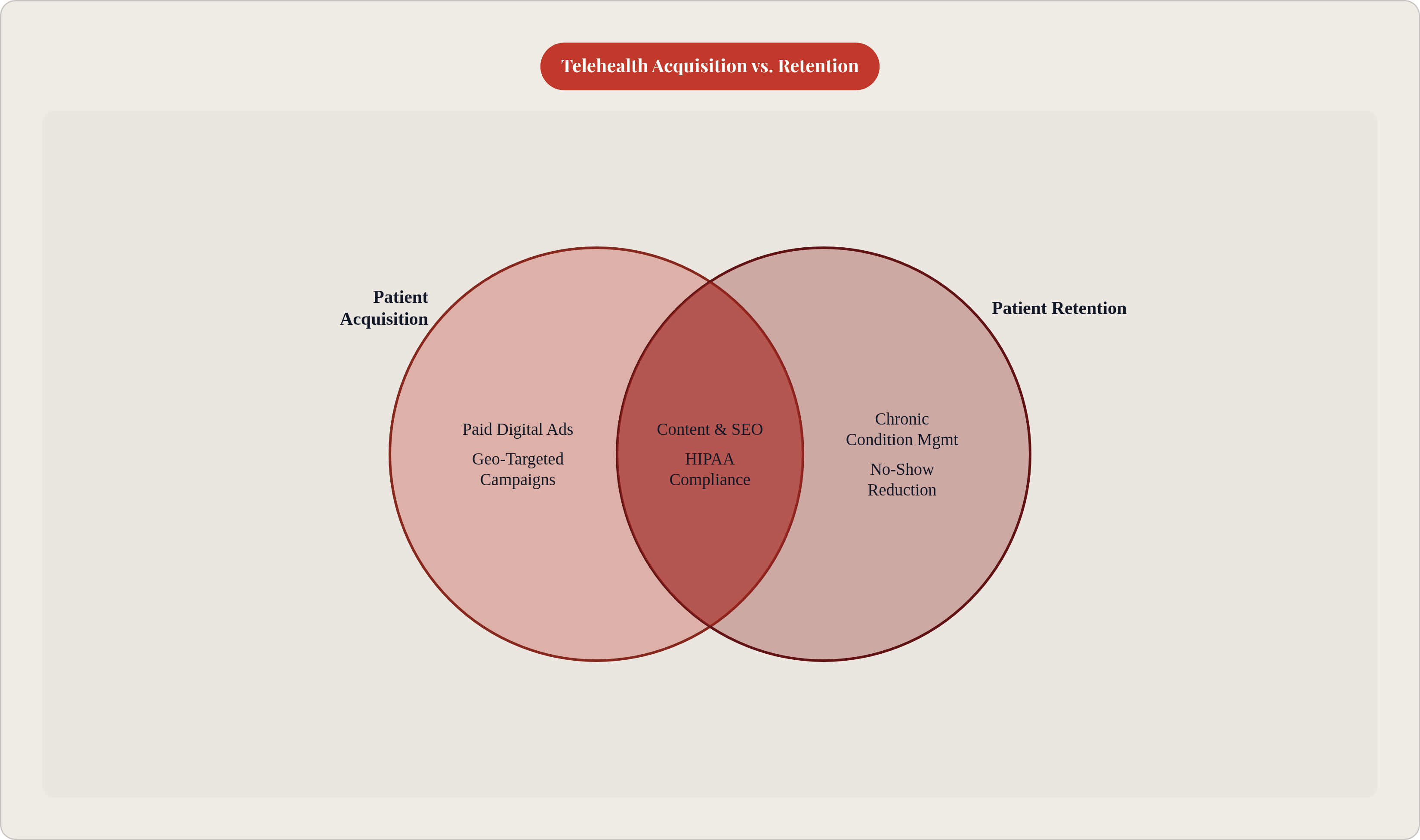
Retention data reveals which patient segments return most reliably; those segments should receive higher acquisition investment. Acquisition channel data reveals which messages created expectations the clinical experience either met or fell short of; that feedback should shape onboarding communication and provider briefings. The loop isn't conceptually complicated. It is operationally uncommon, because acquisition and retention are typically owned by different teams with different reporting structures and different incentive metrics. Neither team has a full picture, and the gap between them is where growth leaks.
Consider content investment as an example of the loop working correctly. Content produced for SEO and trust-building during acquisition, including condition explainers, FAQ pages, and provider profiles, can be repurposed as post-visit resources: care guides, follow-up checklists, condition management summaries. The same asset serves both stages. That's not recycling. It's loop design, and the difference is whether it was planned or accidental.
Chronic condition patients and behavioral health users are the highest-retention cohorts by structural need. Providers with clear data on lifetime value by condition can allocate acquisition budgets accordingly, rather than optimizing for first-visit volume without knowing which patients actually return. Providers who optimized for acquisition volume without lifetime value data have generally built a large patient count and a poor retention curve — both things tend to be true at once, and the teams responsible for each metric rarely compare notes.
Teladoc Health's 2025 benchmark survey found that among health systems with five or more years of virtual care experience, a large majority believe virtual care quality is superior or equal to in-person care. Providers who have operated long enough to collect their own quality data can begin using it as both a retention message and a re-acquisition signal. A claim about patient return rates grounded in a provider's own data is more defensible than generic ad copy, and it's available to almost no one because almost no one is tracking it.
The data infrastructure that enables HIPAA-compliant attribution is the same infrastructure needed to track patient return rates, drop-off points, and lifetime value. One compliance investment serves both stages of the loop. That should change how compliance infrastructure gets budgeted, because it isn't overhead. It's the measurement layer the entire growth system runs on — and providers who treat it as a legal cost rather than a product investment discover, rather painfully, that they can't improve what they can't measure.