Direct-to-Consumer Telehealth Business Models Compared
Hims, Ro, and Amazon each prove telehealth isn't one business—it's five or six.

Direct-to-consumer telehealth is really five or six different businesses that happen to share a video call and a login screen. Mistaking them for a single category is how you end up comparing a subscription pharmacy to a walk-in clinic and wondering why the math never lines up. This piece walks through each model on its own terms: how it makes money, how it keeps patients, and where it's exposed.
The U.S. market for this stuff was worth $1.47 billion in 2023 and is on pace to hit $9.53 billion by 2030, growing about 30.3% a year. That's fast money, which is exactly why the fragmentation happened. EMARKETER puts the 2025 telehealth user base at 86.3 million people, up from 83.3 million in 2024, and says 32.3% of U.S. adults now use telehealth in some form. Real penetration, but still plenty of room to grow, which is why nobody has settled on one winning format yet. Sitting with those numbers for a while, three things seem to be pulling the category apart: whether the patient's need is a one-off (sinus infection, pink eye) or chronic (depression, obesity, low testosterone); what the regulatory rulebook allows for a given condition, especially anything touching controlled substances; and whether the business runs on a recurring subscription, a per-visit fee, or the margin baked into a drug itself. Follow those three forces and the whole landscape starts to make sense.
The vertically integrated subscription model: how Hims & Hers and Ro turned chronic conditions into recurring revenue
Here's the trick, and it's a good one: bundle the doctor visit, the medication, and the pharmacy shipment into one flat monthly charge, then let auto-renewal do the rest of the work. The visit itself functions mainly as an onboarding step, the thing that gets you into the subscription so the subscription can do its job.
What makes this defensible is the plumbing behind the video call. Hims & Hers runs its own pharmacy operations instead of outsourcing fulfillment to a third party, which means it buys generic active ingredients at commodity prices and sells the finished experience at a price closer to what the value is worth to the patient. Ro built something similar with its ro.OS platform, treating telehealth, lab work, and pharmacy as separate pieces it can snap together for whatever new condition it wants to launch next, whether that's weight loss or migraine or menopause care. Own the supply chain, and your margins start looking less like a clinic's and more like a software company's.
Hims & Hers posted a 79% gross margin for full year 2024. That slipped to 74% by the third quarter of 2025, mostly because GLP-1 products, which carry thinner margins than the company's older business lines, made up a bigger share of revenue. Worth sitting with for a second: growth and margin expansion aren't the same thing, and a company can post a 49% year-over-year revenue jump (from $401.6 million in Q3 2024 to $599.0 million in Q3 2025) while its margin quietly erodes underneath it.
The customer math is the more interesting story anyway. Hims & Hers is paying around $929 to acquire a customer, which is steep by DTC standards; you'd wince at that number for a mattress company. An 85% retention rate and a payback period under a year make it work, though, because chronic-care customers stick around for years, not weeks. That's why investors reportedly value this model at roughly 8 times revenue, compared to about 2 times for pay-per-visit outfits. Monthly pricing runs $50 to $299 depending on the condition, with specialty programs like weight loss, hormone therapy, and ED typically landing between $50 and $200, medication and follow-ups included.
The catch is that the whole thing depends on the ability to prescribe and fill a specific catalog of drugs. Any regulatory shift around compounded GLP-1s, which have existed in something of a gray zone during FDA shortage periods, or around controlled substances more broadly, hits this model exactly where it lives.
Pay-per-visit on-demand care: the urgent care model's structural ceiling
No subscription, no relationship, no auto-renewal. You get sick, you book a visit, you pay, you leave. Simple, honest, and, as it turns out, often a tough way to build a durable business.
Self-pay visits in 2026 run anywhere from $19 to $164, with the national median for urgent care sitting around $82; most fall somewhere in the $49 to $149 range depending on complexity and who's on the other end of the call. Sesame Care leans into this directly, advertising urgent care consults starting at $35 and competing almost entirely on price transparency. There's nothing wrong with that as a strategy, but it's a hard one to scale profitably.
Amazon's own path through this model tells you most of what you need to know. It rebranded its national offering as Amazon One Medical Pay-per-visit, folding the old Amazon Clinic into the One Medical platform, and now covers more than 30 common conditions like pink eye, flu, and sinus infections. Amazon also offers a One Medical membership, though, charged monthly or annually, for on-demand virtual care and faster booking. Notice what's happening there: even Amazon, with essentially unlimited acquisition budget, is hedging its pure pay-per-visit bet with subscription economics. That should tell you something about the ceiling on this model.
The unit economics explain why. Acquiring a patient costs somewhere in the low hundreds of dollars, against average revenue per visit ranging from tens to low hundreds of dollars, and there's no recurring revenue to amortize that cost against. Compare that to the subscription model's roughly 8x valuation multiple; pay-per-visit gets discounted down to around 2x, and it's not hard to see why investors treat the two categories so differently. The model does work for conditions that are genuinely episodic, where the patient actually wants zero commitment. That's a narrow, price-sensitive slice of the market, though, and platforms that start here tend to drift toward membership offerings eventually. Pure pay-per-visit at real scale is rarely where anyone ends up staying.
Mental health subscription platforms: two distinct models operating under the same category label
"Online therapy" gets used as a catch-all, but there are two genuinely different businesses hiding under that phrase, and they behave nothing alike financially.
The first is therapy-only: no prescribing, just access to a licensed therapist by message, phone, or video. BetterHelp, now owned by Teladoc Health, runs over 30,000 licensed therapists across all 50 states and prices its service around $260 to $400 a month, advertised in the friendlier-sounding terms of $65 to $100 a week. It's one of the largest virtual therapy platforms in the world by user count. Yet the segment posted $218.4 million in revenue for the first quarter of 2026, down 9% year-over-year, with an adjusted EBITDA margin of just 0.9%. Read that last number twice. Nearly a billion-dollar-scale business, running on essentially break-even margins. That's a business under pressure right now, which is presumably why BetterHelp started accepting insurance in the U.S. in 2025 after years of running cash-pay only. Talkspace took the opposite route years earlier, building broad insurance network participation early on, which generally makes it the cheaper out-of-pocket option for patients who have coverage.
The second model bolts medication management onto the therapy relationship. Cerebral and Brightside both run tiered plans: Cerebral prices medication management alone around $85 a month, therapy alone around $259, and the combined package around $325. This is also the model that got Cerebral a DOJ investigation in 2022 over its prescribing of controlled substances, which pushed the company out of Schedule II stimulant prescribing entirely and forced stricter clinical protocols across the board. Brightside, meanwhile, accepts major insurance carriers and still offers a cash-pay medication-only option, treating insurance participation as much as a trust signal as a revenue channel.
The distinction that matters, once you sit with both models side by side: therapy-only platforms compete on access and convenience, while combined platforms compete on clinical scope, and pay for that scope with heavier regulatory exposure. Both, though, are running into the same wall. Cash-pay pricing gets harder to defend every year as competition increases, and patients increasingly just expect their insurance to cover this the way it covers a physical checkup.
Pharma-sponsored direct-to-patient platforms: drug manufacturers entering the care pathway directly
Here's a genuinely new wrinkle: the drug manufacturer builds the storefront itself. The telehealth visit becomes a doorway into the manufacturer's own product, usually at a cash price that skips insurance entirely.
Eli Lilly's LillyDirect, launched in 2024, is the case that defines this category. Lilly handles the back end, meaning supply and distribution through third-party logistics, and partners with telehealth providers like Ro and Cove to handle the front end, meaning the actual consultation. Zepbound vials get offered at a cash-pay price designed explicitly to route around insurance friction. Read between the lines and the message is pretty clear: the manufacturer wants to own the patient relationship directly, not hand it to an insurer or a middleman.
The federal government has started leaning into the same idea. An August directive from the Trump administration ordered major pharmaceutical companies to build direct-to-consumer models for their high-volume, high-rebate drugs, and TrumpRx.gov was announced as a federal DTC portal connecting consumers to prescriptions through outside partners. The broader pharmaceutical-telehealth integration market is projected to reach close to $791 billion by 2032, which tells you this isn't a side experiment for the industry; it's being treated as a core strategy.
Congress isn't thrilled about it. Senators Durbin, Warren, Sanders, and Welch put out a report titled "Big Pharma's New Sales Scheme" after a nine-month investigation, focused on arrangements where manufacturers partner with telehealth platforms specifically to move their own drugs. One case in the report found that virtually all patients on a given platform ended up on the manufacturer's drug, a number the investigators treated less as coincidence and more as evidence the fix was in. That tension, cheaper access on one side, a prescriber financially aligned with the drug company on the other, is the whole story of this model in miniature. Expect more of these platforms to launch, but also expect more disclosure requirements and prescribing-independence rules to follow close behind.
How each model acquires and retains patients — and why those differences compound over time
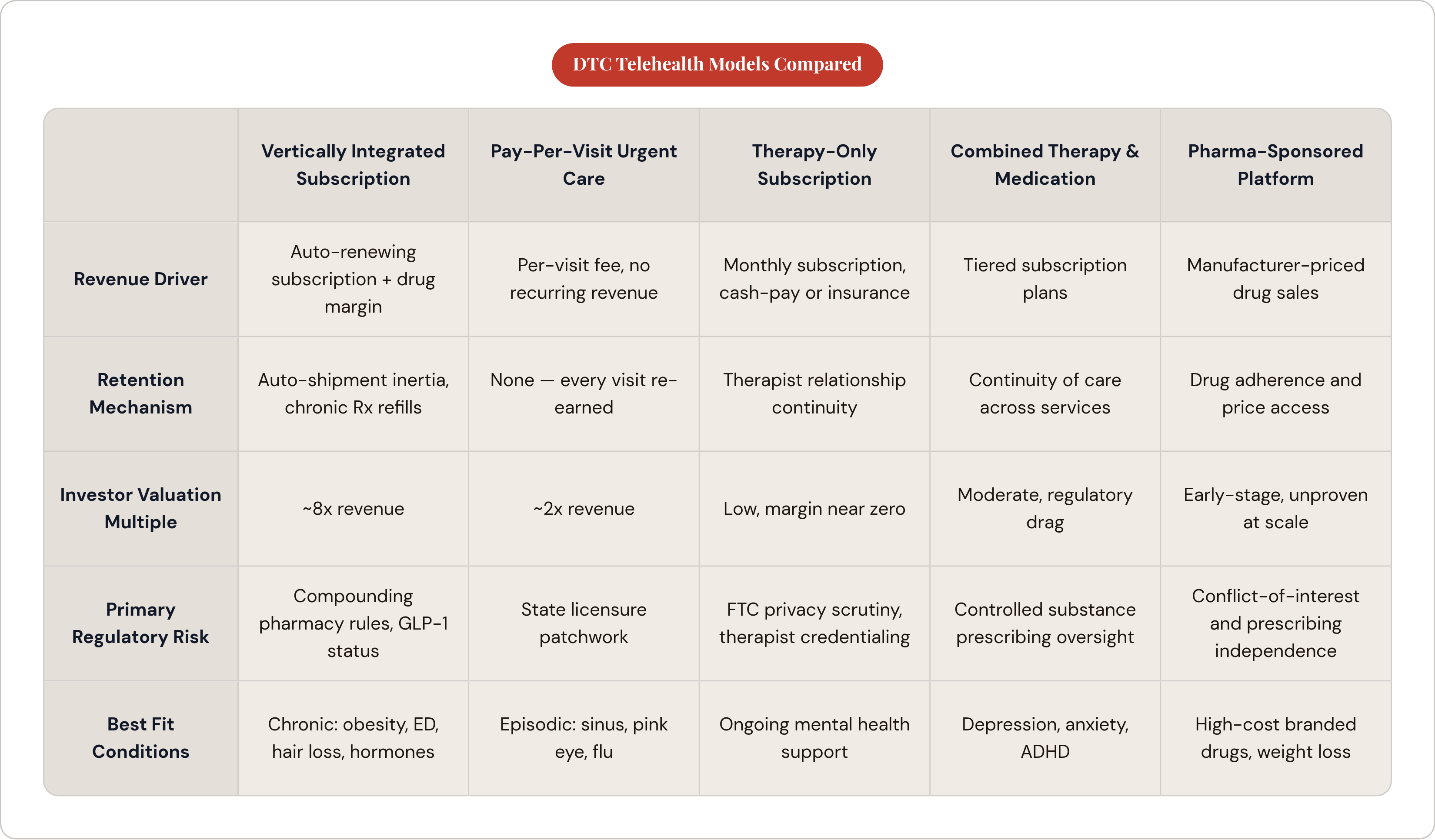
Acquisition is the easy part to compare. Retention is where the real differences show up, and where they quietly compound into either a moat or a leaky bucket.
Vertically integrated subscriptions acquire through paid search and social ads, at high cost, and retain through auto-shipment and the simple inertia of managing a chronic condition. The product itself is the retention mechanism; once your prescription refills automatically every month, canceling requires actual effort. Pay-per-visit platforms acquire through brand recognition and search intent (someone typing "telehealth sinus infection" into Google at 11pm), but they have no built-in retention by design. Every repeat visit has to be re-earned, re-marketed, re-paid for. Therapy subscriptions acquire through stigma-reduction messaging and convenience, and retain through the relationship with a specific therapist; churn here often traces back to a therapist leaving the platform, not to any dissatisfaction with the app itself. Combined medication-and-therapy platforms acquire on the breadth of what they treat and retain on continuity of care, though they carry the heaviest regulatory weight per patient relationship of any model discussed here. Pharma-sponsored platforms acquire through manufacturer marketing and price-transparency pitches, and retention simply tracks drug adherence: the patient stays as long as the medication works and stays affordable through that channel.
The compounding part is this: subscription and pharma-sponsored models accumulate behavioral data on patients over time, and that data funds the next product line, the next condition program, the next expansion. Pay-per-visit platforms don't get that flywheel. Every visit is a fresh transaction with no memory attached. The fact that BetterHelp, after years of cash-pay-only positioning, is now adding insurance, alongside an EBITDA margin sitting near zero, is about as clear a signal as you'll get that cash-pay retention alone doesn't hold up at real scale.
The regulatory and clinical risks each model carries differently
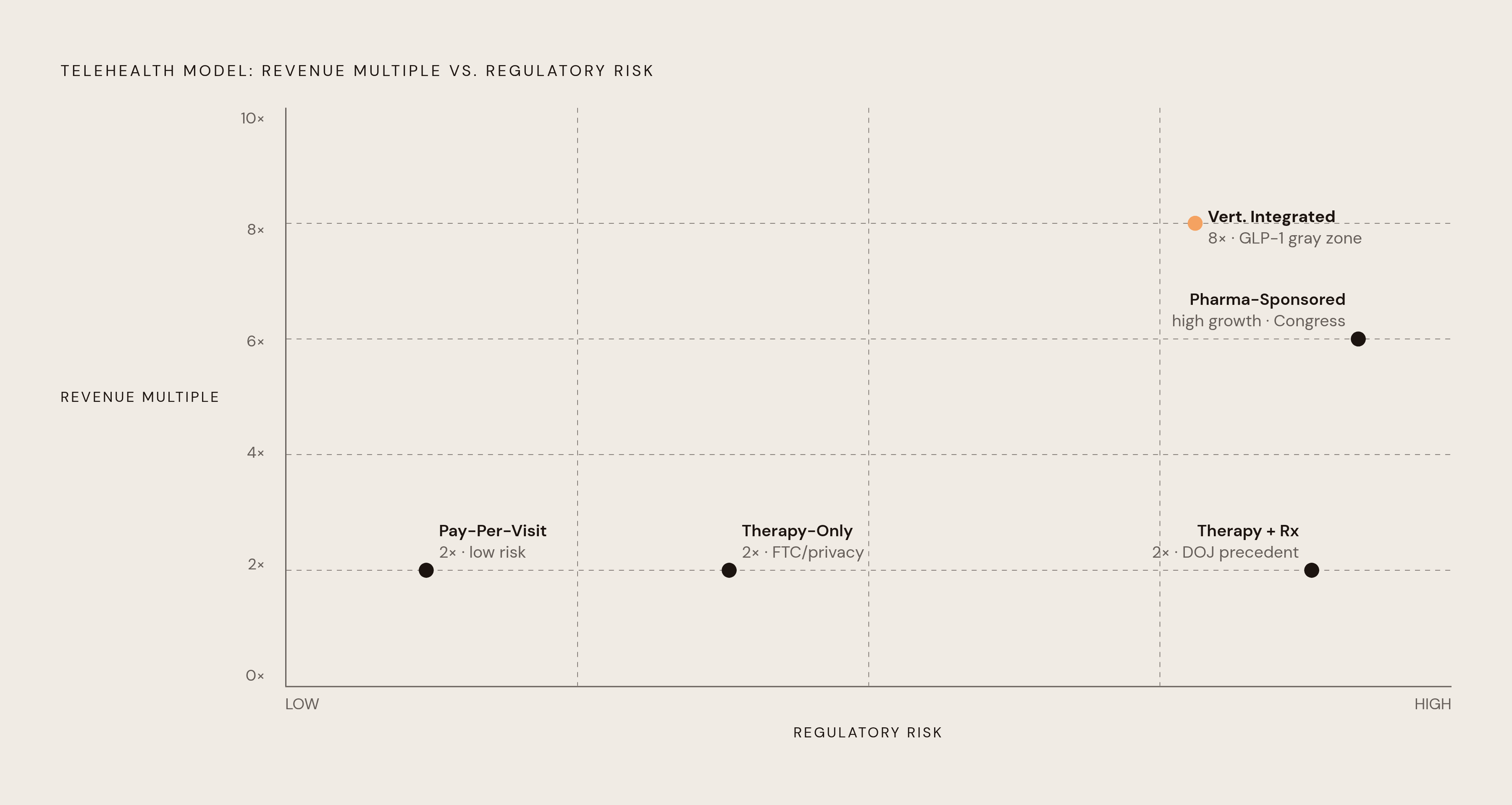
Every one of these models is exposed to something. The exposures just don't look anything alike.
Vertically integrated subscriptions carry risk concentrated in compounding pharmacy rules and the prescribing of drugs that already sit in contested territory, compounded GLP-1s during FDA shortages, testosterone therapy. Any move by the FDA or DEA lands directly on the product catalog. Pay-per-visit urgent care sits in the calmest regulatory waters of the bunch; treating low-acuity, common conditions asynchronously is well-established, and the main friction is licensure and the patchwork of state-by-state telehealth practice standards. Therapy-only subscriptions carry risk around quality and scope of practice; BetterHelp has faced FTC scrutiny over privacy practices, and therapist credentialing and matching quality remain open questions industry-wide. Combined therapy-and-medication platforms sit at the top of the risk list, and Cerebral's DOJ investigation set the precedent that's still shaping how the whole segment operates, particularly around ADHD and anxiety medications. Pharma-sponsored platforms are living under the shadow of the phrase "virtual pill mill," which is how the congressional investigation framed the risk; expect the regulatory response to arrive in the form of conflict-of-interest disclosures and prescribing-independence requirements.
There's a background risk sitting underneath all of this, too. The relaxed enforcement of the Ryan Haight Act and the expanded ability to prescribe without an in-person visit, both leftovers from the COVID era, remain subject to ongoing DEA rulemaking. Any model that depends on prescribing carries that uncertainty whether it acknowledges it or not.
Which raises an obvious question worth sitting with: the model with the cleanest regulatory record, pay-per-visit urgent care, also has the weakest unit economics of the bunch. The models with the strongest economics, vertically integrated subscriptions and pharma-sponsored platforms, carry the most regulatory complexity. That's a trade-off more than a coincidence, and it's one every operator and investor in this space is making, whether they say so out loud or not.
What distinguishes a durable DTC telehealth business from a vulnerable one
The right question was never "which model is best." It's which model fits the condition being treated, the patient being served, and the regulatory ground it's standing on, because a model that's brilliant for weight loss might be entirely wrong for a sinus infection, and vice versa.
Working back through each of the models above, a few markers seem to separate the durable businesses from the fragile ones, regardless of category. Owning the ongoing relationship beats owning a single transaction; a platform managing a chronic condition month after month has more defensible revenue than one waiting for the next flu season. Owning infrastructure matters too. Hims & Hers running its own pharmacy instead of routing through third parties is a good illustration of how vertical integration cuts down on margin leakage and supply risk. Clinical independence from manufacturer incentives is another marker, and it's the one hanging over the pharma-sponsored model most heavily; the growth there is real, but whether it lasts depends entirely on whether prescribing credibility survives the scrutiny already headed its way. Insurance participation cuts both ways, meanwhile: it widens access and cuts down on cash-pay churn, which is exactly why BetterHelp made that pivot in 2025, but it also introduces dependency on payers and squeezes margins in the process.
One more data point worth keeping in mind: 71.4% of physicians reported using telehealth weekly as of 2024, according to EMARKETER. Telehealth itself has become infrastructure at this point, well past the stage of being a novelty. Simply offering a video visit stopped being a competitive edge some time ago; what matters now is how the business around that video visit gets structured, how it makes money, who it answers to, and what happens to it when the regulatory ground shifts, because it will.