Synchronous Versus Asynchronous Telehealth in Specialty Care
Real-time video works for talk-based care; images work better asynchronously.
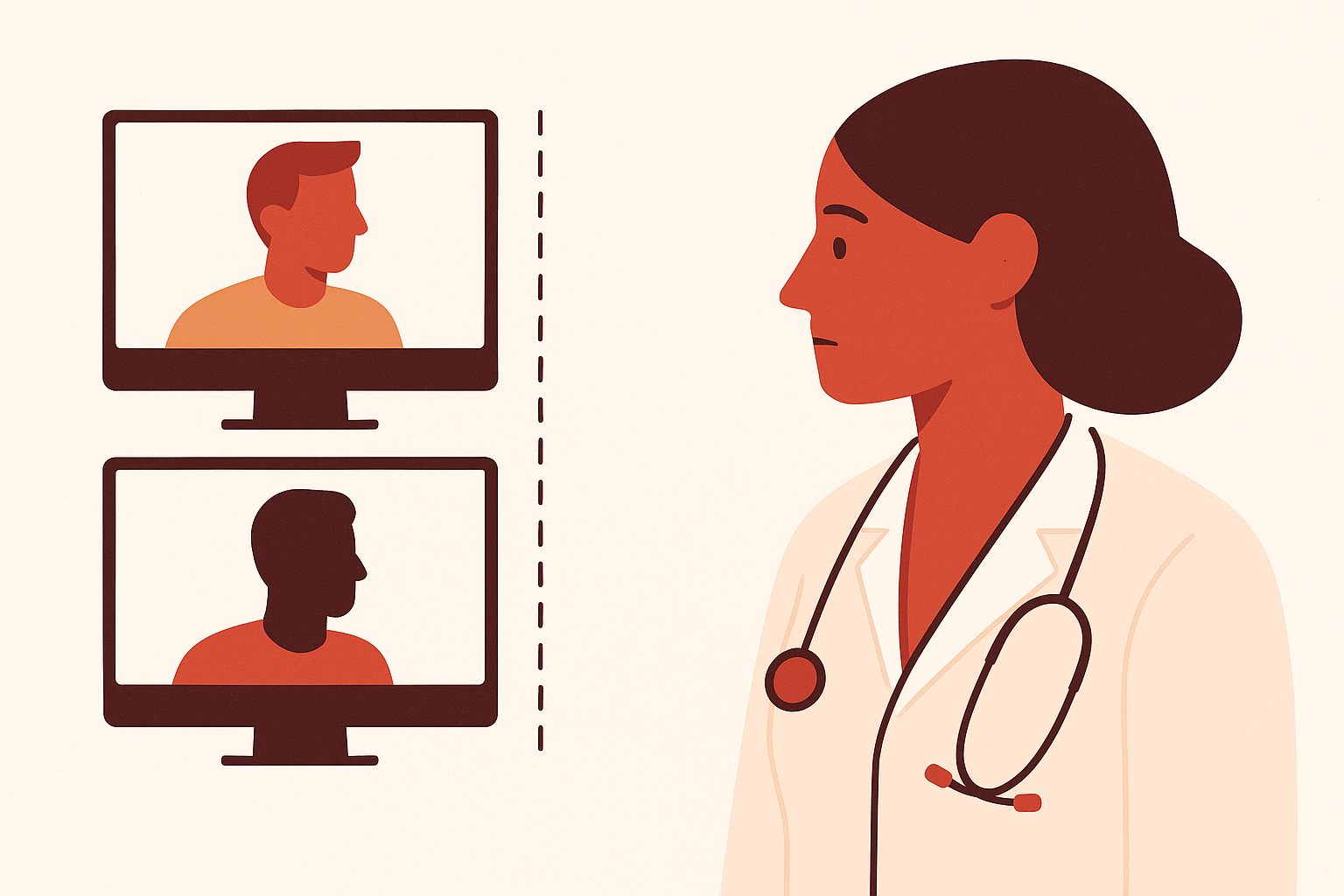
Telehealth in specialty care is really two different tools sharing one name, and mixing them up is how you end up with a program that looks great on a slide deck and falls apart the first Tuesday someone actually tries to use it. Synchronous and asynchronous modalities solve different problems, and which one works depends on what the specialist needs to do with a patient who isn't, strictly speaking, in the room. This piece walks through the data on where each one fits, where the evidence gets messy, and where neither approach really works without some duct tape.
Quick vocabulary check before we go further, because "telehealth" gets stretched to cover everything, the way "cardio" apparently covers both a walk to the mailbox and marathon training. Synchronous means both people show up at the same time, whether that's video, phone, or live chat. Asynchronous, also called store-and-forward, means someone submits something (a photo, a lab value, a recorded clip, an intake form) and a specialist reviews it whenever their schedule allows. Two flavors of async deserve their own names, since they behave nothing alike in practice: remote patient monitoring pulls vitals or wearable data on a schedule and ships it off for review, while eConsults are provider-to-provider, meaning a primary care doctor hands a case to a specialist for guidance with no patient visit attached. Most working telehealth programs blend all of this constantly inside a single patient's care, so sync-versus-async is less a strict category and more a rough map of what's actually happening on a Tuesday afternoon in a clinic.
How telehealth adoption spread unevenly across specialties, and what that pattern reveals
The growth curve here moved fast, then flattened. Pre-pandemic, telehealth made up roughly 0.1% of monthly evaluation and management visits, basically a rounding error. April 2020 hit and it spiked to 41.0%, before settling into a steadier 5.7% to 7.0% range through 2023 and 2024, according to a medRxiv analysis from March 2025. Physician adoption climbed with less drama but the same trajectory: 71.4% of physicians said they used telehealth weekly in 2024, up from 25.1% in 2018, per AMA Policy Research Perspectives data from December 2025.
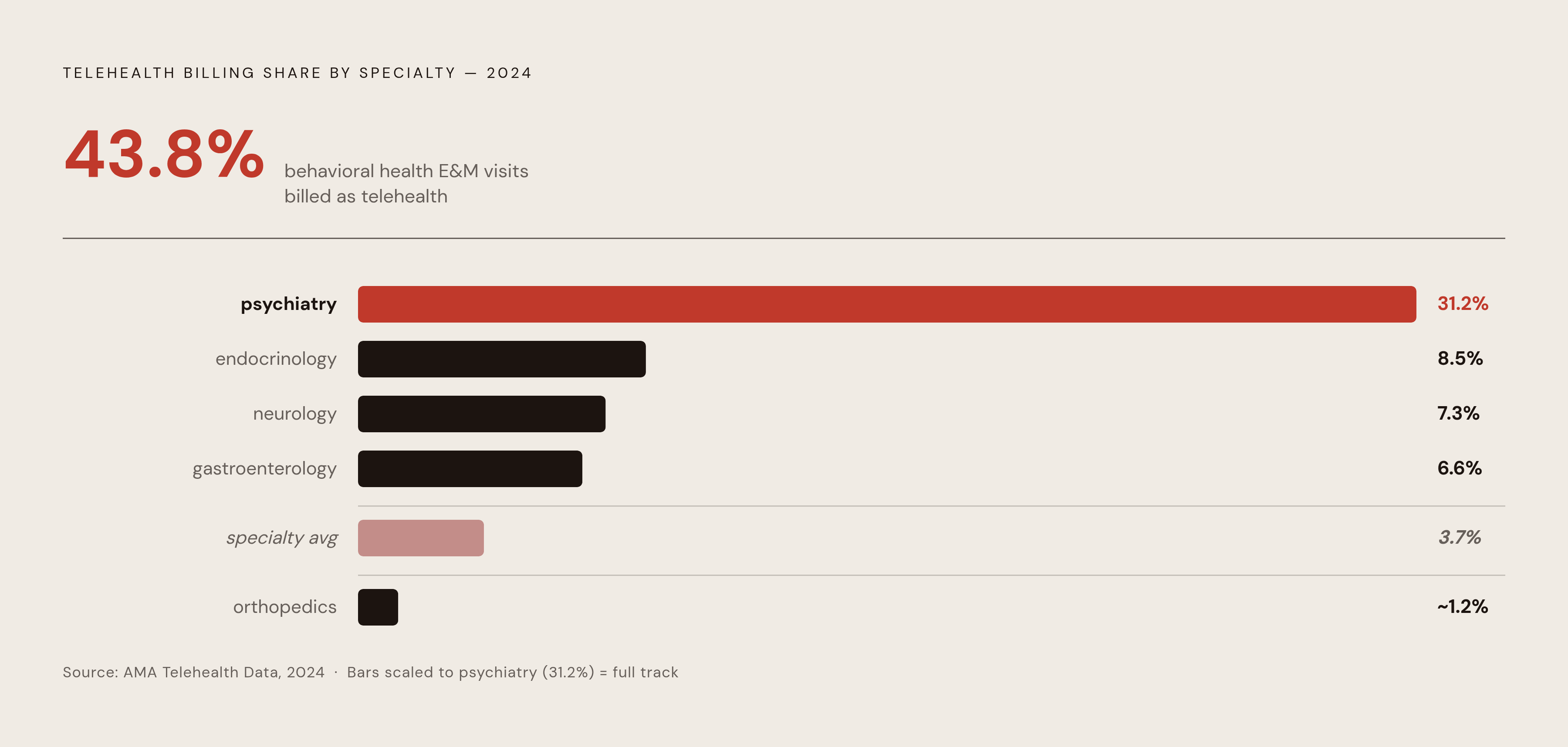
That topline number hides a story that's really about specialty, not technology. Behavioral health sat at 43.8% of E&M visits conducted via telehealth once the pandemic emergency eased. Primary care landed at 8.4%. Orthopedics barely registered at 1.2%. Billing data backs this up from another angle: psychiatrists billed telehealth for 31.2% of eligible spending in 2024, against 8.5% for endocrinologists, 7.3% for neurologists, 6.6% for gastroenterologists, and an overall specialty average of just 3.7% (AMA, December 2025).
So what explains a forty-point gap between psychiatry and orthopedics? Broadband access and smartphone ownership play some role, sure, but the clinical task itself matters more. Some encounters run entirely on talk. Others depend on a clinician's hands and eyes doing something no webcam can replicate. Everything below traces back to that split, and it's worth holding onto as a throughline, because it explains almost every number that follows.
Where synchronous telehealth fits best: specialties built around conversation and ongoing relationship
Synchronous telehealth works best in specialties where the clinical encounter is built around conversation, real-time assessment, and ongoing relationship, not physical examination. Behavioral health makes the case almost by itself. About 36% of mental health and substance-use outpatient visits were still happening via telehealth as of March 2025, per WellSky data, long after the emergency-driven spike faded everywhere else. The specialty holds onto the screen because in psychiatry and therapy, conversation is the clinical exam. Affect, pacing, the specific way someone describes a rough week — a monitor doesn't fail to capture any of that the way it would fail to capture, say, a shoulder exam.
A few other specialties land in the synchronous camp for their own reasons. Neurology depends on real-time cognitive and speech assessment, which you genuinely cannot store and forward; you need the live back-and-forth to catch hesitation or word-finding trouble as it happens. Endocrinology, particularly diabetes and thyroid management, runs mostly on conversation about symptoms and lab trends over time, and video handles that fine. Post-surgical follow-up for low-acuity wound checks or medication adjustments works over video too, as long as nobody needs to physically press on anything.
Here's a number worth sitting with: 76.7% of primary care physicians and 73.1% of medical specialists said they could deliver similar quality of care via telemedicine "to some extent or a great extent." Surgical specialists? Just 50.6% (CDC/NCHS Data Brief No. 493, 2024). That's twenty points of daylight, and it lines up with the theory almost too neatly. When judgment rests on what a patient says and how they present, synchronous holds up fine. When judgment rests on what a clinician can feel, move, or examine with instruments, the format starts to buckle. Urgency changes the math too, since an acute psychiatric crisis needs a real-time response, not a queue and a callback window.
Where asynchronous store-and-forward fits best: specialties that read images and data, not rooms
Asynchronous store-and-forward telehealth is best suited to specialties where the specialist's job is reading an image, scan, or dataset, encounters that never needed two calendars to align in the first place. Flip the logic around and async's home turf comes into focus. If the specialist's actual job is reading a high-resolution image, scan, or slide, forcing two calendars to line up adds friction and nothing else. Nobody needs a dermatologist and a patient both free at 2pm on a Tuesday when the whole encounter boils down to: here's a photo, what is it?
Dermatology, radiology, ophthalmology, pathology, and orthopedic imaging review all fit this pattern without much argument. The market noticed early: store-and-forward adoption grew 312% between 2020 and 2024, the fastest-growing telehealth segment by a wide margin (Arkenea, March 2026). That growth tracks with how much imaging-heavy specialty work never really needed a "visit" in the traditional sense to begin with.
The access case here goes well beyond a sales pitch. A patient in a small town can get an image taken at their primary care clinic and have a specialist review it without booking a flight, a hotel room, or a day off work, which turns a months-long referral wait into something measured in days. Language barriers get easier to manage too, since async workflows let you line up translation ahead of time instead of scrambling for an interpreter mid-call while the clock runs.
Here's the catch, though, and it's a real one. Image quality isn't guaranteed just because someone owns a phone. A blurry shot taken on a five-year-old camera is not the same clinical input as a well-lit, well-framed photo taken by someone who knows what they're doing. Which raises the obvious next question: how good is async, really, once you look past the averages?
What the teledermatology evidence shows about async diagnostic accuracy and its limits
Teledermatology is the best-documented test case for how async performs under real conditions, and the numbers are good, though not spotless. In a UPMC study of 321 asynchronous teledermatology cases of non-scarring alopecia between 2022 and 2023, specialists reached a definitive remote diagnosis in 91.3% of cases; only 8.7% needed an in-person follow-up (PMC, 2025). That's a strong result, for one well-defined condition, and it's worth remembering that alopecia is a fairly forgiving thing to diagnose from a photo.
Widen the lens and the picture gets rougher around the edges. A 2025 randomized cohort study out of AUB found diagnostic concordance of 79% for unassisted patient-taken images, 84% for assisted images, and 87% for resident-taken images (PubMed, September 2025). Accuracy climbs step by step as image quality improves, which isn't exactly shocking once you say it out loud, but it's the kind of thing that's easy to gloss over in a pitch deck. A separate 2024 retrospective in the Journal of Telemedicine and Telecare found async teledermatology changed or modified treatment in 97.6% of cases, while matching the in-person diagnosis in 78.3% of cases.
So what do you do with numbers sitting in the high 70s to high 80s? Read them for what they actually are: async teledermatology handles a wide range of skin conditions well, and roughly one case in five still needs eyes on the patient in person. That's a real limit, not a footnote to bury in an appendix.
The access upside still holds up under that limit. Early benchmarks put async dermatology access time at 1.9 days versus 52 days for a traditional in-person appointment, a gap wide enough that the tradeoff favors async for most patients even accounting for the accuracy ceiling. A 2025 literature review in Dermatological Reviews, spanning studies from 1995 through 2024, found that store-and-forward, synchronous, and hybrid models all performed reasonably, but store-and-forward specifically caught rare conditions when the primary care providers taking the photos had training in clinical photography.
That last detail matters more than it sounds like it should. The ceiling on async accuracy has less to do with bandwidth or resolution and more to do with whether the person holding the camera knows how to frame a lesion. Fix the training, and the whole system's accuracy moves up without anyone touching a line of code.
How eConsults extend async telehealth into provider-to-provider care, and what they do to specialist wait times
eConsults extend the async model into provider-to-provider care, dramatically cutting specialist wait times without requiring a patient visit at all. They take the async idea and move it up one rung. Instead of patient-to-specialist, it's provider-to-provider: a primary care doctor submits a structured case through secure messaging, a specialist responds within a business day or so, and the patient never books a separate appointment just to get that answer.
The effect on referral queues isn't subtle. eConsults have replaced more than 70% of routine referrals with specialist-guided PCP treatment, per Chief Healthcare Executive reporting from May 2026, which keeps lower-acuity patients out of a system that was never built to see them face-to-face and frees up in-person specialist time for cases that actually need it.
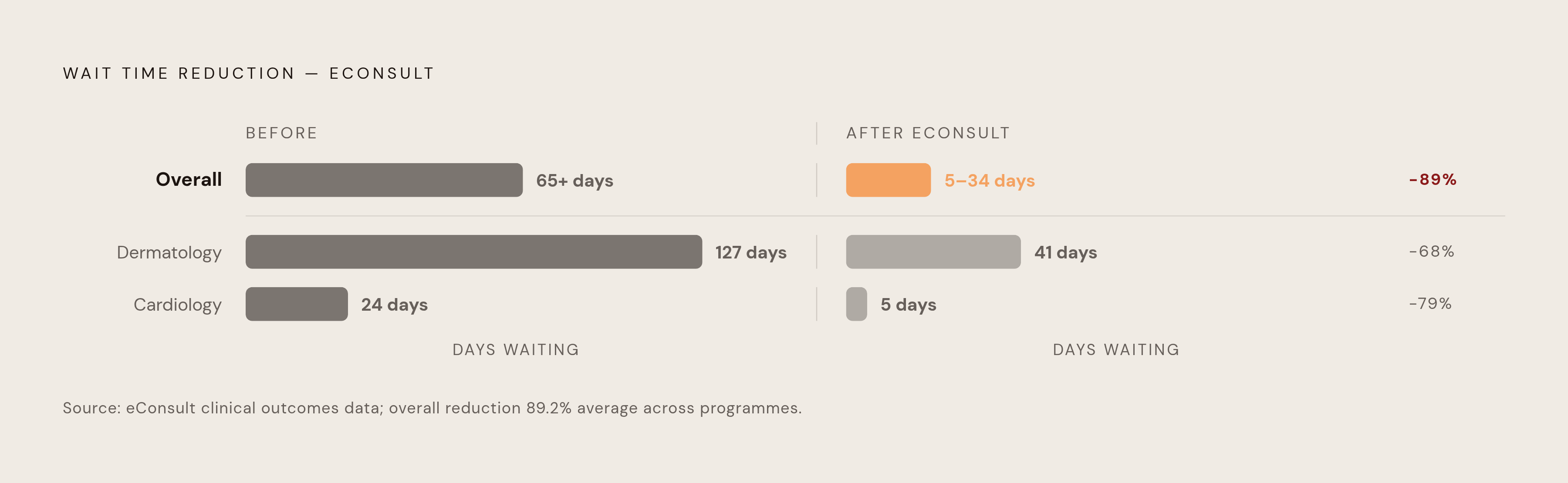
Wait times make the case even harder to argue with. Patients routed through eConsults face 5 to 34 days for specialty input, against 65 days or more without one, an average drop of 89.2% (E-Consult Workgroup, March 2026). Break it down by specialty and the pattern holds with different digits: dermatology dropped from 127 days to 41, cardiology from 24 days to 5 (PMC/NCBI, 2020). Patients seem to feel it too; satisfaction with eConsults runs 78% to 93% across sites. Specialists are more split, ranging from 50% to 95%, a spread wide enough that program design probably explains more of the gap than the modality itself does.
One more detail worth flagging, because it's easy to miss. Pediatric eConsults showed a a substantial visit-aversion rate, meaning over a third of cases never needed a face-to-face visit at all, and the majority of consults wrapped in under 10 minutes (PMC/NCBI, 2018). That's a modality doing its job efficiently, held back mostly by how many specialists are willing to fold it into an already packed week.
Where neither modality works well without modification: surgical and procedural specialties
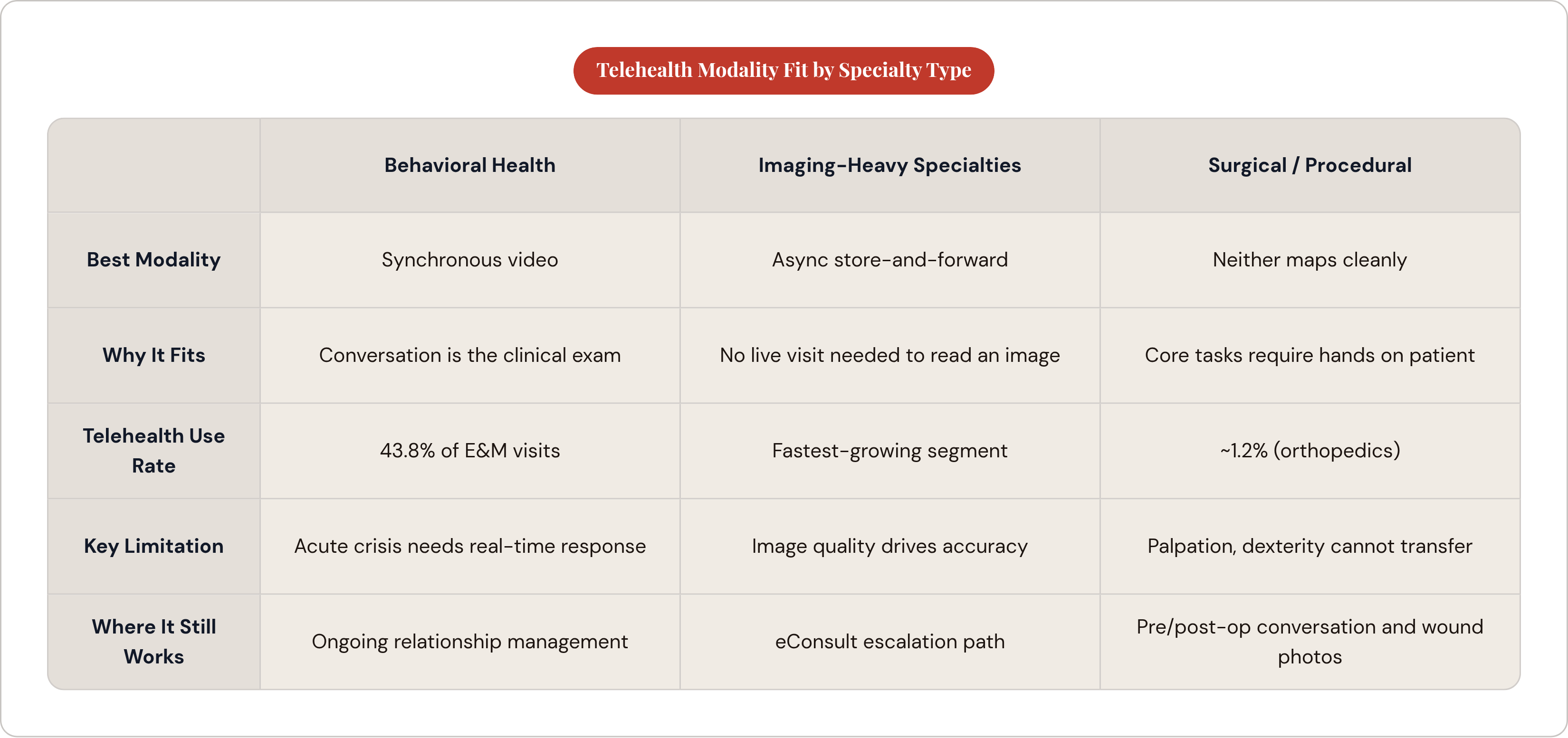
Neither synchronous nor asynchronous telehealth maps cleanly onto surgical and procedural care, because the core clinical tasks require hands on a patient. Surgery is where both modalities run into a wall, and surgeons will tell you so if you just ask. Nearly half, 49.7%, of surgical specialists said telehealth simply wasn't appropriate for their specialty or patients, compared with 26.7% of medical specialists and 15.5% of primary care physicians (CDC/NCHS Data Brief No. 493, 2024). That 50.6% confidence figure from earlier belongs here too: it's the lowest of any group measured, and it comes straight from the people doing the cutting.
The reason isn't complicated, even if it's inconvenient. Physical exams, dexterity checks, wound inspection, procedural planning: these need hands on a patient, and no camera upgrade changes that math. You cannot palpate a joint through a laptop screen no matter how good the lighting is, and no amount of 4K resolution fixes that.
Still, surgical care isn't a lost cause for telehealth across the whole timeline. Pre-operative consultations, the history-taking and expectation-setting conversations, work fine over video. Post-operative follow-up for low-acuity cases splits cleanly between async wound photos and synchronous symptom checks. Orthopedic imaging review benefits from async interpretation of a radiograph or MRI paired with a synchronous conversation walking the patient through what it means. The task inside the encounter decides the modality more than whatever specialty name is on the door, and surgical work just has fewer tasks that qualify.
How to think about choosing a modality when the clinical evidence points in both directions
One question does most of the work here: what does the clinician actually need to do in this specific encounter? Conversational, relational, or time-sensitive judgment calls favor synchronous. Image interpretation, data review, or a stable case getting a second opinion favors async. Plenty of encounters split the difference anyway, running async intake into a synchronous follow-up, or pairing async store-and-forward with an eConsult escalation path if something looks off.
Access factors stack on top of the clinical task, mostly independent of it. Rural and underserved patients tend to gain the most from async, since travel and scheduling are usually the real obstacle, not the medical complexity involved. Patients facing language barriers often do better with async too, since translation can get built into the submission instead of negotiated live, under pressure, with the clock running against everyone.
Yet none of this holds together if training gets treated as an afterthought. The teledermatology numbers make that plain enough: image quality drives diagnostic concordance, and image quality is a training problem before it's ever a technology problem. Health systems building these programs would do better mapping the encounter type to the modality first, rather than bolting a new tool onto an old referral pipeline and hoping the mismatch sorts itself out on its own.
Behavioral health hit 43.8% telehealth use largely because the format actually fits the task at hand. That's not a fluke, and it's a pattern any specialty can replicate, provided it's willing to run the same honest accounting of what the encounter actually requires instead of what the technology happens to make easy.