Telehealth Platform Selection Criteria for Health Systems
Set up governance before vendor selection to prevent implicit criteria from driving the decision.

The most common mistake in platform selection is convening the evaluation team after the shortlist already exists. By that point, the criteria have already been implicitly set, usually by whoever assembled the shortlist, and the team's job becomes justification rather than evaluation. You are not evaluating candidates; you are auditing a decision someone else already made.
Governance structure has to precede vendor comparison. Without it, criteria get weighted by whoever speaks loudest in the room, not by operational reality. Building governance after the shortlist is like installing a foundation under a house that is already framed: technically possible, but you are working around decisions that should have shaped the structure from the start.
The evaluation team must be multidisciplinary, because telehealth touches an unusually wide range of users and workflows simultaneously. Who belongs at the table, and why, is worth spelling out.
The Chief Medical Officer carries the most direct accountability for clinical program outcomes. Per Teladoc Health's 2025 HHS benchmark survey, most respondent health systems identified the CMO as the key decision-maker, which is appropriate given what is at stake clinically. But the CMO cannot represent every service line, and this is where teams routinely shortcut themselves.
Specialty care providers must be represented distinctly, not collapsed into a single clinical voice. Requirements diverge meaningfully across service lines. Behavioral health, for instance, carries the highest adoption rate of any specialty: a large majority of psychiatrists provided video visits in a measured week. Their session privacy requirements, asynchronous messaging needs, and documentation workflows are categorically different from what urgent care or specialist consultation demands. Treating these as interchangeable is how organizations end up buying a platform that fits one department and quietly strains the others.
Nursing leadership is consistently underweighted. Nurses are central to the virtual rooming process and to Remote Physiological Monitoring workflows. A platform that fails to account for how nurses conduct intake, gather device-transmitted vitals, and prepare a patient before the provider joins is not a telehealth platform. It is a video call with a billing code attached.
IT and security must participate from the start, not in a review capacity after a finalist has been identified. Integration architecture decisions made at the evaluation stage carry direct implications for the system's security posture, maintenance costs, and upgrade cycles. Looping them in late means relitigating decisions that have already hardened into preferences.
Finance, compliance, patient experience, and access stakeholders complete the team. Patient-facing requirements carry as much operational weight as clinician-facing ones; this piece returns to that point later.
The team's first deliverable should be a documented set of use-case requirements tied to actual clinical workflows the system intends to run virtually. Not feature wish lists. Actual workflows. Vendors are practiced at demonstrating features that look impressive but fail to correspond to how your organization operates. The requirements document is what prevents that demo from becoming the de facto evaluation.
One structural point that rarely gets stated explicitly: the governance team should be designed to persist through ongoing operations, not dissolve at go-live. Telehealth operations evolve with regulatory changes, patient population shifts, and new service line expansions. A team that disbands after launch leaves the organization without the institutional memory to navigate what comes next, such as a mid-contract state law change or a new service line expansion that requires renegotiating vendor scope.
EHR Integration Depth: The Criterion That Determines Whether Everything Else Works
More than 95% of U.S. hospitals use certified EHR platforms. That means EHR compatibility is not a differentiator; it is a prerequisite. The real evaluation question is whether the telehealth platform connects to the EHR deeply enough, and at what operational cost.
Does documentation from the telehealth visit auto-populate the clinical note in the EHR, or does the provider re-enter anything? That question sounds granular. It is not. Manual re-entry is where data integrity degrades quietly, where provider time disappears, and where errors introduce themselves between the encounter and the record.
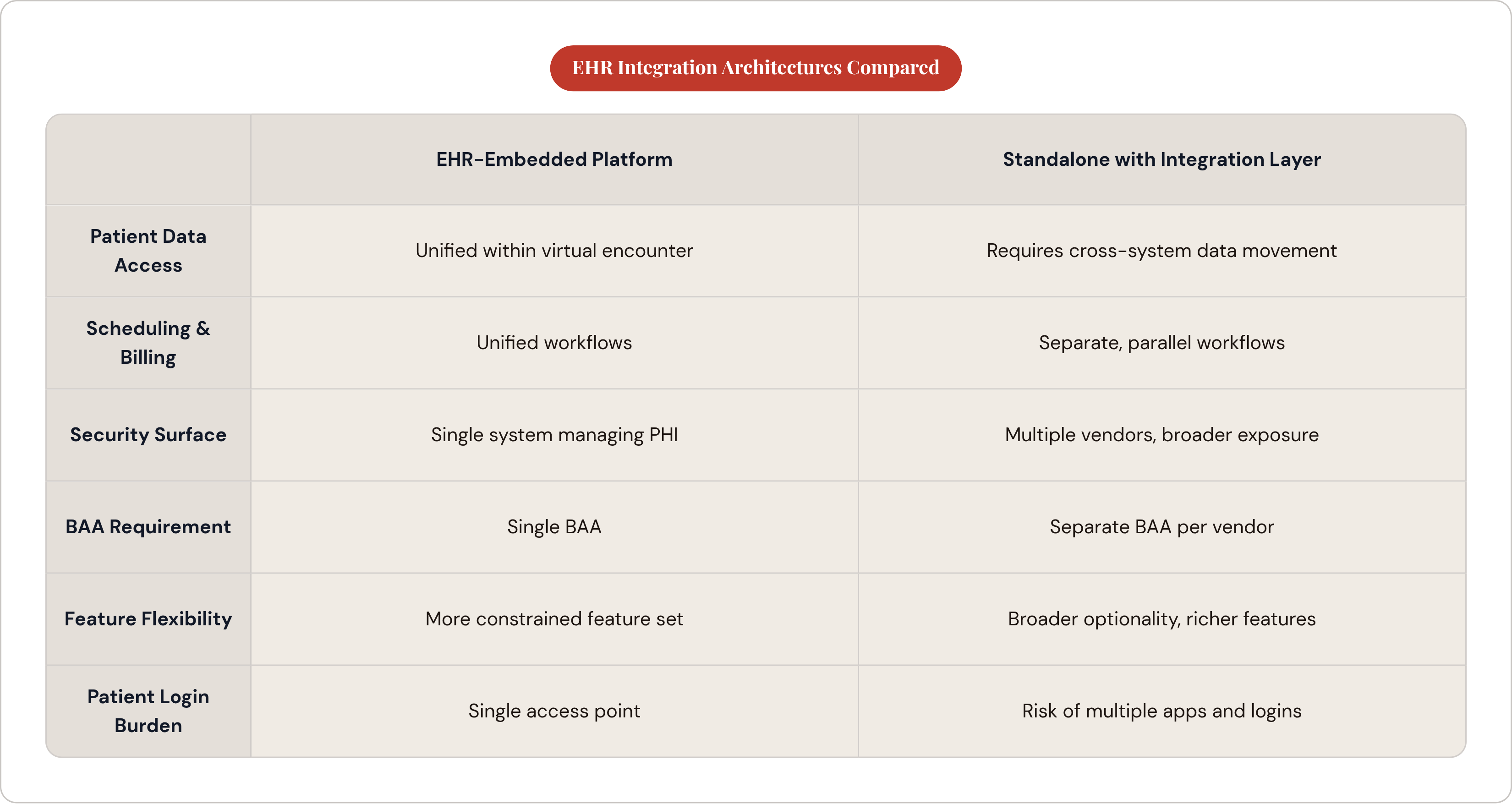
Two fundamental architectures are worth evaluating carefully. EHR-embedded telehealth platforms keep patient data accessible within the virtual encounter, unify scheduling and billing, and reduce the security surface area because there is only one system managing protected health information. The tradeoff is typically less vendor flexibility and, in some cases, a more constrained feature set. Standalone platforms with an integration layer offer broader optionality and sometimes richer purpose-built features, but they introduce separate scheduling, documentation, and billing workflows, a higher risk of manual data movement, and patients who frequently encounter multiple apps and logins before they can speak to a provider.
Interoperability standards deserve explicit scrutiny. FHIR enables real-time data sharing critical for coordinating care between a telehealth specialist and the patient's primary provider. HL7 supports legacy data exchange pipelines that most health systems still depend on. Without these, telehealth can become an isolated service rather than an integrated part of the patient's longitudinal record, meaning a telehealth specialist's findings may never appear in the primary care note, which is a clinical problem before it is a technical one.
Integration costs are routinely underestimated. Initial EHR integration typically runs $5,000 to $50,000, with annual maintenance of $1,000 to $5,000. Those figures exclude (i) API management, (ii) workflow customization, (iii) interface monitoring, and (iv) compliance updates over time. Require vendor-provided estimates for all of those line items in the RFP response, not just the initial connection fee.
A practical implication for RFP design: require a live demonstration of a complete encounter cycle, from scheduling through post-visit documentation, in the health system's actual EHR environment. Not a vendor sandbox configured to make the integration look seamless. If the vendor cannot do that, the inability itself tells you something, most often that their integration is shallower than the sales presentation suggested.
HIPAA Compliance and Data Governance: A Layered, Evolving Obligation, Not a One-Time Checkbox
Every telehealth vendor serving a covered entity must execute a HIPAA Business Associate Agreement. That is the minimum. Treating it as the finish line is how health systems end up in OCR investigations wondering what happened.
The integration architecture choice carries a compliance implication that is frequently overlooked. An EHR-embedded platform operates under a single BAA and a unified security infrastructure. A standalone platform requires a separate BAA, a separate security assessment, and ongoing monitoring of a second vendor's compliance posture. That is not a reason to automatically prefer embedded architecture; it is a reason to price the compliance burden of the standalone option accurately before signing anything.
Technical safeguards that belong on every RFP include (i) TLS 1.2 or higher for all data in transit, (ii) encryption at rest across databases, object storage, attachments, and message archives, (iii) multi-factor authentication across all user roles, and (iv) full audit logging. Geographically redundant, encrypted, immutable backups and a documented disaster recovery mechanism are required under the HIPAA Security Rule.
"Secure" and "HIPAA-compliant" are not synonyms, and conflating them is a surprisingly common evaluation error. Consumer-grade platforms use encryption without satisfying the administrative and procedural requirements the Security Rule also demands. Ask vendors to produce their most recent security risk assessment, not just their BAA.
The regulatory environment is actively tightening. The 2026 Security Rule update adds specific requirements for telehealth session security and remote patient monitoring data protection. State laws now layer meaningfully on top of the federal baseline: (i) Washington's MHMDA and Nevada's SB 370 impose consent, notice, and security duties and restrict geofencing; (ii) Connecticut bans geofencing around reproductive and mental health facilities; (iii) California's AB 352 requires segmenting and limiting disclosures of sensitive services data. Health systems operating across multiple states must map each vendor's data handling practices to every applicable state law, not just the federal framework. This is tedious work, and it is also necessary.
The OCR has also cautioned that patient data used to train or operate AI systems must be fully de-identified or protected under HIPAA standards. That guidance is directly relevant for any vendor prominently featuring AI-powered diagnostic or documentation capabilities, which is most of them now.
Healthcare accounts for 36% of all disclosed data breaches across industries, and telehealth providers have seen a sharp increase in targeted attacks as utilization has grown, with common vulnerabilities clustering in web-based applications and endpoint security.
That raises an important question for the RFP: how does the vendor track and respond to state law changes? A vendor who answers with a policy document from two years ago is, in their way, answering the question, namely, that they have not been tracking state law changes since that document was written.
Clinical Workflow Fit and Specialty-Specific Usability: Where Platforms Reveal Their Real Design Assumptions
A platform can pass integration review, clear compliance evaluation, and still fail operationally. The failure mode is usually this: the platform was designed around in-person clinic workflows with virtual care retrofitted on top, and clinicians know it within three encounters. The tells are in the small details, not in the demo.
The revealing question is not "does it support telehealth?" It is: was virtual care the platform's design origin, or was it added later? How does the platform handle pre-visit intake? Can a nurse or medical assistant conduct a virtual rooming, gather vitals from connected devices, and prepare the patient chart before the provider joins? In-person clinical workflows have that handoff built in over decades of practice. Purpose-built telehealth platforms architect for it. Retrofitted ones ask the provider to absorb it, quietly, one encounter at a time, until the complaints start.
Specialty-specific requirements vary enough that they should be evaluated separately, not averaged into a generic clinical usability score. Each specialty carries distinct requirements: (i) behavioral health needs session privacy, asynchronous messaging, and documentation templates that a general video platform will not natively support; (ii) RPM requires device integration, configurable alert thresholds, and nursing triage workflows that are architecturally distinct from scheduled video visits; (iii) specialist consultation needs handoff documentation, co-visit capability, and care plan sharing across providers; and (iv) urgent care demands queue management, patient self-scheduling, and wait-time visibility. These are not variations on a theme; they are distinct use cases that will expose different weaknesses in different platforms.
Workflow evaluation cannot be delegated to IT, because IT is not the one managing a clinical encounter while also navigating a broken handoff sequence. Disruption at the point of care carries patient safety implications, not just efficiency costs.
Usability must be evaluated by the people who will actually use it. Structured pilot sessions with clinical staff before final vendor selection are not optional. A platform that IT approves and nursing finds disruptive will fail to achieve the adoption rates that justify the investment, and the adoption shortfall will be attributed to change management rather than platform design.
Post-visit workflow continuity is a frequently overlooked test case. After the encounter closes, can the provider schedule a follow-up, share a care plan, assign tasks, and send patient instructions without leaving the platform or re-entering data? If the answer is no, the visit ends and the workflow fragments. That fragmentation accumulates across thousands of encounters into a meaningful operational burden that never shows up in the demo.
Scalability, Technical Performance, and Infrastructure Resilience Under Real-World Load
A platform that performs well in a controlled pilot degrades at system-wide volume across multiple facilities and time zones. The evaluation question is whether the vendor's infrastructure is designed to accommodate your eventual volume, not just your current one.
Audio and video quality degradation directly affects clinical assessment capability. A provider trying to evaluate a patient's respiratory distress or skin presentation through a pixelating, buffering video feed is not conducting a telehealth visit; they are managing a technology failure during a clinical encounter. Stable, low-latency video under concurrent session load is a clinical requirement, not a premium feature to be deprioritized in vendor negotiations.
Bandwidth variability on the patient side compounds the problem. Rural and underserved populations, two groups that stand to benefit most from telehealth's promise of expanded access, are precisely the populations with the least reliable connectivity. A platform that performs well on a fiber connection and degrades on constrained bandwidth is not universally accessible, regardless of what the marketing materials claim.
Uptime SLAs deserve careful reading. Aspirational availability language and contractually guaranteed uptime with defined remediation terms are different instruments. Know which one you are signing before the ink dries.
Multi-site and multi-entity architecture is a scalability criterion that often goes underspecified in RFPs. Health systems with affiliated practices, regional hospitals, and outpatient clinics need (i) role-based access control, (ii) entity-level configuration, and (iii) consolidated reporting across the enterprise. A collection of disconnected deployments is not enterprise telehealth; it is departmental telehealth with enterprise-scale licensing fees.
RPM-specific infrastructure is architecturally distinct from video visit infrastructure. Continuous data streams from patient devices require persistent connections, alert pipelines, and integration with nursing monitoring workflows. Platforms architected primarily around scheduled video visits handle RPM as a bolt-on, which is worth interrogating specifically rather than accepting a generalized answer about.
On pricing: per-visit models that appear attractive at pilot volume become the dominant cost driver at enterprise scale. Model the pricing curve across three to five years at projected volume, not just the entry rate. Ask vendors how capacity is provisioned, elastically or through advance planning, and ask for documentation of how they have handled historical volume spikes. The answer distinguishes vendors who have actually operated at scale from those who have not.
Patient Access and Experience as a Clinical Quality Measure, Not a UX Nicety
74% of physicians' practices offered remote care access through video conferencing in 2024, up from 14.3% in 2018. Supply has expanded dramatically. But a platform that patients struggle to join does not deliver on that expansion; it relocates the access barrier from geography to technology.
No-download, browser-based access is a patient access requirement. Requiring patients to install an application before a visit creates abandonment, particularly among older adults and lower digital-literacy populations. If your patient population skews toward either group and your platform requires a download, your no-show rate will likely reflect that choice.
Mobile-first design must be tested on low-end Android devices, not on current flagship hardware. A meaningful share of telehealth patients connect via smartphone, and among lower-income populations that share is higher. A platform that runs well on the latest iPhone and stumbles on a three-year-old Android is not mobile-friendly in any operationally meaningful sense.
Accessibility compliance is both a legal obligation and a patient access requirement. (i) ADA-aligned design, (ii) screen reader compatibility, and (iii) support for patients with hearing or vision impairments belong in the RFP, not in a post-launch accessibility audit where the costs and timeline are no longer negotiable.
Language and translation support matters for any health system serving multilingual populations. In-platform interpretation capability is meaningfully different from routing through a third-party call. Evaluate it explicitly.
Self-scheduling, automated reminders, and pre-visit intake that does not require a phone call are the current patient expectation. Platforms that require staff intervention for every appointment undermine the efficiency rationale for telehealth and generate back-office burden that counteracts the access expansion the platform was supposed to deliver.
Nearly 97% of healthcare professionals report using telemedicine, and 75% report improved treatment effectiveness. But those outcomes depend on patients successfully completing encounters. Patient-side friction is where outcomes get lost before they can be measured. A telehealth platform with poor patient access is like a hospital with a revolving door that only spins from the inside — the building is open, but no one can get in. That makes patient access a clinical quality issue, which is a category distinction worth defending when the purchasing committee starts treating the patient portal as a line item to trim.
Vendor Stability, Support, and the Consolidating Market's Real Implications for Long-Term Platform Risk
The telehealth vendor market is consolidating. For health systems in the middle of a platform selection, that is a material risk factor, not an industry trend to acknowledge and move past.
A vendor acquired mid-contract will sunset the product, migrate the customer to an acquiring platform without the negotiated terms intact, or deprioritize support while their engineering resources are consumed by integration work. Health systems that failed to evaluate vendor stability before signing experienced exactly those scenarios as the first wave of telehealth consolidation moved through the market. The organizations that fared best had contractual protections in place, not just a good relationship with their account manager.
Vendor financial health can be assessed through publicly available indicators for publicly traded companies: (i) revenue trends, (ii) cash position, and (iii) investor disclosures. For private vendors, require audited financials or third-party financial assessments as part of the RFP process. A vendor who declines is communicating something worth hearing.
Customer concentration is a related risk that rarely gets asked about. A vendor whose revenue is substantially dependent on a small number of enterprise customers is exposed if any of those relationships shift. Ask for customer distribution data and evaluate the answer.
Support infrastructure is a proxy for operational maturity. What are the response time SLAs for critical issues during active clinical sessions? Is there 24/7 escalation support, or does after-hours coverage route to a ticketing queue? Ask for documented incident response procedures. A vendor who describes their incident response protocol in specific terms, mean time to detection, escalation path, communication cadence during an outage, has probably exercised it; one who responds with generalities probably has not.
Reference checks should be conducted with health systems of comparable size and complexity, outside the vendor's facilitation. Call peers directly. The information quality is different when the vendor is not on the call.
It is also worth considering the vendor roadmap against the regulatory trajectory. The 2026 Security Rule update, evolving state laws, and ongoing AI-related guidance will require platform updates. A vendor who cannot articulate how they track and respond to regulatory shifts is presenting a maintenance liability, not just a platform.
One final evaluation criterion, underweighted almost universally: what happens when you need to leave? Contract terms governing (i) data portability, (ii) export formats, and (iii) transition assistance can determine whether platform migration is manageable or catastrophic. Evaluate exit terms with the same attention you give onboarding terms. The vendors who push back hardest on exit provisions are, with notable consistency, the ones whose customers most wish they had insisted on them.