Telehealth Reimbursement Rules After the COVID-19 Flexibilities
Congressional extension and permanent rules reshape Medicare telehealth through 2027.

Congress had already extended the pandemic-era flexibilities multiple times since 2020, so by the time September 30, 2025 rolled around, there was a bit of a "boy who cried wolf" fatigue setting in. Providers and advocacy groups had seen this cliff before, and it always got resolved at the last minute, so the mobilization this time was noticeably quieter. That's a completely human response to deadline fatigue, and it's also, in retrospect, a mistake.
Because this time, the deadline passed without action, and the reversion to pre-pandemic rules wasn't gradual, it was immediate. Patients could no longer receive most telehealth services from home, and geographic originating-site restrictions snapped back into place. Audio-only visits got restricted to behavioral and mental health services only, shutting out plenty of other legitimate audio-only use cases, while the practitioner eligibility list narrowed back down to the original statutory roster.
CMS told Medicare Administrative Contractors to hold claims rather than deny them outright, betting that Congress would eventually act and make the hold moot. That was a reasonable bet, but it still meant payments were frozen in place while everyone waited. Then the federal government shutdown began October 1, 2025, stacking a funding lapse directly on top of the policy lapse.
I kept looking for a cleaner way to explain what "reverting to prior rules" actually costs in practice, and the number that finally made it click wasn't in a committee report — it was HHS data showing a 24% drop in fee-for-service telemedicine visits following the lapse. That's not an abstraction; it's tens of thousands of patients who, on a given day, either could not get the same appointment they'd had the week before, or had to drive somewhere to get it.
The 43-day gap, the November reinstatement, and the retroactive claims question
H.R. 5371, signed November 12, 2025, ended the shutdown and reinstated the telehealth flexibilities. The bill itself didn't spell out an explicit retroactive effective date, which is the kind of legislative gap that keeps compliance officers up at night; CMS closed that gap through updated FAQs confirming retroactive application. The practical upshot: services delivered between October 1 and November 12, 2025, the full 43-day stretch, are retroactively payable under Medicare.
That's good news that comes with homework attached. You now need to go back through that window and identify any beneficiaries who paid out of pocket because Medicare wasn't covering the service at the time. Those overpayments need to be refunded to the patients, not quietly kept as a rainy-day fund, and the applicable claims need to actually get submitted to Medicare, since holding a claim isn't the same as billing it.
This isn't some theoretical footnote buried in a compliance manual. If your practice collected cost-sharing from patients during that gap, you are, right now, holding money that legally belongs to somebody else, so sort it out before an auditor sorts it out for you.
The reinstatement, though, was a patch, not a fix. It bought time, and what Congress did with that time is the subject of the next section, which is where the real structural decisions finally got made.
What the Consolidated Appropriations Act, 2026 actually extends, and what is now permanent
Signed February 3, 2026, the Consolidated Appropriations Act, 2026 extends the Medicare telehealth flexibilities through December 31, 2027. That's the headline, though the details are where it gets interesting, because the extension and the permanent changes are not the same thing, and mixing them up is an easy way to build a five-year business plan on an eighteen-month foundation.
Through December 31, 2027, the extension covers a fairly wide set of non-behavioral, non-mental-health telehealth: (i) no geographic restrictions on originating site, (ii) patients allowed to receive care at home, (iii) all eligible Medicare providers (not just the old enumerated list) allowed to furnish services, (iv) FQHCs and RHCs qualifying as distant site providers, and (v) audio-only delivery permitted. The in-person visit requirement for initial and annual mental health telehealth visits is also waived through the same date, meaning it comes back January 1, 2028 unless Congress moves again.
Now the permanent list, which is shorter but sturdier. For behavioral and mental health telehealth specifically: (i) FQHCs and RHCs permanently qualify as distant site providers, (ii) geographic originating-site restrictions are permanently gone, (iii) home delivery is permanently allowed, and (iv) audio-only is permanently allowed. There's also a broader permanent audio-only allowance for any telehealth service delivered to a patient at home when the patient can't use or won't consent to video, as long as the practitioner is technically capable of using video themselves.
Sit with the two lists side by side for a minute and the distinction becomes obvious: behavioral health access has been structurally settled, while everything else is still on a lease that expires December 31, 2027.
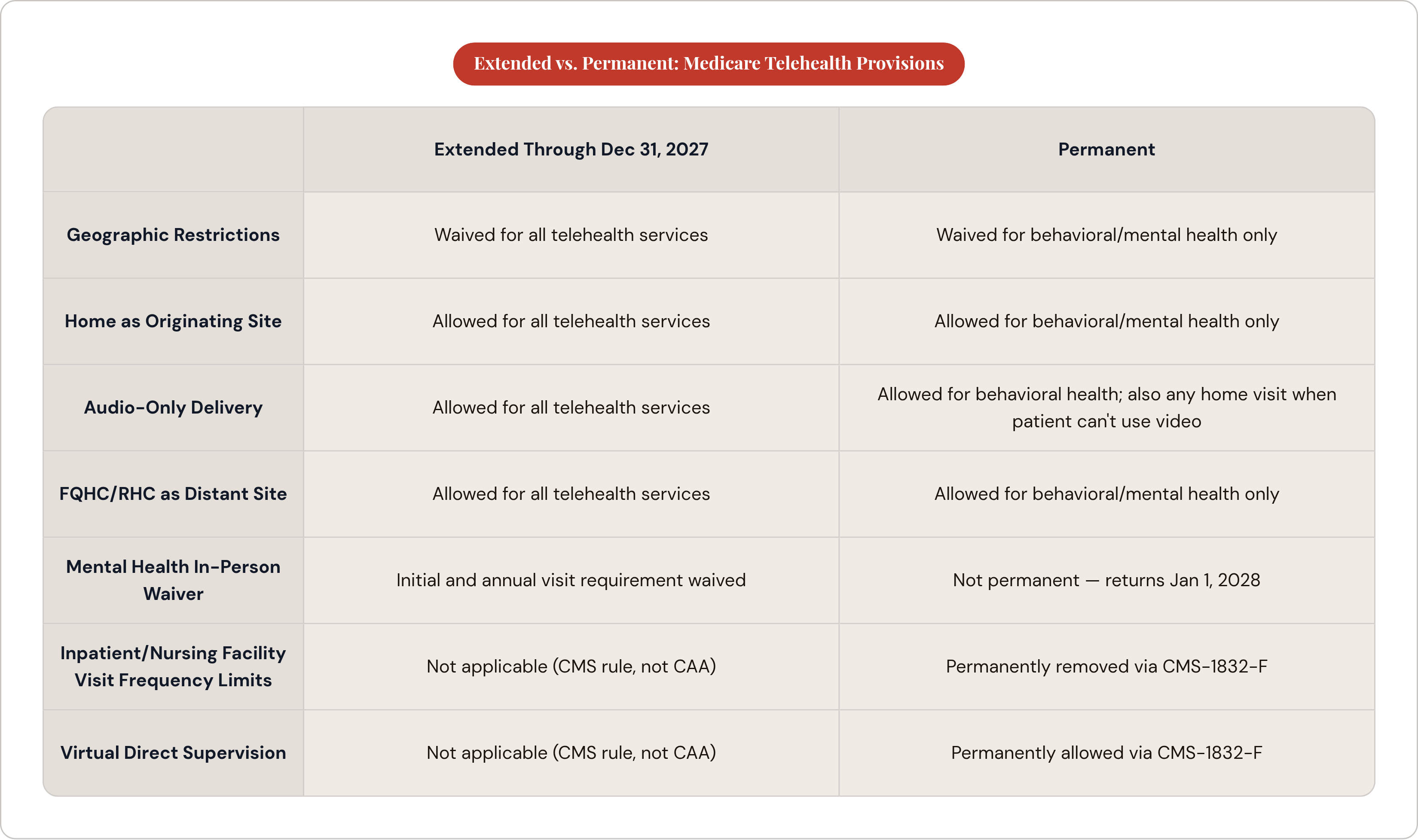
Permanent administrative changes from the CY 2026 Physician Fee Schedule that providers often miss
Separate from anything Congress did, CMS issued its own rule, CMS-1832-F, on October 31, 2025, effective January 1, 2026. This is the part of the story that gets the least attention because it's administrative rather than legislative, but it's arguably more durable, since none of it is tied to the December 2027 sunset.
Frequency limitations on subsequent hospital inpatient visits and nursing facility follow-ups, capped pre-pandemic at once every three days and once every 14 days respectively when delivered via telehealth, are permanently removed. Critical care consultations got the same permanent treatment. Virtual direct supervision is now permanently allowed, which reflects roughly five years of advocacy from the American Medical Association finally landing in a final rule; teaching physicians can now be virtually present when the underlying service itself is being furnished virtually, closing an odd loophole where the resident could be remote but the supervising attending technically couldn't.
The originating site facility fee ticked up to $31.85 for CY 2026, from $31.01 the year before, which won't make headlines but does show up in the math for facilities that bill it. CMS also streamlined the process for adding new services to the Medicare Telehealth List, eliminating two of the previous five review steps, and five new services made the 2026 list as a result. New remote patient monitoring codes arrived too, letting providers tailor monitoring frequency and patient engagement levels rather than working within a one-size-fits-all cadence.
The reason this section deserves its own space, separate from the CAA extension above, is that none of these changes expire in 2027. Build your workflows around this list with more confidence than you'd extend to anything still riding on Congressional goodwill.
The new home-billing location requirement and what it costs to comply
Here's where the fine print turns into a real line item on somebody's budget. Before 2026, a practitioner billing Medicare for telehealth delivered from home could just use their existing practice location on the claim, a pandemic-era shortcut that made administrative sense when everyone was scrambling. Starting January 2026, that shortcut is gone: every location from which a practitioner delivers telehealth now has to be separately enrolled with Medicare and billed as its own distinct location.
That sounds like a paperwork tweak until you look at the scale. A survey of Alliance for Connected Care members found this change could produce up to a fortyfold increase in the number of billing addresses a health system needs to track and report to CMS. Multiple health systems put the direct labor cost of implementing this at roughly $1 million, which is not a rounding error in anyone's operating budget.
The burden lands unevenly, too. Large health systems with dozens or hundreds of clinicians working hybrid schedules from home face the steepest lift, since each home address is now its own enrollment record to manage. Smaller practices with a handful of providers have a more contained task, though "more contained" still means real hours spent on enrollment paperwork that didn't exist a year ago.
If you haven't started, the sequence is straightforward even if the execution isn't: audit every practitioner billing Medicare telehealth from home or any off-site location, file enrollment updates with the relevant Medicare Administrative Contractor for each one, and update your billing system to track location-level identifiers rather than a single default address. No grace period has been announced, and claims submitted with non-enrolled locations are at real risk of denial, so this is not the hill to die on.
Where DEA controlled substance prescribing flexibilities stand heading into 2027
Controlled substance prescribing runs on a completely separate track from Medicare payment policy, governed by the DEA rather than CMS, and it's currently on its own countdown clock. The baseline law here is the Ryan Haight Act, which required at least one in-person evaluation before a practitioner could prescribe a controlled substance through telemedicine. That requirement got waived during the pandemic, and the DEA has kept extending that waiver in stages, most recently through a Fourth Temporary Extension running through December 31, 2026.
Under the current extension, Schedule II through V controlled medications can be prescribed via audio-video telemedicine without a prior in-person visit, and Schedule III through V narcotic medications approved for opioid use disorder treatment can be prescribed via audio-only telemedicine, also without a prior in-person visit. This isn't a fringe use case: HHS reported more than 7 million prescriptions for controlled medications were issued via telemedicine without a prior in-person visit in 2024 alone.
There was supposed to be a permanent fix. The Biden administration's January 2025 proposed rule would have created a special registration pathway for permanent telemedicine prescribing, essentially replacing the temporary extensions with a durable framework. The Trump administration hasn't moved to finalize that rule, so it sits in a kind of regulatory limbo.
Which creates an odd asymmetry worth noticing: the DEA extension expires six months before the CMS extension does, and there's no permanent replacement waiting in the wings. If you run an addiction medicine or pain management telehealth program, you're planning against a shorter and shakier horizon than a general medicine practice is. Watch the special registration rulemaking closely; it could move, stall, or get rewritten entirely under the current administration, and any of those outcomes changes your 2027 staffing and workflow decisions.
How state private-payer rules layer on top of — and sometimes diverge from — the Medicare framework
Medicare gets the headlines, but Medicare isn't the whole reimbursement picture, and pretending otherwise is how billing departments end up underpaid. Before the pandemic, only around ten states had private-payer payment parity laws on the books. The pandemic accelerated state-level action considerably; as of fall 2025, according to the Center for Connected Health Policy, 44 states, D.C., Puerto Rico, and the U.S. Virgin Islands all have some law addressing private payer telehealth reimbursement.
"Some law" is doing a lot of work in that sentence, though, because there's a definitional split that determines whether your telehealth visit actually pays what you expect. Coverage parity, sometimes called service parity, just requires an insurer to cover the same services via telehealth that it covers in person, but it says nothing about the rate. Payment parity requires the insurer to reimburse telehealth at the same rate as an equivalent in-person visit, and that's the protection that actually shows up in your revenue.
As of November 2025, per Manatt's telehealth policy tracker, roughly half of states have full payment parity, about five have parity with caveats attached, and the rest have no payment parity requirement at all. Texas passed HB 1052, which beginning January 1, 2026 requires health plans to cover telehealth delivered from or to out-of-state sites on the same basis as in-state care, a meaningful shift if you serve border populations or run a multi-state practice. Maryland made its own private-payer telehealth coverage law permanent by simply removing the repeal date that had been sitting on it.
The question worth asking isn't whether your state has a telehealth law, but whether that law includes payment parity specifically, and whether that parity covers the modality you're actually using, audio-only versus video, home-based versus facility-based. Get that wrong and a billing assumption that's perfectly valid in one state can quietly turn into underpayment the moment you cross a state line.
The three dates providers need to track and the decisions that hinge on each
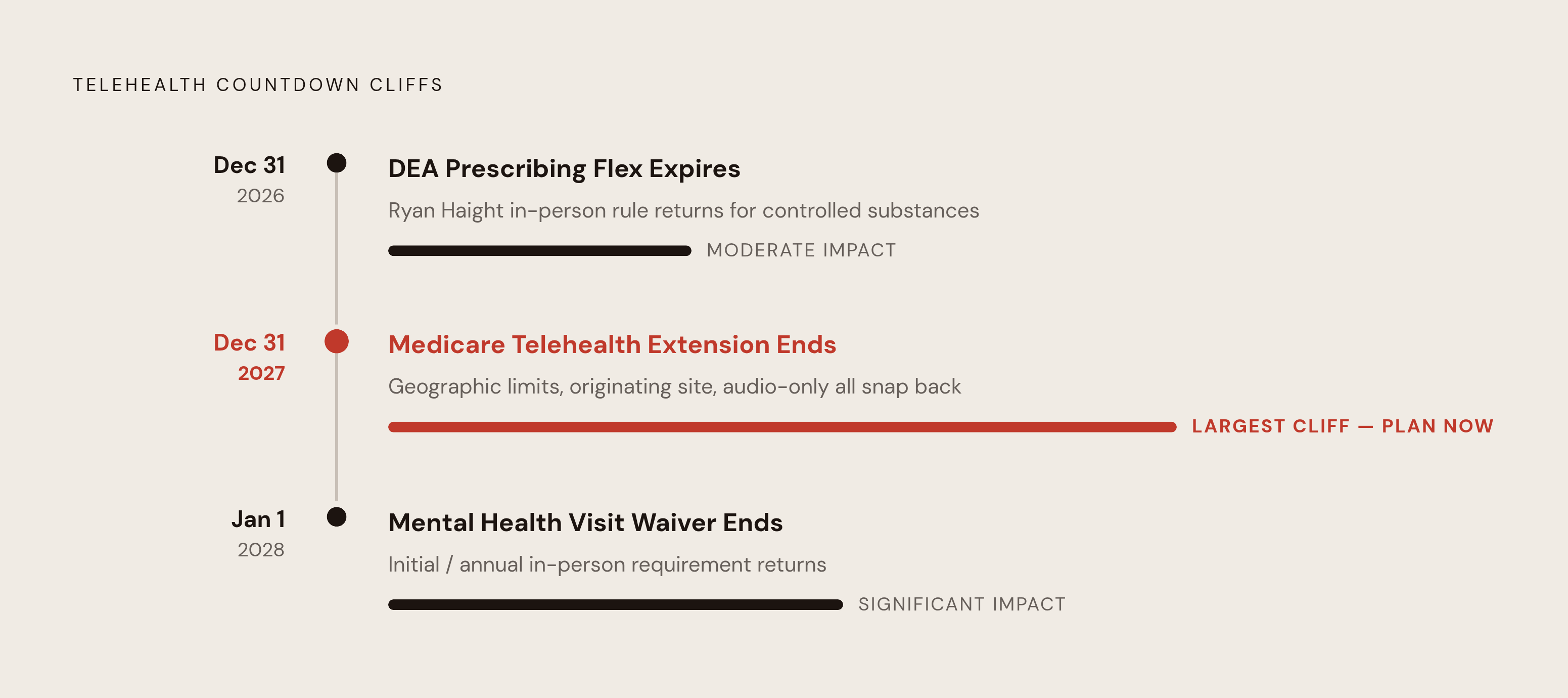
Three dates, three cliffs, three different decisions riding on each one, worth writing on an actual calendar rather than trusting to a mental note.
December 31, 2026 is when the DEA's controlled substance prescribing flexibility expires. If it isn't extended again or replaced by a permanent special registration rule before then, you fall back to the Ryan Haight in-person requirement. If you run a practice dependent on telemedicine prescribing for opioid use disorder treatment or other controlled medications, you need a contingency workflow ready well before this date arrives, not after.
January 1, 2028 is when the mental health in-person visit waiver ends, unless Congress acts again before then. This one's narrower than it sounds: the underlying geographic rules, home-delivery allowance, and audio-only permission for behavioral health are all permanent, as covered above. Only the requirement for an in-person visit within six months of an initial telehealth mental health service, and annually after that, is set to return.
December 31, 2027 is the big one, the main Medicare telehealth extension expiring. Miss this deadline the way Congress missed September 2025, and everything non-permanent reverts: geographic restrictions, originating site limits, audio-only restrictions for non-behavioral services, all of it snaps back at once. Given the pattern of extensions landing at the last possible minute, and given that the 2025 lapse produced a measurable 24% drop in telemedicine utilization, there's little reason to assume Congress handles this one earlier or more smoothly.
What can you actually plan around without flinching at a calendar? Behavioral and mental health telehealth, specifically the geography rules, home delivery, audio-only allowance, and FQHC/RHC distant site status, are permanent fixtures now, and so are the removed frequency limits on inpatient and nursing facility telehealth visits. Everything else on this list is temporary, subject to further Congressional action, and the smart move is building your practice's telehealth strategy around which category each rule falls into, rather than treating "telehealth is allowed" as a single, stable fact.