Pharmaceutical Marketing Compliance Essentials

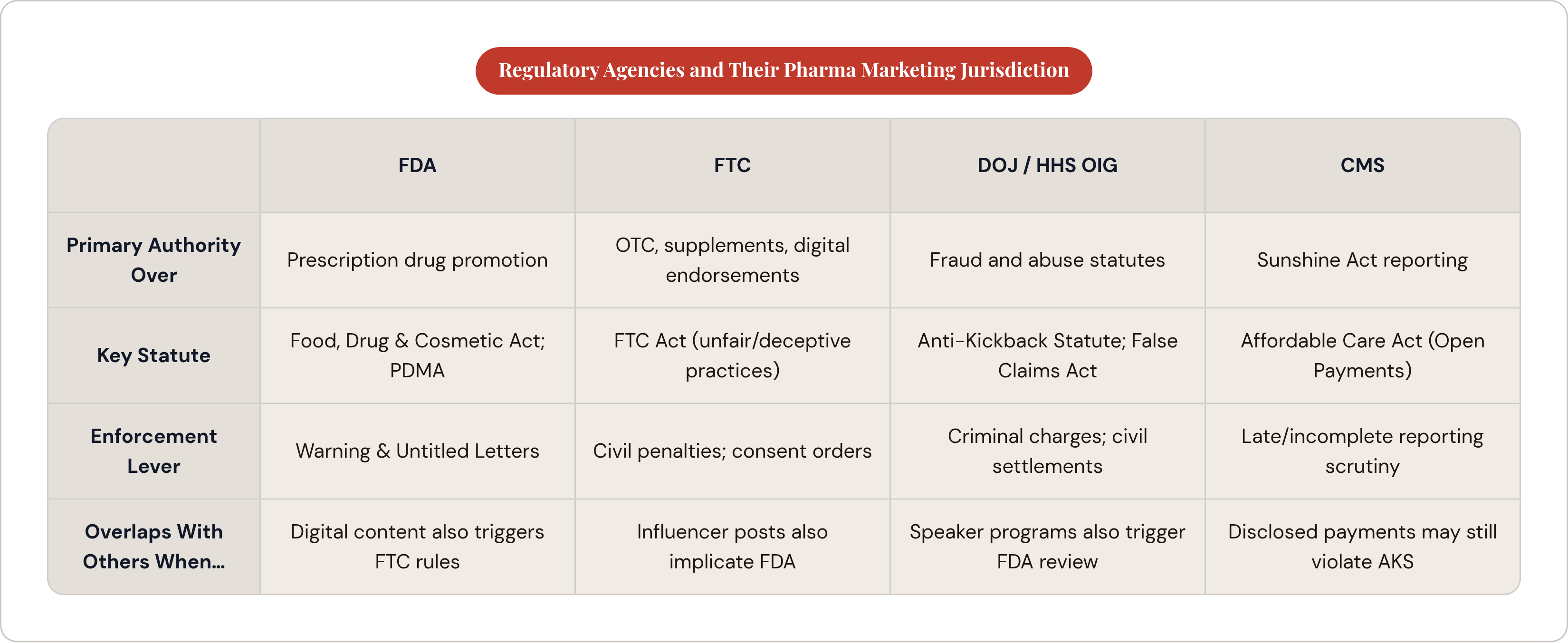
No single agency owns pharmaceutical marketing compliance. The FDA handles advertising and promotion for prescription drugs. The FTC governs general advertising truthfulness, particularly for OTC products, dietary supplements, and digital endorsements. The Department of Justice and HHS Office of Inspector General enforce fraud and abuse statutes. CMS administers the Sunshine Act reporting program. Each holds jurisdictional authority over a distinct slice of the activity, and those slices overlap constantly.
The foundational statute is the Food, Drug, and Cosmetic Act, which grants FDA its authority over drug promotion. Layered onto that is the Prescription Drug Marketing Act, governing samples, distribution, and promotional materials. The Anti-Kickback Statute governs financial relationships with healthcare professionals and is enforced by DOJ and HHS/OIG. The False Claims Act creates liability when off-label or misleading promotion leads to false government reimbursement claims, making it a downstream consequence of FDA promotion failures. The Sunshine Act requires public disclosure of financial transfers to physicians and teaching hospitals. The operational home for prescription drug advertising rules is Title 21 of the Code of Federal Regulations, Part 202.
A single speaker program can simultaneously implicate FDA promotion rules, the Anti-Kickback Statute, the False Claims Act, and Sunshine Act reporting obligations. What the framework demands is a working mental model of which agency owns which type of activity, and where the jurisdictional handoffs happen.
The Four Content Standards FDA Applies to Every Promotional Piece
Every promotional piece must meet four baseline content standards that FDA applies universally, regardless of format, audience, or channel. These standards don't shift depending on whether you're targeting a consumer or a cardiologist.
First, the content must be truthful and not misleading. This covers not just outright false claims but omissions that create a false impression. A technically accurate statement placed in context designed to mislead still fails this standard, and FDA enforcement letters make that point repeatedly.
Second, it must present fair balance. Risks and benefits must receive comparable prominence. You cannot lead with a compelling efficacy narrative and then bury risk information in a visual footnote.
Third, every efficacy claim must be substantiated. FDA's substantiation standard typically requires adequate and well-controlled clinical studies. Anecdote, expert opinion, and mechanistic reasoning are not substitutes, no matter how compelling they appear in a creative brief.
Fourth, there is a meaningful distinction between promotional and non-promotional labeling, and that distinction determines which review and approval pathway applies. Misclassifying a promotional piece as non-promotional to avoid the approval process is itself a compliance failure.
The failure modes worth naming are remarkably consistent across enforcement letters: overstatement of efficacy, including through visual representations and patient testimonials framed as typical outcomes; mechanism of action claims when the mechanism is not fully established; superiority claims without head-to-head data; and single-arm study findings presented as if they reflect comparative efficacy against another product. None of these are exotic violations. They show up in polished, professionally produced materials all the time, because they originate in creative decisions made upstream of legal review, often by people who never saw a regulatory submission in their lives.
What the CCN Rule Changed About Risk Disclosure in Broadcast Ads
FDA's final rule on DTC prescription drug broadcast advertising required full compliance as of November 20, 2024, codified at 21 C.F.R. § 202.1(e)(1)(ii). The rule mandates that the major statement, meaning the disclosure of significant side effects and contraindications, must be presented in a "clear, conspicuous, and neutral" manner, using consumer-friendly language that is readily understandable.
"Clear" means not buried in rapid-fire audio or obscured by competing visuals. "Conspicuous" means given adequate time and prominence relative to the benefit claims that preceded it. "Neutral" is the standard that most often catches production teams off guard, because it's not just about what's said but about every sensory element surrounding it. Calming music, soft lighting, serene pastoral imagery playing under a recitation of serious adverse events — those are not neutral. FDA's view is that this kind of audio-visual softening constitutes a CCN failure, and the 2025 enforcement letters confirm that they're looking for it.
The rule currently applies to television and radio, but both FDA and industry observers see pressure building to extend equivalent standards to digital and social media formats, an extension that hasn't happened yet. Of the 74 FDA enforcement letters issued to pharma manufacturers in 2025, 42 targeted DTC television ads, and CCN failures were among the most frequently cited categories.
The production implication is specific: CCN compliance has to be evaluated at the editing stage, not at legal review. By the time a spot reaches the medical-legal-regulatory review process, the visual and audio decisions that create CCN violations have usually already been locked.
The "Adequate Provision" Rulemaking That Could Effectively End Broadcast DTC Advertising
Since 1997, broadcast prescription drug ads have operated under an "adequate provision" framework that lets them satisfy the brief summary requirement by pointing consumers elsewhere: a toll-free number, a website, print materials. The full safety information doesn't have to air. That one provision has underwritten nearly three decades of pharma TV advertising as we know it.
FDA is now pursuing rulemaking to eliminate it. The proposal is formally listed in the 2026 Unified Agenda as RIN 0910-AJ14, titled "Transparency in Direct-to-Consumer Advertising." If finalized, every broadcast prescription drug ad would be required to include a "brief summary of all necessary information related to side effects and contraindications." Both HHS and FDA have acknowledged that this requirement would render broadcast ads "prohibitively long and expensive" in practice.
The administration has been explicit that the rulemaking is intended, at least in part, to deter DTC broadcast advertising by making full compliance impracticable. The likely effect, if the rule is finalized in its current form, would be to end or drastically curtail broadcast DTC pharma advertising as practiced since 1997.
Any final rule will face First Amendment challenges. Commercial speech protection under the Central Hudson framework doesn't immunize this category of advertising, but it does require the government to demonstrate that any restriction directly and proportionally advances a substantial interest. The rule is proposed, not final. It is not yet actionable as a compliance constraint.
What it does do, right now, is accelerate the urgency of building robust digital compliance infrastructure, because assuming broadcast remains the primary DTC vehicle indefinitely is no longer a safe planning assumption. Pharma TV ad spending topped $7 billion through the first 11 months of 2025. That is a lot riding on a regulatory framework currently under direct attack.
How the 2025 FDA Enforcement Surge Changed the Risk Calculus for Pharma Marketers
FDA issued more than 130 DTC enforcement letters annually in the late 1990s. By 2023, that number had dropped to three. In 2024, it dropped to zero. Somewhere along the way, low enforcement stopped feeling like a temporary condition and started feeling like the norm. Compliance processes quietly loosened. Review timelines compressed. The muscle memory of genuine regulatory risk atrophied.
In September 2025, following a Presidential Memorandum directing HHS to ensure transparency and accuracy in DTC prescription drug advertising, FDA announced an aggressive enforcement crackdown. The result: more than 200 enforcement letters issued in 2025 total, with 74 directed specifically at pharmaceutical and biologic manufacturers. That 74-letter subset included 10 Warning Letters and 64 Untitled Letters. Of those 74, 42 challenged DTC television ads and 16 addressed HCP-directed promotion. The remainder targeted social media, sponsored search links, newsletters, sales aids, exhibit booth panels, online videos, print ads, and virtual backgrounds.
FDA has deployed AI and tech-enabled tools to proactively surveil drug advertising and has publicly committed to escalating enforcement to hundreds of letters annually if initial actions fail to sufficiently change DTC advertising behavior.
Compliance teams that spent the past several years operating under low-scrutiny assumptions now have to rebuild habits that the enforcement gap eroded. The new baseline is that every promotional piece should be treated as if it's already under review, because for a growing number of companies in 2025, it was.
Digital and Social Media Channels and Where Existing Compliance Rules Apply to Them
Digital and social media channels are now the primary frontier of pharma advertising spend, and the area where compliance infrastructure is most urgently underdeveloped. Social media surpassed linear TV in healthcare and pharma ad spending in 2025, with nearly half of pharmaceutical digital advertising budgets now allocated to social media channels. This is where the gap between regulatory intent and enforcement capacity has historically been widest.
The same FDA truthfulness, fair balance, and substantiation standards apply to digital content. There is no social media exemption. The channel-specific complications are structural, not conceptual. Character limits and short-form video formats make fair balance presentation genuinely difficult. FDA has issued guidance on the "one-click" rule, which allows a single hyperlink to satisfy the risk information requirement in space-constrained formats, but how this applies across specific platforms is still being worked out in practice. If your company has a material connection to an influencer or patient advocate, FDA promotion rules apply to that person's posts, and you are required to disclose that relationship under both FDA and FTC guidelines. Engaging with or amplifying user-generated content can constitute promotion if not handled carefully. Sponsored search links were explicitly flagged as a violation category in 2025 enforcement letters.
The FTC layer applies in addition to, not instead of, FDA rules. Both agencies can act on the same piece of digital content under different authorities.
The emerging industry consensus, shaped by what happened in 2025, is to apply CCN-equivalent standards across all digital formats now, before formal rules require it. Being ahead of the requirement is cheaper than being caught by it.
How the Anti-Kickback Statute Constrains HCP Engagement Programs
The Anti-Kickback Statute casts a wide net over HCP engagement programs, and the practical compliance strategy centers on structuring arrangements within defined safe harbors. The statute prohibits offering, paying, soliciting, or receiving anything of value to induce or reward referrals covered by federal healthcare programs, including prescriptions, and it is broad by design. Safe harbors are arrangements structured to meet defined criteria that provide protection from AKS liability.
Bona fide consulting arrangements are the most commonly used safe harbor in HCP engagement programs. A physician can be compensated for real, necessary services at fair market value under a written contract, provided the arrangement isn't tied to prescription volume or value. "Fair market value" is a meaningful constraint. Rates that exceed what an arm's-length buyer would pay, or that vary based on the physician's prescribing behavior, fail the safe harbor. OIG defines nominal gifts as items with a retail value below a low per-item or annual per-patient threshold. Above those thresholds, the item requires independent safe harbor analysis.
Speaker bureau programs occupy their own risk category. OIG's 2020 Special Fraud Alert identified suspect characteristics that elevate AKS risk: luxury venues, high meal costs, repeat attendance by the same HCPs who already received the same content, and low attendee counts suggesting the educational purpose is pretextual. Those characteristics have defined enforcement priorities in the years since.
The settlements that define the stakes are instructive. In January 2025, Pfizer agreed to pay $59.7 million to resolve AKS and False Claims Act allegations tied to speaker programs run by subsidiary Biohaven. Takeda agreed to pay $13.6 million over allegations it provided lavish meals to HCPs to encourage prescriptions of its antidepressant Trintellix. Biogen paid $900 million in 2022 to settle whistleblower allegations of kickbacks to physicians through speaker fees and consulting arrangements. Teva agreed to pay $425 million in 2024 over allegations it funneled money through a charity to cover Medicare patients' copays.
In January 2026, HHS OIG released a Special Advisory Bulletin addressing AKS application to pharma manufacturers' direct sales to cash-paying patients who are also enrolled in federal healthcare programs. As direct-to-consumer sales models expand, this is the new compliance frontier.
What the Sunshine Act Requires Pharma Companies to Track and Report Publicly
The Sunshine Act, part of the Affordable Care Act, requires pharmaceutical and medical device manufacturers to report transfers of value to physicians and teaching hospitals to CMS, which publishes the data in the Open Payments database. Reportable transfers include consulting fees, speaker honoraria, meals and entertainment, travel and lodging, research payments, education, gifts, and charitable contributions above a de minimis threshold.
The data is public. Any patient, journalist, or regulator can look up what a given physician has received from a given company. This creates reputational risk that operates entirely independently of legal liability. A disclosed payment that is legal and properly reported can still generate adverse coverage or patient distrust.
The compliance mechanics matter more than people expect. Every interaction involving a transfer of value must be tracked at the time it occurs. Retroactive reconstruction of payment records is unreliable and a common audit failure point. Records must capture the recipient's name and credentials, the nature of the payment, the amount, the date, and the drug or device associated with the interaction. Annual reporting deadlines to CMS are fixed; late or incomplete reporting draws scrutiny.
The most important framing distinction for commercial teams is that the Sunshine Act does not prohibit these payments. It requires disclosure. Compliance teams that communicate this clearly to field teams see better real-time tracking behavior than those who let the obligation be perceived as a deterrent.
The connection back to AKS is equally important. A disclosed payment can still violate the Anti-Kickback Statute if it doesn't meet safe harbor criteria. Disclosure and legality are separate questions, answered by separate agencies under separate standards.
Where the FTC's Role Begins and How It Overlaps With FDA Oversight
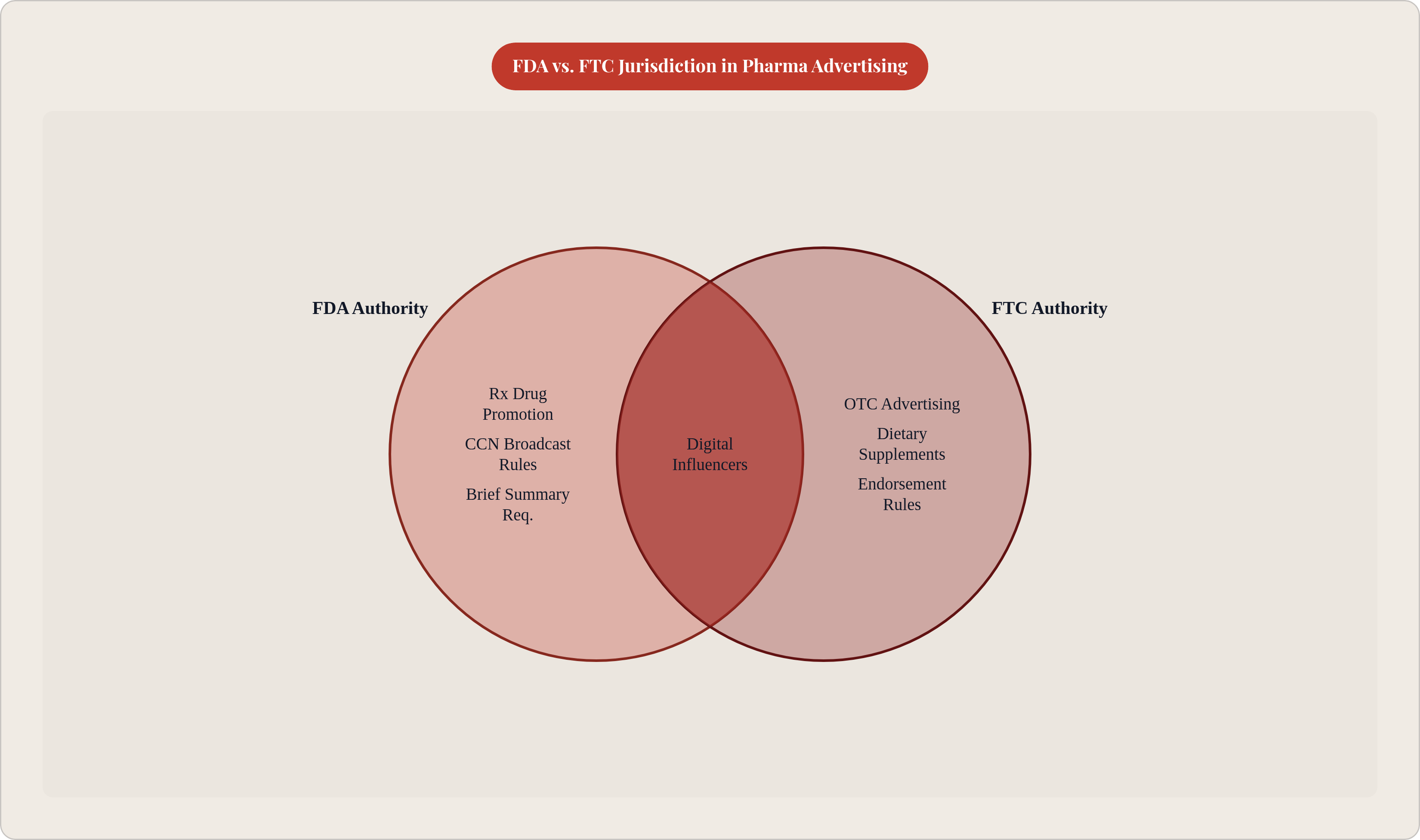
FTC jurisdiction covers advertising that doesn't fall neatly under FDA's drug promotion authority: OTC drug advertising, dietary supplements marketed with health claims, and digital endorsements regardless of product type. For prescription drug promotion, FDA is the primary authority. But the two agencies' jurisdictions overlap in ways that create dual compliance obligations, particularly in digital channels.
The FTC's core authority is its mandate to prohibit unfair or deceptive acts or practices in commerce. In pharma-adjacent advertising, this surfaces most directly in two areas: endorsement and testimonial rules, and substantiation requirements for health and efficacy claims.
On endorsements, the FTC requires disclosure of any material connection between an endorser and the company whose product they're promoting. "Material connection" includes compensation, free product, employment, or any relationship that affects how an audience perceives the endorsement. This applies to influencers, patient advocates, and key opinion leaders posting on social platforms. FDA promotion rules apply to the same post for the same reasons. Both agencies can independently take enforcement action, and the fact that one has already acted doesn't preclude the other.
On substantiation, the FTC applies a "competent and reliable scientific evidence" standard for health-related claims. In practice, this often aligns closely with FDA's substantial evidence standard, but they are not identical. The distinction matters most in the dietary supplement and wellness-adjacent space, where products are not subject to FDA drug promotion rules but still carry health claims the FTC can challenge.
The operational implication is that digital compliance review cannot treat FDA and FTC as an either/or determination. Sponsored content, influencer partnerships, and paid social require simultaneous evaluation under both frameworks. Building a review process that addresses both in a single workflow removes redundant steps and closes the coverage gap at the same time.