Mental Health Telehealth Outcomes Versus In-Person Therapy
Video therapy works about as well as in-person sessions for most mental health conditions.
Telehealth gets roughly the same clinical results as in-person therapy for most common mental health conditions. But "roughly the same" is doing a lot of quiet work in that sentence, and if you're the one actually choosing a modality, the gaps hiding inside that phrase are exactly what matter. The pandemic pushed mental health care onto Zoom and its rivals in about eighteen months, a shift that would've otherwise taken a decade of pilot programs and cautious committee meetings. The data on what happened next has finally piled up enough to say something worth trusting, and some of it surprised people who'd bet against video therapy from the start.
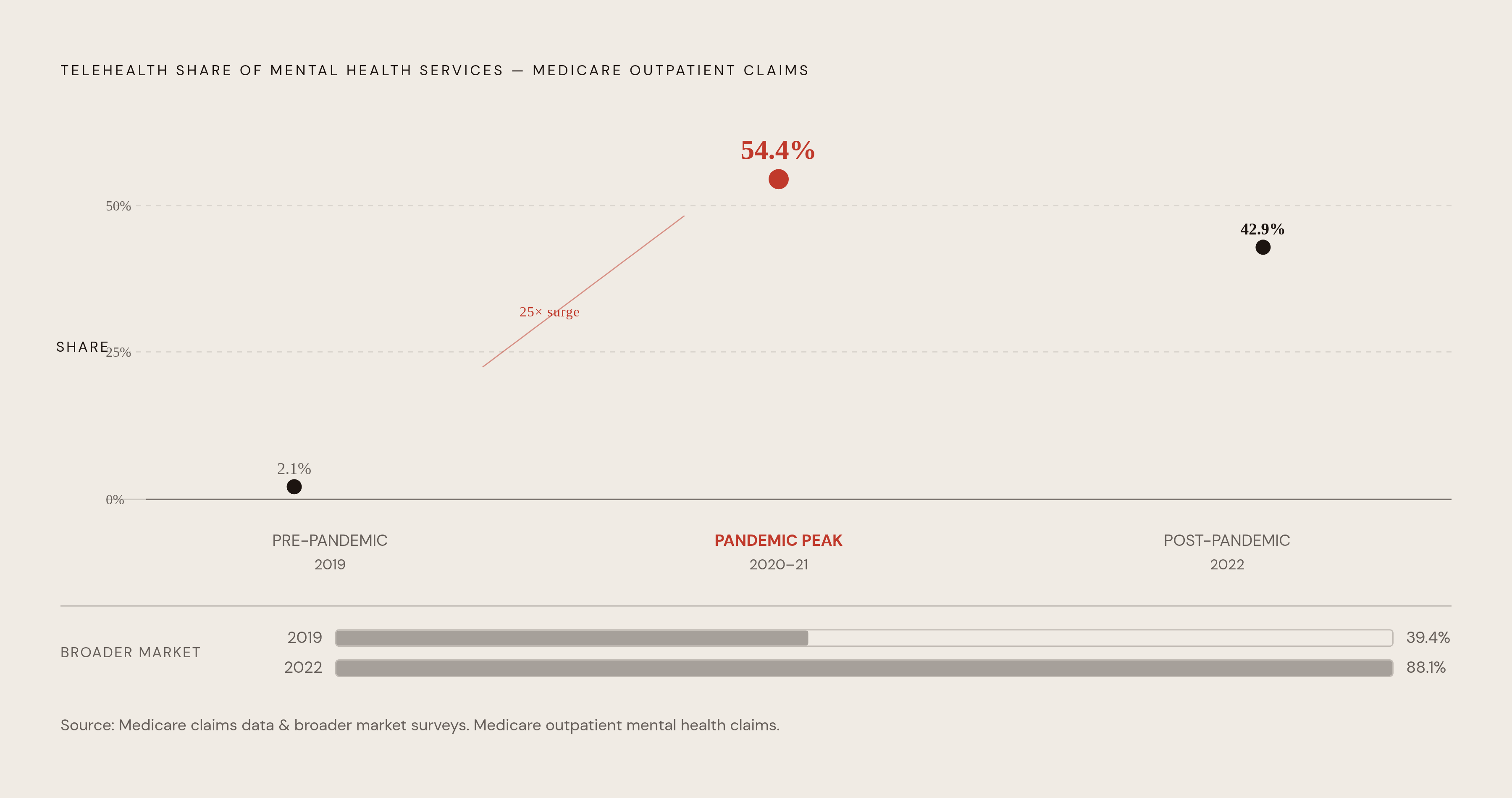
Start with scale, because the numbers are almost cartoonish. Telehealth's share of mental health services jumped from 39.4% in 2019 to 88.1% in 2022, according to JAMA research tracking the shift. Among commercially insured patients, in-person visits fell 39.5% while telehealth visits rose 1,019.3% over the same stretch; I checked that figure twice, half expecting a stray decimal. By August 2022, in-person visits had climbed back to 79.9% of prepandemic levels, but total mental health utilization sat 38.8% higher than before the pandemic started. Telehealth wasn't just replacing office visits. It was pulling in people who hadn't been getting care at all.
A 2026 RAND and JAMA Network Open study of 9,548,926 Medicare beneficiaries, representing $8.1 billion in spending, found telehealth's share of outpatient mental health claims rising from 2.1% before the pandemic to 54.4% during it, then settling at 42.9% afterward. Tens of millions of people are now doing therapy through a laptop camera instead of an office chair. Does it actually hold up? The honest answer runs closer to "usually, but not always," and the rest of this piece is about figuring out which side of that line a given person lands on.
What the strongest clinical evidence actually says about comparable outcomes
Randomized controlled trials and meta-analyses are the gold standard here, and the field has piled up enough of them now to say something with real confidence. A 2023 systematic review in JMIR Mental Health pooled 20 RCTs covering more than 1,800 participants treated for PTSD, depression, and anxiety, and found a standardized mean difference between telehealth and in-person treatment that rounded to essentially zero.
A broader 2024 review across PubMed, PsycINFO, CINAHL, and the Cochrane Library pulled in 35 qualifying RCTs covering 4,827 participants and landed in the same spot: telehealth performs about as well as face-to-face care for depression and anxiety. A separate 2024 JMIR Mental Health review found over 80% of participants in virtual therapy reported outcomes comparable to, or better than, what they'd gotten in an office, which is not the outcome most people expect walking into a video call where the therapist's face is pixelating on a bad connection.
None of this evidence is spotless, and pretending otherwise would be dishonest. A 2024 review of 77 pandemic-era studies found that 47 of them, 61%, carried serious or high risk of bias: small samples, inconsistent outcome measures, trials thrown together in a hurry because nobody had time to design anything cleaner during a global emergency. Fair criticism. But the newer studies tend to be tighter, built with better methodology once everyone stopped panicking long enough to run a real trial instead of a rushed one.
What does "parity" actually mean here? Anyone who's sat through therapy both ways knows the sessions don't feel identical. The couch is different, the eye contact is different, the whole texture of the hour shifts. Concretely, parity means that tracked across validated symptom scales like the PHQ-9 for depression or the GAD-7 for anxiety, patients in both formats improve by roughly the same amount over the same course of treatment. Researchers went looking for a gap. Mostly, they came up empty, which is either reassuring or a little anticlimactic depending on how badly you wanted a villain in this story.
Condition-by-condition breakdown of where the evidence is strongest
Telehealth's strength varies by condition, with structured, protocol-based therapies showing the clearest equivalence to in-person care. Depression and anxiety treated with cognitive behavioral therapy have, by a wide margin, the deepest evidence base for telehealth equivalence. That tracks. CBT runs on structure and protocol, and it rarely needs a therapist doing something that requires shared physical space, like guiding a relaxation exercise while watching muscle tension shift in real time.
Anxiety subtypes get a little stranger. For panic disorder, PTSD, and specific phobias including claustrophobia and agoraphobia, virtual formats have shown particularly strong results, and in some studies, beat in-person care outright. Sit in the patient's chair for a second: if you have agoraphobia, leaving the house to sit in a waiting room is itself a symptom trigger before the session has even begun. Doing exposure work from your own living room can remove that barrier entirely. It's a strange little irony baked into the design of the treatment; the technology built to keep people apart ends up being the thing that lets the most housebound patients finally show up.
PTSD might be the single most studied condition in this space, with consistently noninferior findings across multiple RCTs and meta-analyses. Rural populations show the same pattern. A multi-site federal study of 1,514 rural patients found PHQ-9 score reductions of 2.8 points for telehealth versus 2.9 for in-person, and GAD-7 reductions of 2.0 versus 2.4; neither gap reached statistical significance. A separate 2025 rural telehealth study found average PHQ-9 improvements of 7.0 points and GAD-7 improvements of 6.1 points, with 70.5% of patients hitting a minimal clinically important difference. One figure from that study stopped me cold: 66.7% of patients who reported suicidal ideation at baseline no longer endorsed it at follow-up.
Pediatric OCD offers a newer data point. A 2025 JMIR retrospective study of 2,173 children and adolescents receiving exposure and response prevention therapy through video teletherapy found meaningful symptom reductions, extending real-world evidence into a population that has historically struggled to find specialized OCD care at all. ERP specialists are thin on the ground even in major cities; outside them, good luck.
Opioid use disorder treatment holds up too. Among 1,816 rural patients diagnosed via telemedicine, retention rates at 1, 3, and 6 months came in at 74.8%, 61.5%, and 52.3% respectively, broadly in line with in-person benchmarks. And late-life depression is a genuine bright spot: a 2024 JMIR mHealth meta-analysis of 12 RCTs covering 1,663 older adults found telecare a promising option for treating depression and anxiety in that population, cutting against the lazy assumption that older patients simply won't engage with a screen.
The pattern, once you squint at it: the more a condition responds to structured, protocol-based treatment, whether CBT, ERP, or motivational interviewing, the more smoothly it translates to video. Conditions that depend on improvisation, physical observation, or crisis response run on a different set of rules, and that's where things start getting complicated.
Whether the therapeutic alliance, the core mechanism of therapy, holds up remotely
This is the part that should, on paper, break telehealth's case. The therapeutic alliance, the working relationship and trust between client and therapist, is one of the strongest predictors of outcomes across nearly every form of psychotherapy and population studied. Without that bond, technique barely matters; you can run a textbook-perfect CBT protocol and still get nowhere if the patient doesn't trust the person delivering it. So can two people build real trust through a webcam, with a screen and a few hundred miles between them?
A 2024 systematic review focused on exactly this question and found that a strong alliance can and does form remotely, continuing to predict good outcomes in roughly the same way it does face to face. A JMIR meta-analysis measuring working alliance directly found no significant difference between telehealth and in-person care, with patient satisfaction and dropout rates landing in similar ranges for both. Only a minority of patients said they'd prefer in-person psychotherapy if given the choice, which suggests the alliance worry lives more in providers' heads than in patients' actual lived experience. And A large majority of telehealth users reported satisfaction with their most recent appointment, a number most industries would kill for and most therapists probably didn't expect.
So the outcome parity showing up study after study runs on the same relational mechanism that's always driven therapy; it's just routed through a different pipe. That changes the real question. It's no longer whether trust can form on a screen, since apparently it usually does. It's under what specific conditions that trust gets harder to build: a language barrier, a tech glitch mid-session, a kid wandering into frame during a parent's appointment. Those are the variables actually worth tracking, rather than some abstract worry about whether a laptop can hold a relationship the way a room does.
Access as an outcome: where telehealth creates gains that in-person care cannot replicate
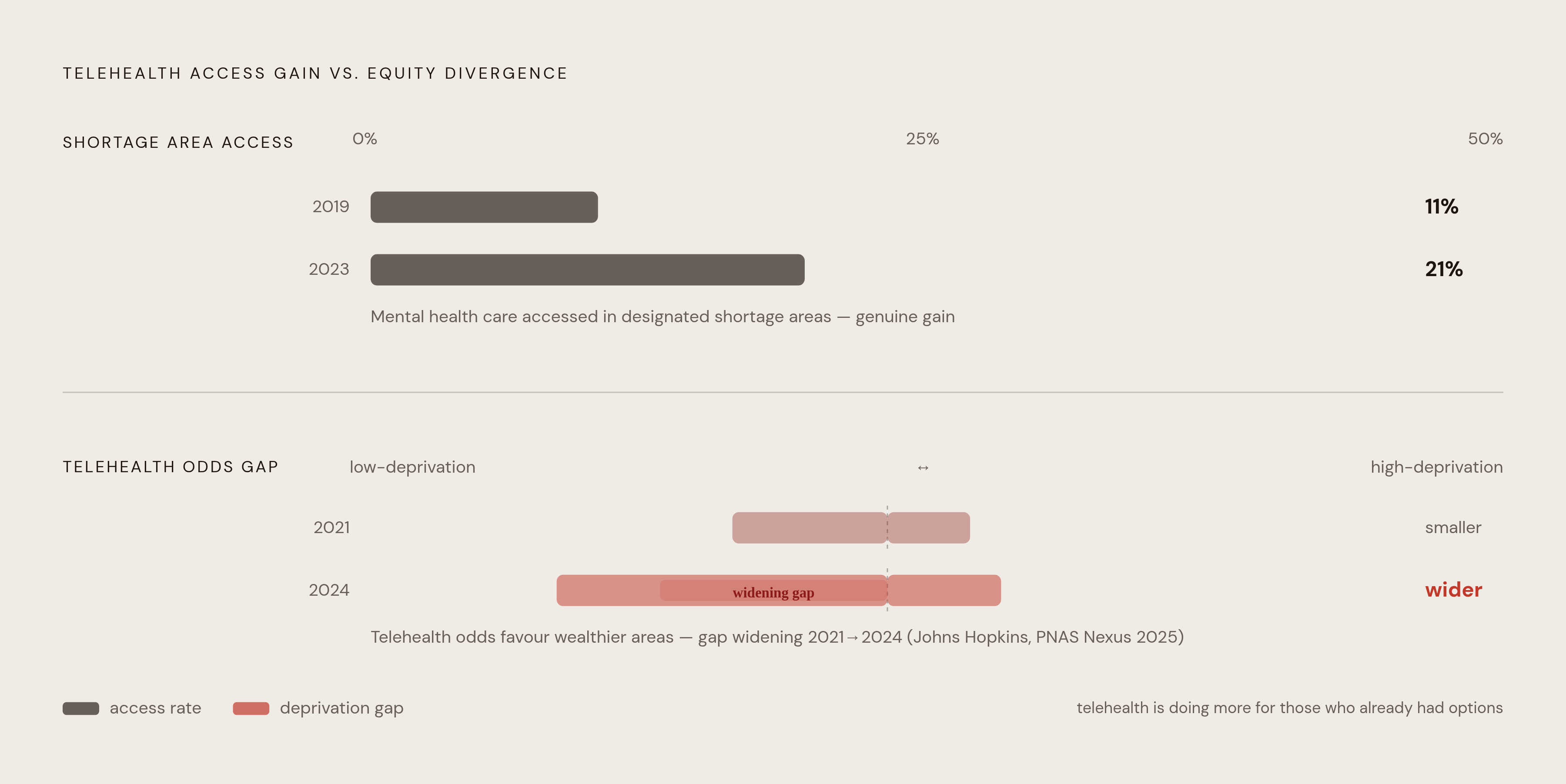
Telehealth creates meaningful access gains for populations that in-person care has historically failed to reach. Clinical parity studies assume both options sit side by side, waiting patiently for someone to pick one. For millions of people, that assumption falls apart before you even get to the comparison. In designated mental health professional shortage areas, the share of residents accessing any mental health care nearly doubled, climbing from 11% in 2019 to 21% in 2023, driven almost entirely by telehealth, since in-person provider availability in those same areas barely budged. Office visits need a nearby provider. Video calls just need a signal, which is a lower bar in more places than you'd think and a higher one in more places than the optimists like to admit.
States with more generous telehealth reimbursement policies saw meaningfully larger jumps in mental health utilization and better outcomes than states that kept reimbursement restrictive; about as close to a natural experiment as health policy gets. And the people using telehealth aren't a random slice of the population. Americans with depression or anxiety used telehealth at a much higher rate than those without those diagnoses, at a substantially higher rate than those without those diagnoses. Telehealth is finding the people who need it most, alongside plenty of people who simply have decent broadband. That second group looks a lot less flattering once we get to the equity section further down; keep it in mind, because it comes back.
There's an engagement angle worth naming too. Telehealth links to fewer missed appointments, an effect that shows up especially strongly among youth and emerging adults, a population notorious for no-showing traditional office visits. There's also a real, mechanistic edge to the home environment itself: patients report lower anxiety, less travel-related stress, and more openness in session when they're on their own couch instead of a waiting room chair. For someone with agoraphobia or severe social anxiety, that convenience carries genuine clinical weight, not just logistical convenience.
The Medicare data adds a subtler wrinkle. Total visit volume for that population stayed roughly stable across the study period, meaning telehealth mostly substituted for in-person visits rather than manufacturing new demand among Medicare beneficiaries specifically. Monthly spending, though, rose from about $71,109 to $87,792 per 10,000 beneficiaries. Same volume of care, moving through a pricier channel; somebody should probably ask why.
The conditions and clinical situations where in-person care has genuine advantages
In-person care retains clear advantages for acute crises, complex diagnoses, and therapies that depend on physical observation. All of this parity data comes with a real asterisk: it applies to common conditions treated with structured therapies. It doesn't generalize to everything, and pretending otherwise would be malpractice, professionally and rhetorically both.
Acute crisis situations make the clearest case. Active suicidal ideation with a plan, psychosis with impaired insight, severe agitation: these can require immediate in-person intervention or hospitalization that no video platform provides, no matter how good the bandwidth happens to be that day. Complex psychiatric conditions like schizophrenia and bipolar disorder often need in-person evaluation that includes a physical exam and full observation of nonverbal behavior, the kind of thing no camera angle captures.
There's a technical constraint worth naming plainly, too: video calls typically carry a lag of around 450 milliseconds in audio transmission. That doesn't sound like much until you realize it's enough to disrupt the natural rhythm of conversation, the pauses and interruptions and overlapping speech a skilled clinician reads for emotional cues. Add that video only shows a portion of a patient's body, and you've got a real gap in the clinical toolkit. Missing nonverbal cues has documented consequences for diagnostic accuracy, and it can make it harder to catch subtle signs of abuse, neglect, or domestic violence, the kind that show up in posture or hesitation rather than in anything said out loud.
Certain techniques just don't translate well either. EMDR, somatic approaches, and other trauma-informed modalities that depend on the therapist monitoring physiological responses in real time, adjusting pace, watching breathing change, generally need physical presence to work as designed. New or complex diagnoses also benefit enormously from a full in-person assessment before anyone commits to a treatment plan. Ongoing telehealth therapy for an established diagnosis is a very different animal than a telehealth intake for a presentation nobody's figured out yet; conflating the two is where a lot of well-meaning telehealth advocacy goes wrong.
In-person care wins, or is flatly required, for a defined set of clinical situations, without being generically superior across the board. Knowing which category you're standing in is most of the battle, and it's a smaller battle than the modality debate usually makes it sound.
Who telehealth doesn't reach, and where the equity promise breaks down
This is the part that gets left out when a piece stops at "access improved," and it's the part I find genuinely more interesting than the parity numbers.
A 2025 Johns Hopkins study published in PNAS Nexus found that the odds of receiving telehealth instead of in-person care were significantly higher for patients living in low-deprivation areas: wealthier, better-resourced communities. There was no evidence telehealth improved access in high-deprivation areas, and the gap between the two widened from 2021 to 2024, not narrowed. That runs directly against what the access story promises. Telehealth may be doing exactly what it's supposed to for people who already had decent options, while doing a lot less for the people the whole conversation claimed to be about in the first place.
Older adults face a similar squeeze. A 2024 nationally representative survey of more than 6,000 community-dwelling adults aged 65 and older found that people who were older, non-white, living outside metro areas, or had lower income and education were consistently less likely to use telehealth. These barriers don't sit in isolation; they stack. A rural, low-income, older adult isn't facing one obstacle to access but four at once, each compounding the others: (i) unreliable broadband, (ii) no smartphone or laptop, (iii) unfamiliarity with video platforms, and (iv) sometimes a language barrier layered on top of all of it.
There's a quieter problem, too, and it doesn't show up in most of the studies cited above. Telehealth assumes a private, stable place to have the session. For patients dealing with severe mental illness who lack stable housing, or who live in crowded or unsafe situations, a "home-based" session can be neither private nor conducive to the kind of disclosure therapy actually requires, especially when someone else is in the next room and the walls are thin enough to matter.
Telehealth expands access for a lot of people, and it deepens inequality for a different, often overlapping group. Both things are true simultaneously, and neither cancels the other out. Expanding reimbursement and building more platforms matters, but it isn't close to sufficient on its own. Broadband infrastructure and digital literacy gaps need their own fixes, not just policy riding on telehealth's coattails and hoping the rest sorts itself out eventually.
How to think about choosing a modality for a specific person and situation
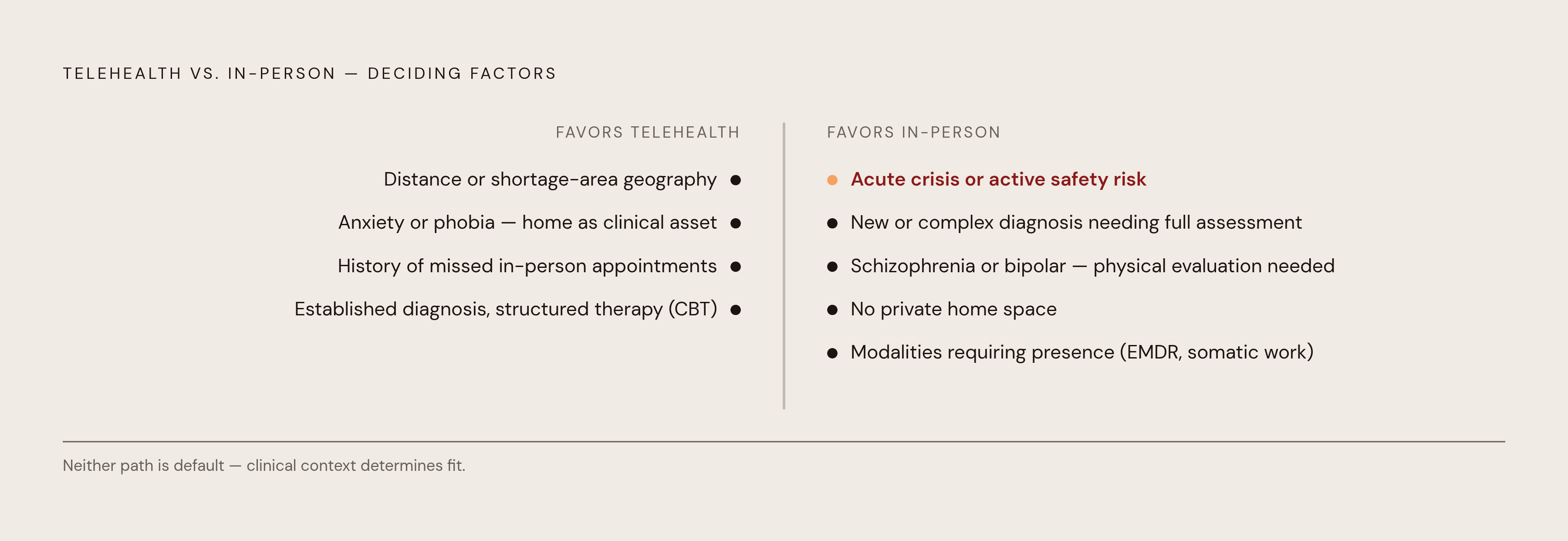
The research doesn't hand you a single verdict; nothing this messy could produce one. What it hands you instead is a set of questions, and the answers tend to point toward one modality or the other with real clarity once you actually sit down and ask them.
Telehealth tends to make sense when (i) distance, mobility, or shortage-area geography puts in-person visits out of reach, (ii) the condition is an anxiety disorder or phobia where the home environment functions as a genuine clinical asset rather than a fallback, (iii) a patient has a track record of missing in-person appointments and needs the friction removed, or (iv) an established diagnosis is being treated with a structured, well-defined therapy like CBT.
In-person care tends to win (i) during an acute crisis or active safety risk, (ii) for a new or complex diagnosis that needs a full assessment before treatment even starts, (iii) for conditions like schizophrenia or bipolar disorder where physical evaluation matters, (iv) when a patient has no private space at home, or (v) when the approach depends on physical presence, like EMDR or somatic work. Sometimes it wins simply because the patient prefers it, and the alliance research makes clear that preference itself shapes outcomes; it carries real predictive weight, not sentiment tacked on for politeness.
A hybrid model is emerging as the practical answer for a lot of people: in-person for assessment and acute phases, telehealth for maintenance and ongoing structured therapy once things stabilize. Reliable technology, decent broadband, and actual privacy at home need to get checked explicitly before anyone defaults to telehealth just because it looks like the easier box to tick. Easier on paper isn't the same thing as workable in someone's actual living room, especially if that living room doubles as a kid's playroom during business hours.
Run through everything cited here and one thread holds up: the strongest predictor of outcomes was never modality by itself. It comes down to whether a person gets care at all, and sticks with it long enough for that care to do anything. Telehealth versus in-person, in the end, comes down to which format removes more barriers for the specific person sitting across from you, or on the other side of that screen, connection a little shaky, still logging on anyway.