Rural Telehealth Adoption Barriers and Policy Solutions
Broadband gaps and device access combine to block rural telehealth adoption.
Rural telehealth should work better than it does. Broadband, device access, reimbursement, and licensure stack on top of each other, and fixing one without touching the rest leaves the rest of the problem exactly where it was.
The deteriorating baseline that makes every barrier more urgent
Start with how bad things already are, because that part tends to get skipped in favor of the tech talk. Chartis found 46% of rural hospitals ran a negative operating margin in 2025. The Center for Healthcare Quality and Payment Reform puts more than 700 rural hospitals, 31% of the national total, at possible risk of closure, with 360 of those, 16% of all rural hospitals nationally, at immediate risk. Eighteen closed or dropped inpatient care in the past year alone, which brings the total since 2010 to 182. I don't throw that number around lightly; it's a number that used to have waiting rooms attached to it.
Obstetrics is where you feel it hardest. Between 2011 and 2023, 293 rural hospitals stopped offering OB services, 24% of the nation's rural OB units gone, and 116 labor and delivery units have closed since the end of 2020 alone. 2025 is on pace for 27 more closures, the second-highest single-year total in five years running. Nearly 4.5 million Americans now live in a county with zero acute care hospitals. And the physician math is its own kind of grim: 20% of Americans live rural, only 10% of physicians practice there, and 60% of Health Professional Shortage Areas are rural. Somebody, somewhere, is doing that math and deciding it's fine. It is not fine.
Telehealth isn't a nice add-on anymore, not for a growing number of counties. It's what's left after everything else has closed its doors. So every barrier covered in this piece isn't just an inefficiency to smooth over. It's a widening hole where care used to sit.
Broadband as the load-bearing wall: why every other barrier rests on connectivity
Start with the part nobody argues about: you can't run a video visit over a connection that can't carry video. As of March 2025, the FCC counted 45 million Americans without access to a quality rural internet option. Back in 2020 the split was stark: 22.3% of rural Americans and 27.7% of those on tribal lands lacked high-speed broadband, against 1.5% of urban Americans. That's not a small gap. That's two different countries trying to run the same healthcare system on two different networks.
There's been movement, credit where it's due. Pew found 73% of rural adults had home broadband in 2024, up from 58% in 2018. Still trails the 77% urban rate and the 86% suburban rate, though, and a gap that narrows this slowly is still a gap. It just takes longer for anyone to notice it isn't closing.
The workaround people found isn't pretty. Nearly half of all telehealth visits in July and August of 2022 were audio-only, a figure that speaks for itself. Read that number for what it actually is: a rough headcount of everyone who tried video, watched it freeze, and gave up for a phone call instead. It ripples outward, too. Counties with low broadband access had 12% fewer outpatient care centers and 48% fewer diagnostic labs than high-broadband counties, per a December 2024 analysis of 2020 and 2022 data. Weak connectivity doesn't stay contained to telehealth. It drags the whole local health infrastructure down with it.
Picture the family parked outside the library after closing, borrowing Wi-Fi through a closed door for a kid's pediatric visit. That's not an inconvenience you route around with a better app. That's a locked door, full stop, and no amount of clever interface design opens a door that was never wired in the first place.
The FCC's Mapping Broadband Health in America platform at least lets policymakers see where broadband gaps and health access deserts overlap. That turns a vague ask, "we need more rural broadband funding," into a specific one: these fourteen counties, this fiscal year. The lever, on paper, is simple. Keep the federal broadband money moving (BEAD, E-Rate, the FCC's rural health care program), aim it using that mapping data instead of spreading it thin across the whole map, and hold audio-only reimbursement parity in place as a bridge while fiber and towers actually get built. Infrastructure takes years to lay. Patients don't have years to wait on it.
Device access and digital literacy: the layer infrastructure policy keeps missing
Say broadband gets solved tomorrow. Fiber to every rural home in America overnight, no waiting list, no construction crews dragging their feet. Would that fix it? No, and the Elevance Health report says so plainly: expanding coverage alone will not close the rural telehealth gap.
Rural populations skew toward lower socioeconomic quartiles, and that lines up directly with lower digital engagement and reduced telehealth access. Layer in older age, racial minority status, and lower educational attainment, and the disparities sharpen further still. These problems don't sit politely side by side. They pile on top of each other, so the person with the worst broadband access is frequently the same person least likely to know how to open a video app, let alone troubleshoot it when the login fails at 8am with a doctor waiting.
Some targeted subsidy programs that helped low-income households afford devices and connectivity have ended without replacement, and that support gap still hasn't been filled.
What seems to actually move the needle is pairing a patient with a trained "digital navigator," someone who walks them through setting up the device, logging into the platform, and getting through that first virtual visit without hanging up in frustration halfway. Research specific to telehealth navigators is still thin, but the broader access-gap literature points the same direction, and the concept itself isn't complicated. It's tech support with a bedside manner.
A few concrete moves follow from that: device lending and subsidy programs run through Federally Qualified Health Centers and Rural Health Clinics, navigator positions embedded in libraries and senior centers and community health worker programs, and digital literacy training bundled together with health literacy training, since the two gaps tend to show up in the same households anyway. Timing matters more than people give it credit for here. Broadband and device-and-literacy fixes need to launch together, side by side. Wait for the fiber to land before touching the device problem, and you've burned a few years for nothing.
Why rural hospitals and clinics often cannot afford the telehealth they need most
Here's a number that surprised me the first time I saw it: 78.6% of US hospitals had a telemedicine solution installed as of February 2024. The technology is mostly already there. Supply isn't the national bottleneck anymore. But installed and actually used live in different zip codes, and rural utilization hasn't caught up to that installation number at all.
Dig into 2023 American Hospital Association data and the shortfall shows up in capability, not mere presence. Rural hospitals averaged 0.24 fewer telehealth services and 0.25 fewer patient engagement capabilities than urban hospitals, both statistically significant gaps, and rural hospitals were less likely to have any health information exchange capability whatsoever. The advanced stuff, eICU support, telestroke consults, stays parked in urban systems, even though rural hospitals need it more given how thin their in-house specialist bench already runs.
The financial trap here is real and it's wrecking hospitals one by one. A Rural Health Clinic that adds telehealth still has to keep the physical lights on, pay physical staff, cover physical overhead, and now bolt virtual infrastructure costs on top of all of it. Reimbursement that ignores this dual-operation reality doesn't just fail to help. It actively punishes hospitals for trying to modernize in the first place.
Medicaid expansion status matters more here than most people assume walking in. Hospital financial sustainability is exactly what funds telehealth investment down the line, and anything that shores up rural hospital margins matters here. The financial-to-telehealth link is explicit rather than implied: hospitals that can't stay solvent can't invest in virtual infrastructure either. So capital grants or low-interest loans for telehealth infrastructure at Critical Access Hospitals and RHCs would help, and reimbursement models that price in hybrid physical-plus-virtual overhead would help even more. Medicaid expansion, where it still hasn't happened, functions as a de facto telehealth policy whether or not anyone in the statehouse ever calls it that.
Reimbursement parity: how inconsistent payment rules stall provider participation
This one predates COVID and outlasted the pandemic-era flexibilities that were supposed to put it to bed for good. Lack of reimbursement parity between telehealth and in-person visits has been documented for years now, and it's still here, stubborn as ever.
Part of the mess is structural. Medicaid rules vary state by state on what telehealth services get covered, which modalities qualify (live video only, or also store-and-forward and remote patient monitoring), and what the actual payment rate is. Fifty rulebooks for one basic service, a genuinely strange way to run anything. Without parity, a provider's math turns brutal fast: you cannot run a telehealth line that pays less than it costs to deliver, especially in a rural market where margins were razor thin before telehealth ever entered the conversation.
On top of the payment confusion sits regulatory fog. Rural programs routinely report they aren't even sure what the eligibility rules are, and one documented result is providers backing away specifically from asynchronous telehealth because the reimbursement path is murky at best. Why would any clinic build out a service line it might never get paid for?
Modality matters more than people give it credit for. Audio-only reimbursement is its own separate policy fight from video reimbursement, and given how many rural patients are stuck on phone calls thanks to the broadband gap covered earlier, audio-only parity carries outsized weight for exactly this population. Yet plenty of payers scaled it back or killed it outright once the pandemic wound down.
What would actually move this: a federal floor for Medicare telehealth reimbursement so providers stop waiting on Congress to renew flexibilities every year or two, state Medicaid plan amendments that cover store-and-forward and remote monitoring instead of just live video, plain-language CMS billing guidance built for RHCs and FQHCs specifically, and audio-only parity kept in place on purpose, as an equity measure, not something that quietly lapses because nobody got around to renewing it.
Cross-state licensure: the regulatory barrier that shrinks the specialist supply
This one sounds like bureaucratic trivia until you see how much it shrinks the pool of specialists a rural patient can actually reach. The rule is simple on its face: a provider needs a license in the state where the patient physically sits. For border communities, or a specialist trying to serve patients across three or four rural states, that means separate licenses, separate fees, separate renewal cycles, all for one doctor doing one job.
Two different things go wrong here at the clinician level. Sometimes a hospital's risk management team blocks a physician from getting licensed in additional states over malpractice coverage worries. Other times the clinician wants the license but just can't get it fast enough, or cheaply enough, or navigate the compact eligibility maze cleanly enough to bother finishing the paperwork. The malpractice piece is real, too: most states don't require carriers to cover telehealth claims or extend coverage across state lines. Hawaii is the exception that proves the rule. Everywhere else, providers largely sort it out themselves, or they don't, and the patient never finds out why the specialist never called back.
The Interstate Medical Licensure Compact is the main fix on the table right now. As of November 2025 it covers 44 member jurisdictions, and has issued a substantial number of new physician licenses, expanding the pool of providers able to reach patients across state lines.
Here's the gap that undercuts the whole thing, though: some of the largest physician workforces in the country sit outside the Compact entirely, in states with sizable rural populations that could use the same cross-border flexibility everyone else is getting.
The framework does exist beyond physicians, at least. Similar compact frameworks exist for other health professions, extending the same cross-state telehealth logic beyond physicians. So the architecture works. It just needs to spread further and faster than it has. Worth pushing on next: political pressure to bring remaining large states into the IMLC, funding to extend profession-specific compacts to behavioral health and other allied fields that rural HPSAs need most, federal safe harbors so malpractice coverage stops functioning as a silent veto on care, and simpler compact enrollment so cost and processing time stop scaring off individual clinicians who'd otherwise sign up.
How the barriers interact, and why single-lever fixes keep falling short
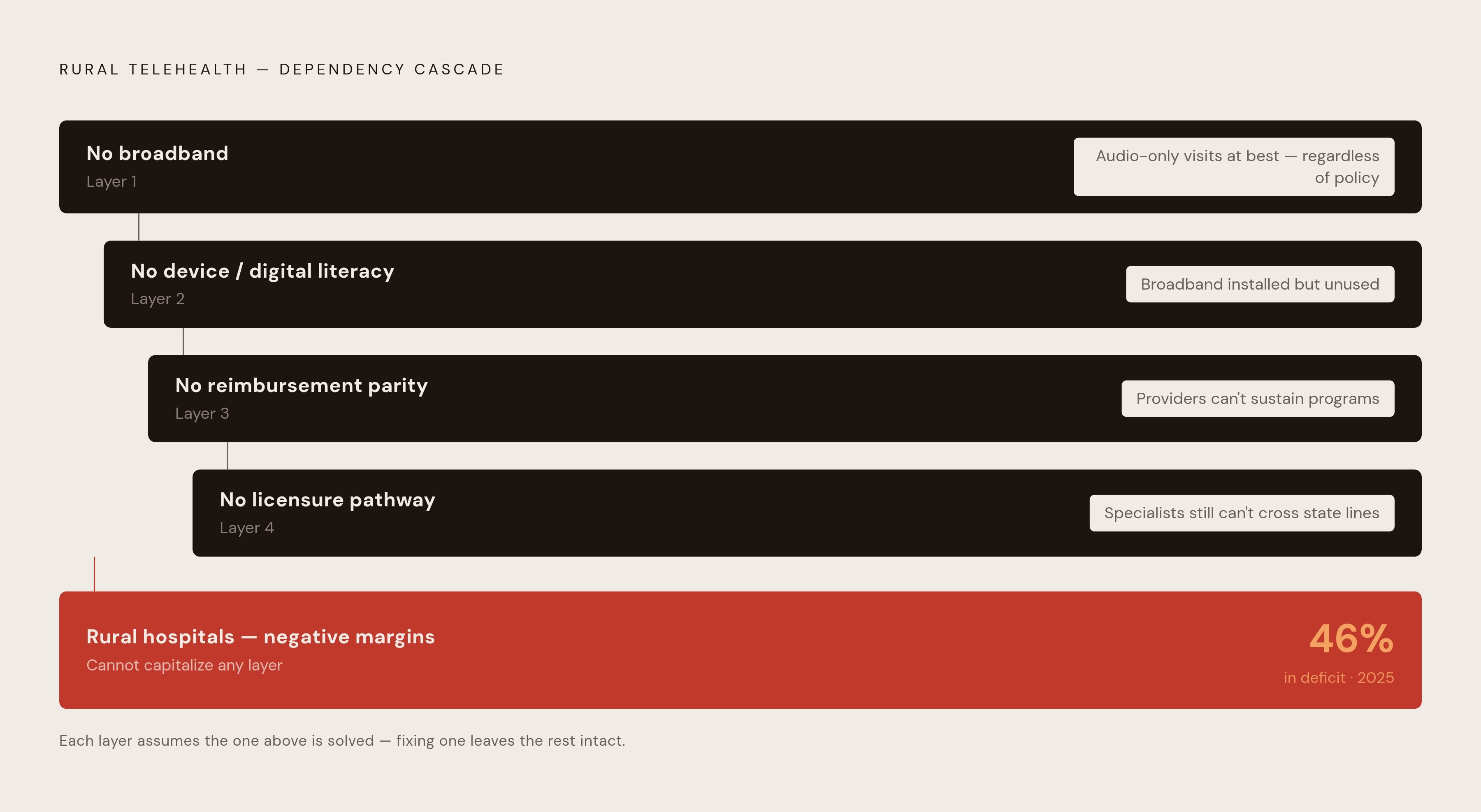
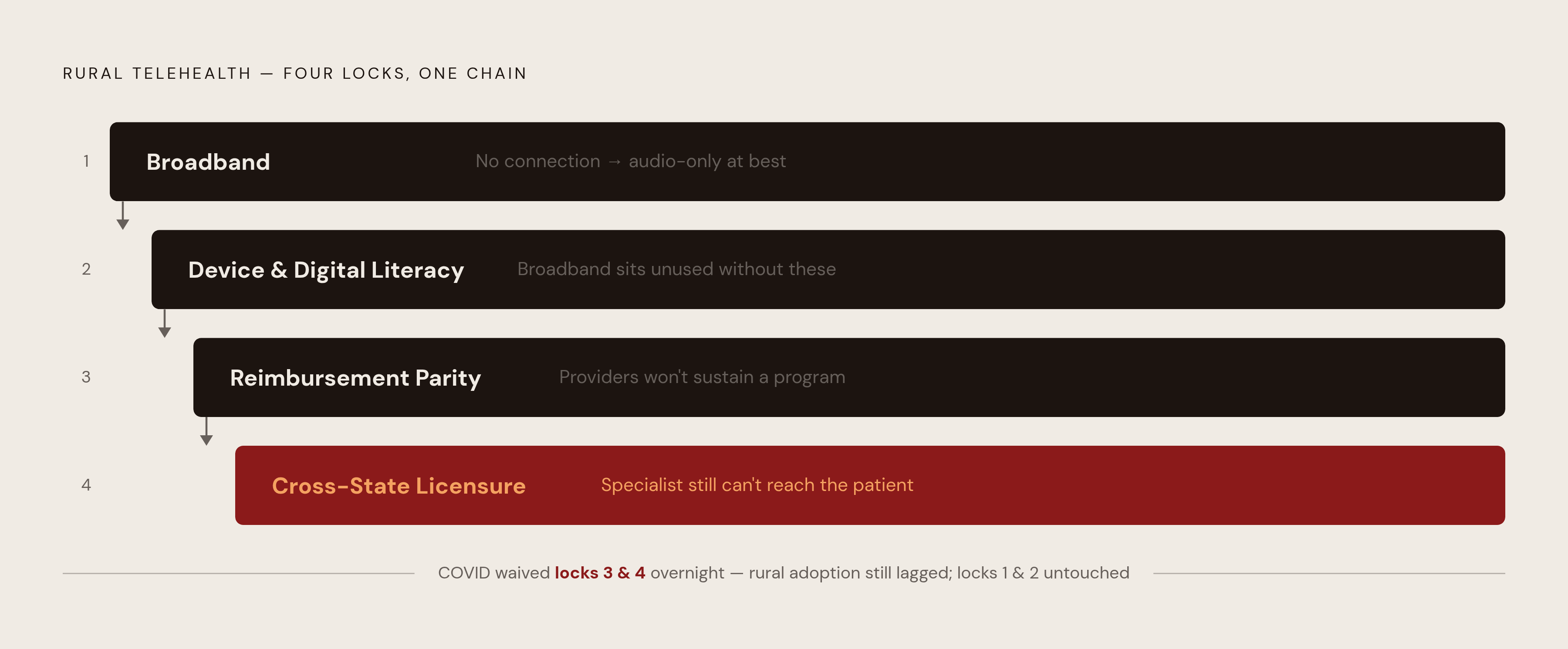
Line these four up and they stop looking like separate problems sitting politely next to each other. They're a dependency chain. No broadband means audio-only at best, no matter how generous the reimbursement rate turns out to be. No device or no digital literacy means the broadband just sits there, unused. No reimbursement parity means providers won't sustain a program even where patients can connect just fine. No licensure pathway means the specialist still can't reach the patient after broadband, devices, and payment are all sorted out. And a hospital bleeding money on a negative margin doesn't have the capital to build any of this in the first place.
We more or less ran this experiment already, almost by accident, during COVID. Pandemic waivers knocked out the reimbursement and licensure barriers overnight, and utilization jumped fast. But connectivity and device gaps didn't budge an inch, and rural adoption still lagged urban adoption the entire time regardless. That's about as clean a natural experiment as you'll find showing that clearing one or two layers off the stack isn't the same as clearing the stack. Progress, sure. Not the fix.
Take the tens of millions of Americans living in mental health professional shortage areas. Behavioral telehealth is arguably the single highest-demand rural use case there is, and it needs every layer solved at once: broadband to hold a private video session, a device the patient can actually operate, a therapist licensed across state lines, and a reimbursement rate that makes billing the visit worth a provider's time. Miss one piece and the visit doesn't happen. Not partially, not at a discount. It just doesn't happen.
Or take the worst-case version, which isn't rare at all: a Critical Access Hospital running a negative margin, in a state that didn't expand Medicaid, in a county with poor broadband, serving an older population with low digital literacy. Every barrier live at once. Fix reimbursement alone and nothing changes, because the patient still can't get online. Fix broadband alone and nothing changes, because the hospital still can't staff the program to use it. Policymakers don't need to do everything everywhere at once; nobody's budget allows that anyway. But bundled interventions beat sequenced single-issue fixes every time, and the real planning question in any given county is which bottleneck to clear first, not whether clearing just one will be enough on its own.
What actionable looks like: federal, state, and health system moves that actually match the barrier
Federally, the obvious move is making Medicare telehealth flexibilities permanent instead of running them through repeated Congressional renewal cycles that leave providers guessing every few months whether the program they built will still get paid for next quarter. Sustained funding through BEAD and the FCC's rural health care program, aimed using the FCC's broadband-health mapping data instead of spread evenly and thin across the whole map, would do more with the same dollars than what's happening now. Bringing California and New York into the Interstate Medical Licensure Compact would widen the specialist pool available to rural patients nationwide almost overnight, and funding the profession-specific compacts next (audiology, speech-language pathology, occupational therapy, and ideally behavioral health) would push that same fix into the fields rural HPSAs need most.
At the state level, Medicaid plan amendments covering store-and-forward and remote patient monitoring, not just live video, would close one of the more avoidable reimbursement gaps still sitting out there. States that haven't expanded Medicaid are, whether they'd frame it this way or not, also constraining their own rural hospitals' ability to invest in telehealth; that financial link is documented now, not a hunch. Clear, plain-language billing guidance from CMS, scaled to the state level where it needs to be, would cut into the eligibility confusion pushing providers away from asynchronous care specifically.
At the health system level, it comes down to device lending and subsidy programs run through FQHCs and RHCs, digital navigator positions that pair a patient with a real human for that first video visit, and hybrid reimbursement models that don't punish a rural clinic for keeping its physical doors open while it builds virtual capacity on the side. None of this requires inventing new technology, and that's almost the frustrating part. It requires treating four barriers as four separate locks on the same door, and showing up with four different keys instead of betting everything on one master key that was never going to open all of them anyway.